



National CRE News In Your Inbox.
Sign up for Connect emails to stay informed with CRE stories that are 150 words or less.

“YIGBY” Movement Supports Different Uses for Houses of Worship
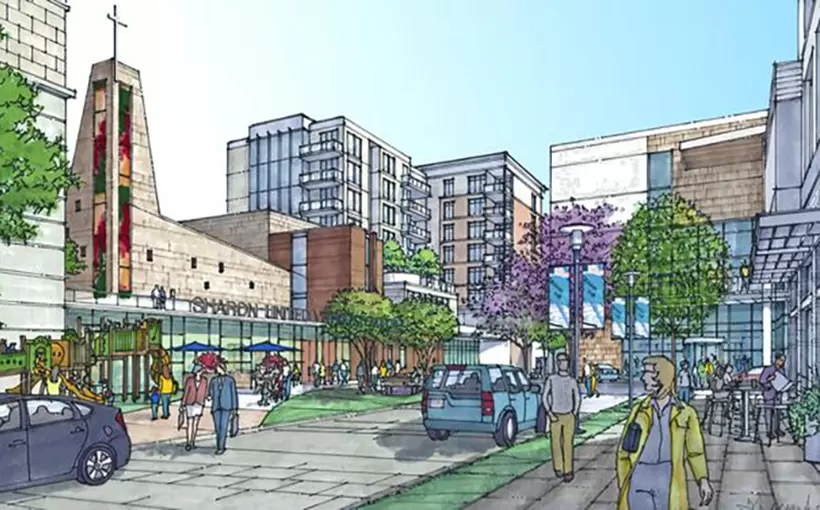
Pictured: Childress Klein’s redevelopment of Sharon United Methodist Church
The closures of large churches, synagogues, mosques and other places of worship continue to plague cities, especially if those buildings are in or near central business districts. A recent article on the Urban Land website pointed out, “Cities are struggling to address these large church closures, just as they must grapple with the demise of major department stores.”
The truth is there are more houses of worship than department stores. Additionally, the specific architecture of religious buildings can make conversion, reuse and adaptation more difficult. This doesn’t consider the community’s emotional feelings when a landmark sanctuary shuts down and is targeted for demolition or reuse.
The Urban Land article commented that the “Yes in God’s Back Yard” (YIGBY) movement could benefit from specific strategies, including the following:
Sell and relocate. Religious building owners can leverage their properties by selling them and then buying elsewhere. The First Church Miami UMC did just this, selling its location in downtown Miami for development and using the proceeds to buy back 25,000 square feet in the development to set up a coffee shop, gym, yoga room and worship center.
Close and donate. Sometimes, selling to another congregation can be a way to repurpose. The 50-member Twinbrook Baptist Church congregation in Rockville, MD, sold its building to the Hispanic congregation already meeting there. The Baptist church donated the money from the sale to help support area charities.
Join a developer. Partnering with a mixed-use developer can provide a solution, which Sharon United Methodist Church in Charlotte, NC, did. The partnership with Childress Klein resulted in luxury apartments, a hotel and a 35,000-square-foot worship center.
Rent underused facilities to others. Some religious organizations have benefitted from renting underused properties to the local community. Venuely in New York, ChurchSpace in Austin and thisspace in San Francisco help houses of worship offer these spaces to those who need them.
The article acknowledged that transforming underused religious and faith-based properties into different-use community hubs requires commitment from municipalities, developers, financiers, citizens and church members. However, “with a bit of faith, due diligence, and imagination, even a declining congregation can find a way to keep the spirit of their faith alive—even as the building itself shifts from its single-purpose origin to one serving the larger community in a variety of new ways,” the article said.
- ◦Sale/Acquisition
- ◦Development


