



National CRE News In Your Inbox.
Sign up for Connect emails to stay informed with CRE stories that are 150 words or less.

Trophy Office Development: Yes or No?
In the April 10, 2024 Walker Webcast, Walker & Dunlop’s Willy Walker and noted economist Peter Linneman discussed the office sector, among other things. One discussion focused on the idea that $80 billion is being directed to new office construction.
This might seem like a lot of money directed toward what’s commonly believed to be a struggling sector. But Linneman commented that brand-new office buildings were attracting their fair share of tenants.
CBRE Econometrics Advisors (CBRE EA) supports this assertion. In its recently released report, “A Unique Opportunity for Trophy Office Development,” the CBRE EA authors explain that:
- Prime office properties are dramatically outperforming other office types
- Drilling down geographically, the authors noted that Miami, FL and Boston, MA, are “the most attractive when considering the amount of inventory that is prime, cost-to-rent ratio and prime vacancy rates
- Interestingly, 70% of the hardest-hit buildings from Q1 2020 to Q2 2022 were actually Class A-minus, “generally built during the building boom of the 1980s and 1990s,” the report authors said
Prime Space, Prime Locations
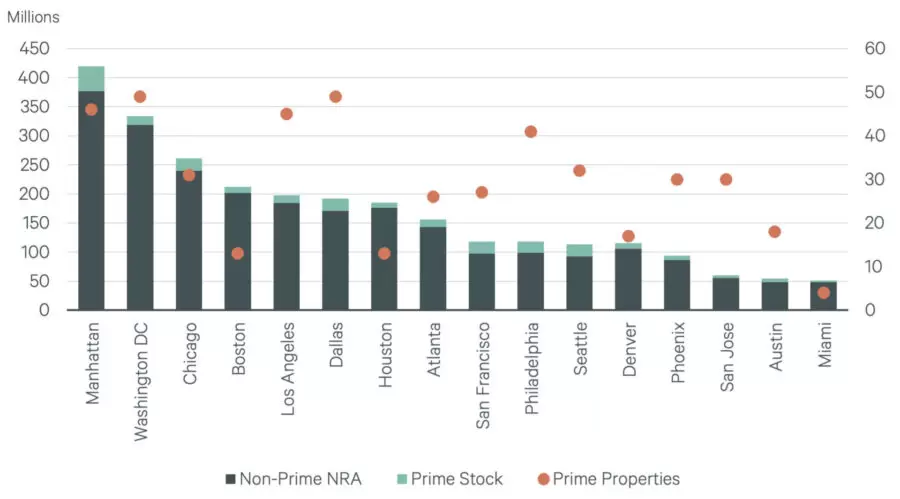
Prime buildings tend to experience lower vacancies, higher rent rates and are newer. In its report, the CBRE EA authors outlined the “best” areas for prime space based on multiple factors like competition. With this data, the report presented inventory by prime status per market:
The report also outlined markets in order of highest to lowest fraction prime. The CBRE EA authors commented that Boston or Miami could be “good candidates for new development” because of less competition for top tenants. Meanwhile, markets like Seattle might already have a great deal of prime space.
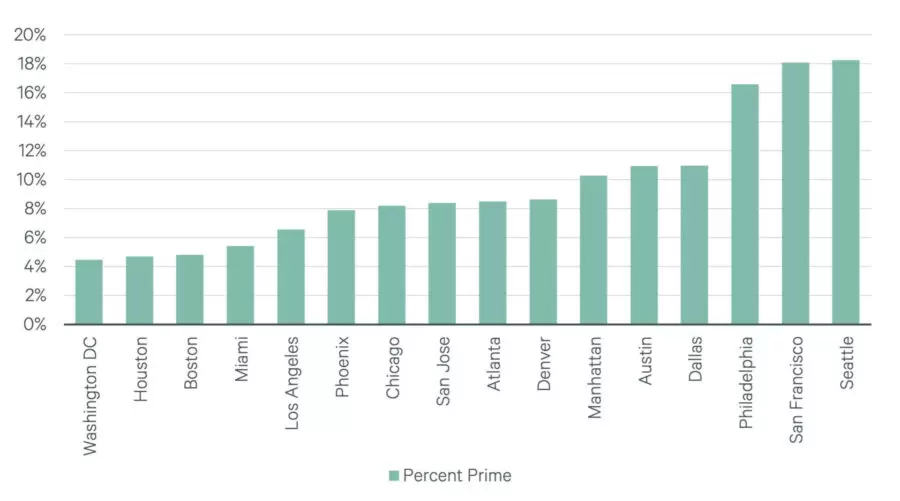
The report also commented that prime properties aren’t outperforming in all markets. Austin, Seattle and Phoenix “have a prime vacancy rate above the market average,” according to the report. This might be due to:
- Newer buildings in lease-up
- Some oversupply, especially relative to demand
- Buildings in less-desirable submarkets
Factoring in Construction Costs
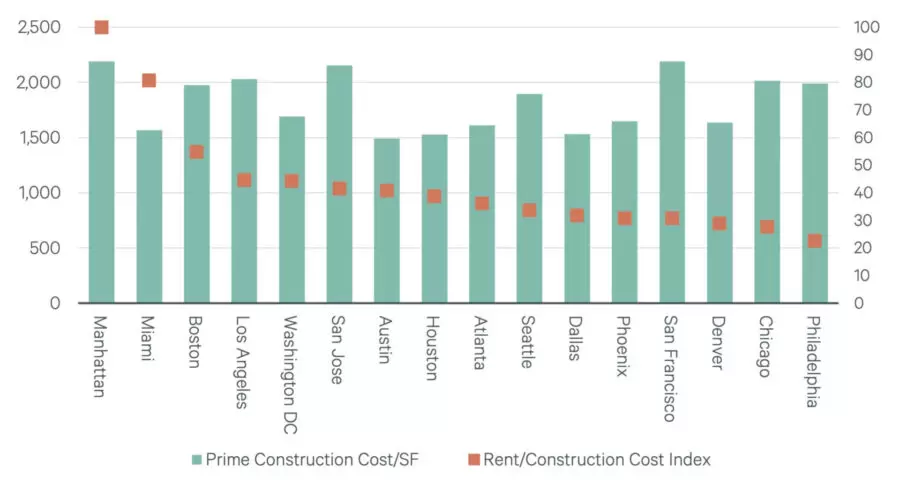
Over the past several years, increasing construction costs have been a fact of life across most commercial real estate sectors. CBRE EA goes one step further, pointing out that due to the change in office demand in conjunction with cost hikes, “most office buildings built in recent years would not pencil out today.” Furthermore, a prime building offering a boatload of much-demanded amenities might be more costly to build today. However, “they may be the only office asset worth building,” the report pointed out.
By analyzing various construction costs, cost indexes and likely rents, the CBRE EA report surprisingly indicated that Manhattan offers the most favorable rent-to-cost ratio, followed by Miami and Boston. Meanwhile, Philadelphia came in with the worst prime construction cost ratio.
Cautious Analytics
Nothing here suggests that developers should grab their construction staff and head to Miami or Boston to start building a prime office. The report’s point was to note that a deeper dive should be considered when discussing any kind of development—and yes, that includes offices.
For example, the CBRE EA authors pointed out that while Miami is a highly attractive location for the development of prime office buildings, the exorbitant price of land could be an inhibiting factor. While this might eliminate competition, it can mean a deal doesn’t make sense.
The report is a “reminder that commercial real estate is a hyper-local industry, and every deal is unique,” the report said.
- ◦Development


