



California CRE News In Your Inbox.
Sign up for Connect emails to stay informed with CRE stories that are 150 words or less.
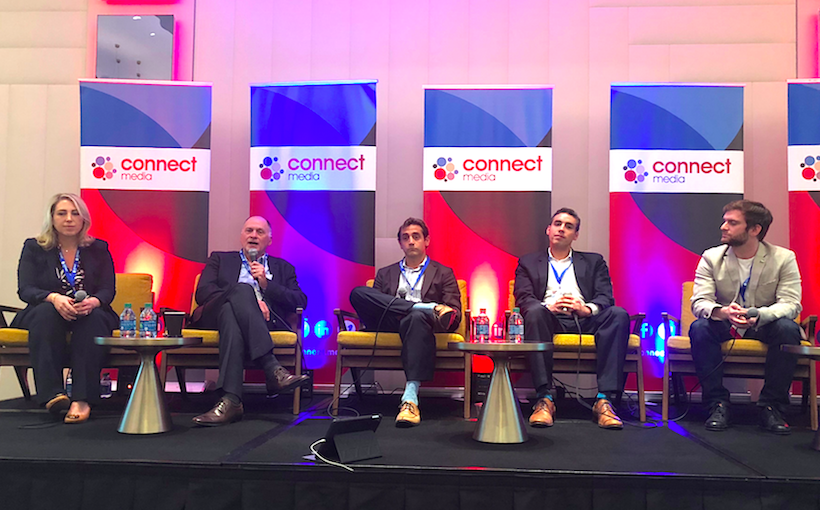

Transaction Series: Large Deals, Big Loans
By Dennis Kaiser
An expert panel of brokers, principals, and capital sources shared what it takes to get a bigger deal financed today at 2018’s Connect Apartments. As the apartment market continues to change, the Transaction Series: Large Deals, Big Loans explored the challenges and opportunities facing top multifamily players as they seek to balance for-sale and rental product in their portfolios.
The panel was moderated by JLL’s Dana Brody, who started the conversation by asking if capital favors mixed-use or straight multifamily deals today.
CapitalSource’s Tom Whitesell says they “like mixed-use to attract tenants and help de-risk the deal,” though he notes straight multifamily deals are easy. “We’re happy to do both, and we’re starting to see some by USC that require ground-floor retail.” Sometimes that can be problematic if there’s too much retail or not the right mix. That may be a mismatch, agreed Brody, “if you can’t get them both rented,” she said.
Madison Realty Capital’s Bradley Ross pointed out that when retail is required in a multifamily project, it may be a “loss-leader” and it is “more complicated.” He observed that retail can be a “home run,” but typically one out of three don’t work.
Gelt, Inc.’s Keith Wasserman suggested a way to address cities’ retail requirement is to incorporate innovative uses such as food courts to bring unique to market concepts or adding a self-storage component for residents.
Meridian Capital Group’s Seth Grossman, noted that today a “gym is more value add for a building” because “tenants need to feel like they are getting a benefit like an Equinox type of facility” as part of their living experience. That way they don’t have to go down the street to a gym.
Whitesell said he’s seen a club-type of facility work out well in multifamily properties. In one case the 3,000-square-foot facility was more like a hotel that was all glass and overlooked a park. Programming was scheduled for activities such as cooking classes and beer tastings, and it has become a fun place to go to.
Given the capital allocations and amount of money seeking to find a home today, the lending market is mixed in terms of getting deals done. While some investment strategies are well timed, others may need more time. Grossman notes they’re seeing some bridge deals where the cost went up and it is hard to get take-out, so they’re going with another bridge loan rather than a permanent one. That’s creating somewhat of a “phased lending cycle,” he notes.
Ross added, some bridge deals “got it right” and are ready for a permanent financing, while others may not be so they “need to look for other options.”
And Whitesell pointed out “overconfidence” may be credited for some deals not being ready for permanent financing. That’s mainly due to business plan’s taking longer to execute than anticipated. That might mean a simple bridge deal ending up taking longer, though it will eventually be ready, he says.
Grossman says the realization is that 20% returns of five years ago are no longer achievable, but if they can get 12% now, “that’s a great place to put money.”
As a result of rising land, labor and materials costs, the cost may have gone up 10% from when the original quote was made – even as rents decelerated. That’s not going to deliver 20% returns, says Whitesell.
But, there’s still a wide array of lenders in the marketplace, says Grossman. “It is mind blowing” how many are out there that’s shifted from CMBS to other pockets of capital,” he notes. Whitesell agrees, “there’s tons of capital on the sidelines now, if there’s a drop, they will pounce.”
Wasserman says in the current market their strategy has hinged on building a reputation as a solid partner for capital. He notes “not doing re-trades as the interest rates spike up” is most important to the company.
Ross says there’s “huge uncertainty right now.” That could deliver “huge opportunities for those who make the right bet.” Grossman agrees, its the first time in 7-8 years for a slowdown to happen for lenders, it is “not a no-brainer anymore,” he said.
For comments, questions or concerns, please contact Dennis Kaiser
- ◦Financing


