



National CRE News In Your Inbox.
Sign up for Connect emails to stay informed with CRE stories that are 150 words or less.

The True Costs of Nationwide Office Vacancies

Office vacancies in almost every geographic area have existed for several years, further exacerbated by work-from-home and hybrid work trends.
But how much do those empty spaces actually cost?
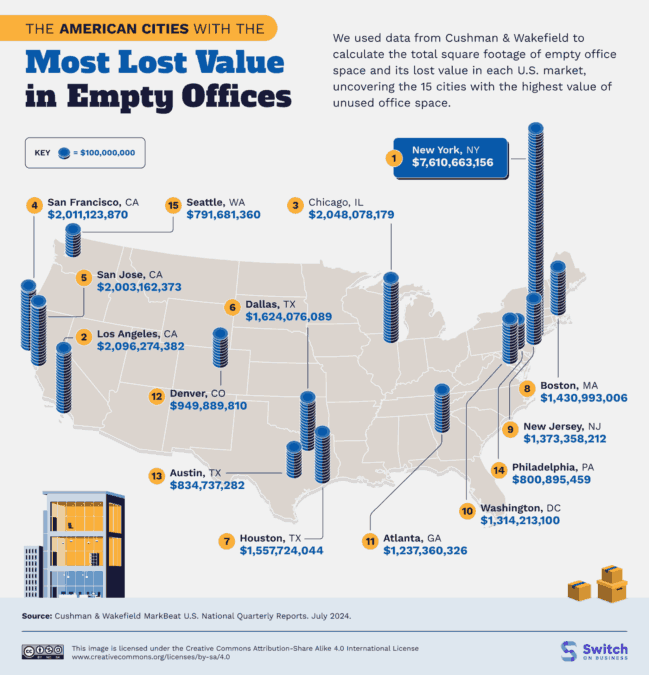
To determine actual lost value of vacant buildings, Switch On Business used numbers from Cushman & Wakefield’s Q1 2024 report to calculate the total square footage of empty office space. Then, the Switched on Business analysts multiplied that square footage by rental costs. From these actions, the analysts determined the following:
- New York City, with the highest value of vacant office space in the country, loses $7.61 billion in rent annually
- Los Angeles stood in second place, losing $2.10 billion per year from vacant office space
“Office vacancies are to be expected, with so many companies shifting toward remote work,” Taylor Tomita, Switched on Business’ spokesperson, told Connect CRE. “Still, the sheer amount of lost rent is quite surprising, especially in New York City.”
Meanwhile, in other areas of the nation:
- In California, San Franciso’s lost rent totals $2.01 billion, while San Jose’s total is $2.0 billion
- Chicago has the highest lost value in the Midwest, totaling $2.05 billion
- Dallas ($1.62 billion) and Houston ($1.56 billion) clocked in with the most lost value in the Southwest, partly due to overbuilding in the 1970s
But with all of the office vacancy space in play (and the lost rent connected with it), why does new space continue to come online? Tomita said one cause is the preference for more modern buildings with state-of-the-art amenities. “As long as a subset of tenants are willing to pay premium rents to lease new offices, developers will continue building despite the vacancy rates,” he said.
However, the problem is that this still leaves empty, older buildings, many of which aren’t suitable for the other-use conversions that many municipalities continue to push for. Tomita suggested that one solution is implementing flexible workplace solutions, such as co-working environments. Shorter leases and shared amenities could appeal to smaller tenants, like start-ups and freelancers.
Also important is understanding the trends. “With the rise of remote work, the demand for traditional offices is changing,” Tomita observed. “Landlords and investors can work together in repurposing spaces to meet the evolving needs of tenants, such as creating co-working environments or mixed-use developments.”
- ◦Lease
- ◦Development


