



National CRE News In Your Inbox.
Sign up for Connect emails to stay informed with CRE stories that are 150 words or less.


The Retail Comeback: What Matters to Real Estate Investors and Shoppers
While the brick-and-mortar retail industry was one of the hardest hit during the pandemic, it’s now experiencing a resurgence. Investors are seeing opportunity in this asset class as it rebounds, with customers returning to physical stores post pandemic. Still, with talk of a recession buzzing, retail center owners are seeking to fuel investor interest and implement amenities that appeal to shoppers.
Connect CRE recently spoke with Barry Caylor of OTL about what lies ahead for the sector in terms of investor appetite, amenities, sustainability, and cost control.
Q: With a recession looming, what types of retail centers will be attractive to investors?

A: In these uncertain economic times, retail investors are focusing on shopping centers with robust foot traffic that will drive tenants’ sales figures for the foreseeable future. These centers offer a good mix of popular and unique tenants that appeal to a wide range of demographics—including food-and-beverage purveyors, and cinemas and/or boutique grocery stores that are replacing department stores as anchors. They also tend to be attractively designed, well maintained, and feature amenities that bring in individuals and families.
We have found that water features are in high demand at these centers as they serve as gathering places and beautiful centerpieces for these retail venues. In addition, shopping centers with show fountains can present dazzling programmed displays that are bound to draw in a steady flow of visitors all year round.
Q: How might omnichannel trends be impacting retail space needs?
A: As the popularity of online shopping continues to grow, and savvy retailers increasingly use an omnichannel approach to sales and marketing, many are utilizing their brick-and-mortar stores as showrooms for customers to see, touch and interact with the merchandise that they will either buy online or in-store. These retail tenants will need adequate spaces to display their merchandise and provide people with an enjoyable shopping experience that will boost sales volume.
As the economy grows more uncertain, consumers are becoming more discerning in their purchase decisions, and retailers are finding it necessary to do all they can to drive sales. Providing online buying opportunities in concert with an appropriately sized and appealing physical environment promotes and supports sales and is a great way to employ an omnichannel strategy.
Q: What kinds of amenities will be most in demand from shoppers in the coming years?
A: Before the pandemic, retail stakeholders were beginning to recognize the importance of experiential retail—providing shoppers with unique and enjoyable experiences. As the pandemic subsides, this trend has resumed. Consumers are coming back to the shopping centers they missed, and they are craving different and exciting experiences to make up for many months of virtual interactions with the world. Amenities that deliver those experiences in interesting and meaningful ways will be most in-demand from shoppers in the coming years.
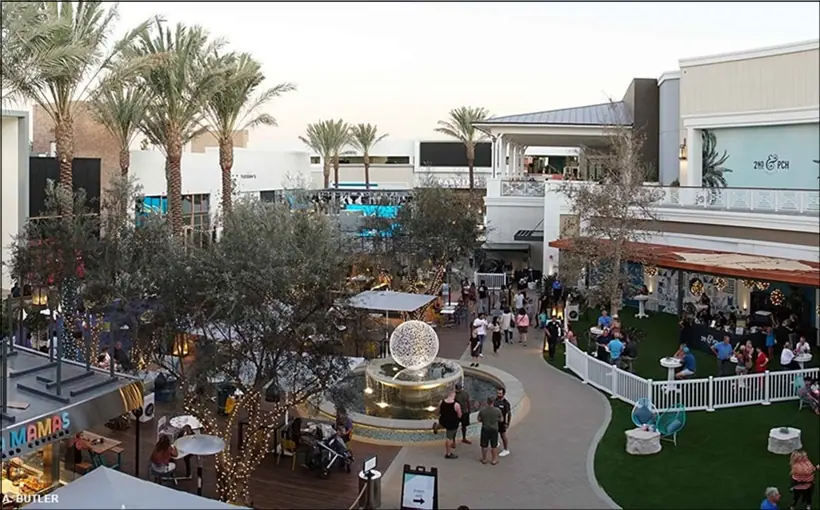
For example, 2nd & PCH, a contemporary lifestyle destination in Long Beach, CA developed by CenterCal Properties (pictured), features a spectacular architectural fountain our company designed and built. In the fountain’s center is a magnificent spherical sculpture created by artist Ivan McLean, and the project’s exterior is highlighted by a bespoke glass mosaic tile. The water feature is the engaging backdrop for shoppers to take social media selfies and videos and a huge draw for visitors from miles around.
As we navigate through a recessionary economy, successful retail stakeholders are attracting customers by redefining what it means to visit a retail center, such as tasting the trendiest new cuisine, receiving top-tier customer service, and enjoying immersive entertainment in many forms.
Q: Which amenities can help retail investors achieve their sustainability initiatives?
A: Sustainability has become extremely important for all categories of real estate investments, including retail. As such, retail stakeholders are looking for sustainable ways to operate their centers, and water features can truly help them achieve this.
It may sound counterintuitive, but today’s water features can aid with water conservation by using recycled water, such as in rainwater harvesting, naturally distilled HVAC condensate, greywater (which is recycled from on-site systems including sinks or other non-sewage uses), and municipal recycled water. Also, almost all the water features we build are engineered to recirculate water, which is a sustainability goal with any type of water use in a fountain.
In addition, these amenities can help decrease HVAC use in retail centers. Atrium fountains and other interior water features can be integrated as part of a property’s environmental system to reduce inside relative humidity, diminishing the load on the HVAC. Reducing humidity in this way can enable property managers to run air conditioning at a higher temperature, which saves energy and costs, while allowing shoppers and employees to remain comfortable.
Further, tying outdoor fountains into a retail center’s mechanical system utilizes the water system as a heatsink for HVAC equipment, creating a passive heat exchange that reduces cooling electricity use substantially. This enhances the center’s overall environment.
Lastly, today’s water feature technology allows these amenities to be controlled remotely so they can be shut down when necessary. These controls also can alert retail owners and property managers if a leak is detected, or a situation arises that could result in wasted resources if left undiscovered.
All these attributes make water features an ideal option for retail center owners exploring ways to amplify their properties’ sustainability.
Q: How can retail owners keep costs in check as they make their centers more compelling?
A: One way to maintain control of costs in a retail center is to implement property improvements that will last for years and can be updated as needed to continually attract shoppers.
Once again, fountains fit the bill. The same water feature processes that contribute to sustainability initiatives also help with cost control. As water and energy use are minimized, utility expenses are decreased, which impacts the bottom line in a positive way.
Water features are perennial favorite amenities that draw shoppers back to retail centers for repeat visits and can make these venues true entertainment destinations. Water has always been important to human culture, and general gathering places historically have included water features as a central component. At a time when retailers are working hard for every consumer dollar, water features can provide them with a distinct advantage in the marketplace.
- ◦Development


