



National CRE News In Your Inbox.
Sign up for Connect emails to stay informed with CRE stories that are 150 words or less.


The Relationship Between Transportation Infrastructure and Industrial Growth
It’s a given that a well-functioning supply chain depends on quality infrastructure. Also crucial to that supply chain are well-located (and well-built) warehouses and logistics centers that receive, store, process and then send products to end users.
A new report by Newmark explained that transportation infrastructure goes hand-in-hand with industrial market activity regarding seamless logistics and economic development. “Historically, infrastructure spending has closely tracked industrial construction activity, an integral contributor to expanding industrial occupancy,” the report commented.
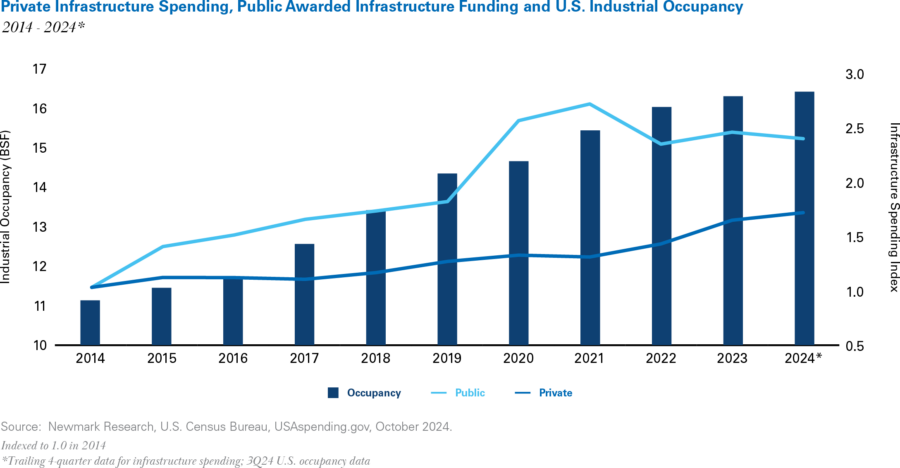
Though the industrial markets have undergone a roller-coaster period of low vacancies and high supply, the Newmark report’s authors anticipate that speculative industrial development should moderate into 2025, with new space trending toward build-to-suit and owner-built deliveries.
Meanwhile, infrastructure spending is likely to grow. The $1.2 billion Bipartisan Infrastructure Law of 2021 is one way to fund the need for infrastructure improvements throughout the United States. Private sector participation in boosting infrastructure quality and quantity has also increased. Said the report: “BIL outlays are set to accelerate, particularly between 2024 and 2027, and interest rate relief will help unlock liquidity in private spending.”
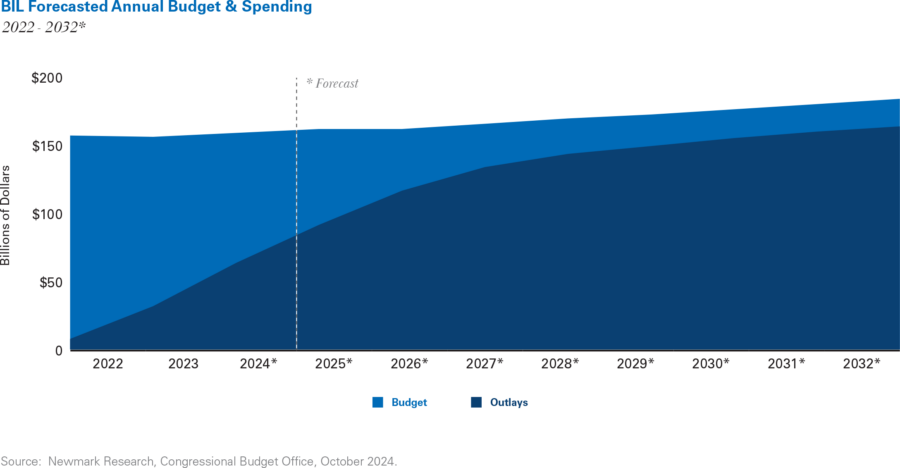
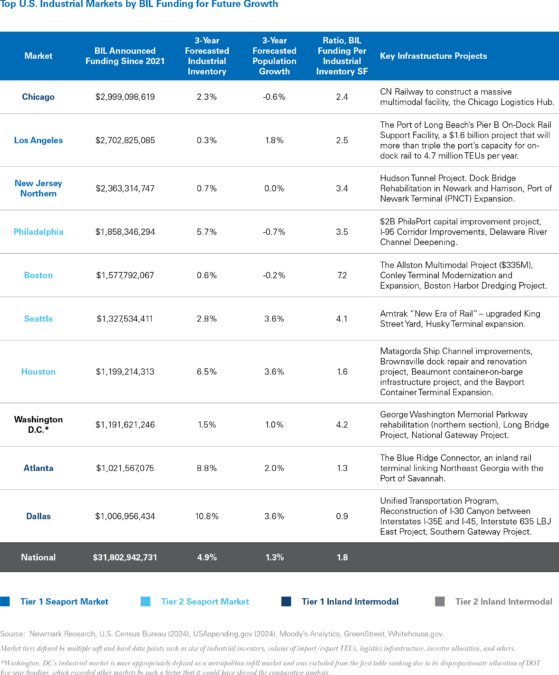
Also anticipated to increase? “U.S. freight tonnage is projected to grow by 42% from 2023 to 2050, as firms onshore and nearshore production and e-commerce continues to mature,” according to the report. Over the past few decades, ocean port volume has increased thanks to global trade patterns, leading to U.S. port expansions in Los Angeles and Northern New Jersey, among other locations. Furthermore, Tier 1 intermodal markets—think Atlanta, Chicago and Dallas—have benefitted from increased infrastructure development.
In fact, the report commented that inland intermodal markets have been the main beneficiaries of infrastructure spending. These markets have also benefitted from funds earmarked under the BIL:
- Atlanta and Dallas are leading U.S. markets in recent DOT outlays
- Chicago, meanwhile, leads the country in BIL funding for future growth
- Other markets are earmarked for substantial infrastructure investment, including Houston and Philadelphia
The report looks as far ahead as 2027, suggesting that “a generational wave of public and private infrastructure investment will unfold, extending holistically beyond transportation to all types of infrastructure.” Furthermore, allocations to infrastructure will need to consider emerging technologies and the evolution of supply chains to ensure long-term sustainability.
- ◦Development
- ◦Economy
- ◦Policy/Gov't


