



National CRE News In Your Inbox.
Sign up for Connect emails to stay informed with CRE stories that are 150 words or less.

The Ongoing Evolution of American Cities
Consider Manhattan. Once a quaint Dutch village, the city today boasts mile after mile of high-rise buildings, crowded streets and apartment buildings. Nor is Manhattan alone in its change over the past 500 years. “American cities are much younger than those in many other parts of the world yet would still be unrecognizable today by those who originally built them,” said a recent CBRE study.
The Current Scenario
The study “Shaping Tomorrow’s Cities” explained that what’s currently happening in U.S. cities in response to the increase in remote working is another evolution. The study’s authors said the pandemic “brought 30 years of urban renaissance to a halt” as many fled to the suburbs.
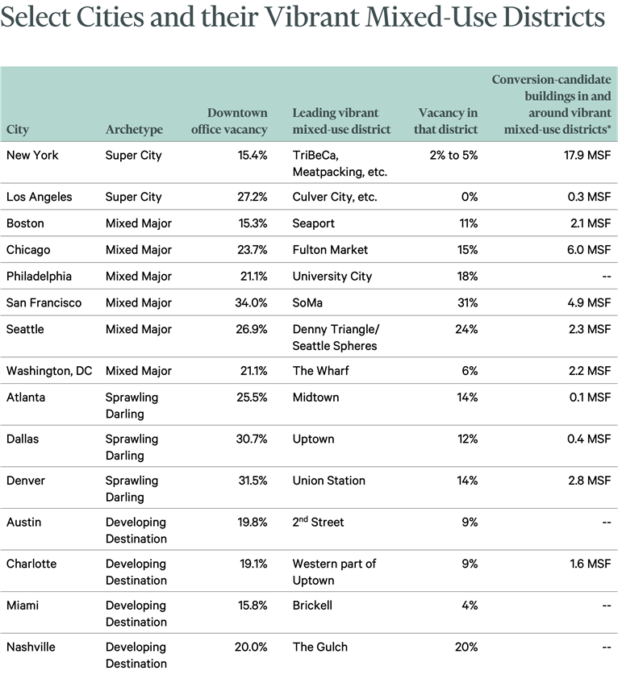
Public safety issues have made workers and visitors more reluctant to return to what CBRE dubbed as the “Mixed Major” cities, notably Boston, Chicago, Philadelphia, San Francisco, Seattle and Washington, DC.
In addition to the “Mixed Majors,” the study categorized 19 markets into other “archetypes” based on economic, demographic and development issues:
- Super Cities – Los Angeles and New York
- Sprawling Darlings – Atlanta, Dallas, Denver, Houston and Phoenix
- Developing Destinations – Austin, Charlotte, Miami, Nashville, Orlando and Tampa
Mixed-Use Vibrancy
The study suggested that bright spots have involved mixed-use developments and districts, defined as “walkable urban areas including a mix of properties such as apartments, retail, restaurants, hotels and the highest-quality office space.”
In analyzing 68 mixed-use districts across 19 U.S. markets, the study’s authors found that office rents tend to be higher, while vacancies were, on average, 18% lower than in non-prime business districts. The latter are described by the study as “mostly office parks that lack top-quality office buildings and live-work-play amenities.”
Revitalization Focal Points
In addition to offering in-depth discussions about conversion potentials and keys to thriving cities, the study suggested six elements that are critical for urban evolution:
- Economic vitality and adaptability: talent pool diversity, industry mix, innovation culture, civic engagement and capital inflows.
- Demographics: age distribution, education, skills, cost of living and diversity
- Quality of life: recreational opportunities, green spaces, overall residential well-being
- Infrastructure: Social, educational and medical facilities, transportation systems, water and power
- Identity: history, natural resources and culture
- Governance: efficient zoning and permitting regulations, economic incentives, safety and cleanliness standards, tax structures, safety and immigration policies
The study also indicated that revitalization isn’t just the purview of government or the private sector. Rather, “there are roles for every constituency to play in revitalizing cities,” said John Stephens, CBRE Americas Consulting senior director, in a press release announcing the study. “For example, building owners and developers can invest in redeveloping existing properties and contribute to the placemaking of vibrant areas.”
- ◦Development
- ◦Economy
- ◦Policy/Gov't


