



National CRE News In Your Inbox.
Sign up for Connect emails to stay informed with CRE stories that are 150 words or less.


The Office Story: Digging into the Nuance
You don’t have to look too far for negative headlines concerning the office sector. They’re all over the place, from a “muted” outlook for 2024 to concerns over the debt maturity in this sector.
A recent brief released by CBRE, “There is Nuance to the Office Story,” doesn’t sugarcoat any of these issues. The “sobering headlines” are accurate due to historically high vacancy rates and loss in value. But “what’s often lost amid the doom-and-gloom are the stark differences between office asset classes,” the brief said. There is also a difference in the asking and economic rents.
The office asking rent is the amount requested by a landlord or property owner for a tenant to take space. The CBRE brief explained that office asking rents are above 2018 levels as “landlords are often loathed to drop asking rents and prefer to offer more generous incentive packages to attract tenants.”
However, the real story can be found in what CBRE analysts dubbed the “economic rent.” The brief noted that economic rents are calculated by multiplying the asking rent by market occupancy. The current economic rent is 14% above 2018 levels and close to the peak of the pre-pandemic 2020.
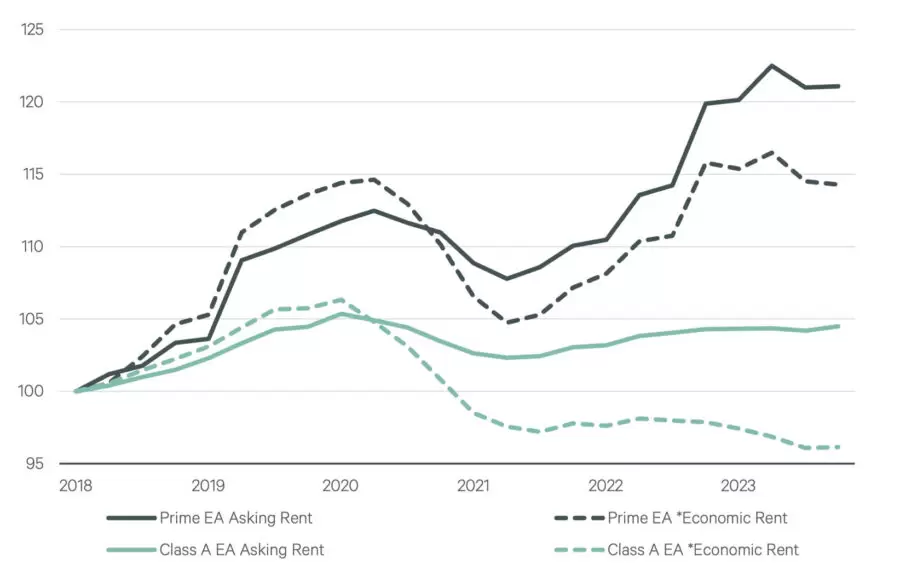
Interestingly enough, the brief indicated that economic rent for Class A buildings is down 10% since the pandemic. Why? This asset type has experienced a higher degree of occupancy loss “since the pandemic radically changed office cultures and companies began trading up to higher-quality space,” the CBRE analysts said.


