



New York & Tri-State CRE News In Your Inbox.
Sign up for Connect emails to stay informed with CRE stories that are 150 words or less.

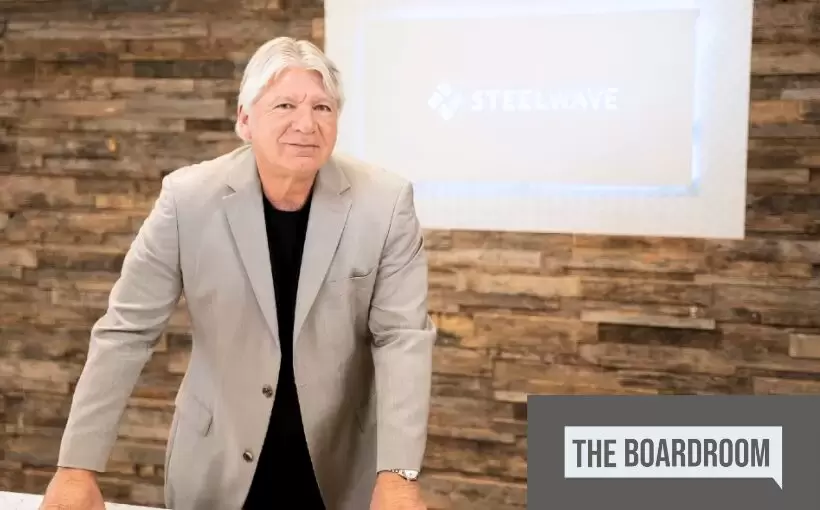

Takeaways from the Top with SteelWave CEO Barry DiRaimondo
In 2024, SteelWave Digital, a subsidiary of the SteelWave Commercial Real Estate organization, is at the forefront of innovation, exploring a tokenization strategy. This approach aims to offer coins tied to physical assets, opening up new opportunities for both local and global investors. We sat down with the person behind this novel strategy, Barry DiRaimondo, the CEO of SteelWave Digital, as he envisioned the future of investment in the digital age.
Q: What’s your view on the current market?
A: There are two different aspects of the CRE market: One, Capital Market fundamentals (values) and two, Supply/Demand fundamentals (vacancies and leasing velocity). Capital market fundamentals are completely dislocated and values have plummeted from their peak 2022 values.
Listening to
the industry’s
foremost voices
RE values are generally inversely proportional to interest rates…as rates go down, values go up. That relationship is amplified when the rate of change is accelerated.
When interest rates tripled over an 8-month period in late 2022-2023, values completely imploded. Values today are 50-70% below peak for office, 30-40% off for multifamily and 20-30% off for industrial. That level of drop is almost unprecedented. Low starting cap rates make for very high value cliffs during times of rapid deflation.
Current owners of CRE are struggling with debt restructures and little to no asset cash flow. Much, if not all, of the equity invested in CRE during 2017-2022 has been washed away based upon today’s spot values…certainly in the office sector, maybe less so in certain industrial markets, such as Southern CA, where you have had enormous runup in rental rates from 2017 to today.
If you don’t HAVE to sell an asset today, you wouldn’t. On the other hand, groups with liquidity who are looking to buy assets feel really good about the opportunity to buy assets at today’s price points. Many consider the buying opportunity to be generational in nature.
Q: Where do you see the opportunities?
A: The biggest opportunities are in product types where both the capital markets AND the supply and demand fundamentals are dislocated.
Today, that would be ‘office’.
Life Science might not be too far behind.
Unfortunately, these opportunities are also the riskiest. The amount of vacant office space is staggering in markets that are dominated by the tech sector. The fact is that the tech sector over leased space based upon some very aggressive growth projections. The CRE community was more than happy to build products to accommodate those projections.
Now we have too much new supply at a time when most tech tenants are shrinking their office footprints. Likewise, the amount of new supply of Life Science products that is under construction or newly delivered is unprecedented as a percentage of the existing base.
This will lead to a dramatic uptick in vacancy levels.
It will take much longer for the supply and demand metrics to get back to equilibrium than it will for the capital markets to get back to equilibrium. The risk is that nobody has a crystal ball on how quickly, or conversely, how long it will take to burn off all the excess supply…is it two years or is it 5 years?
The difference between these two time frames has enormous implications to the economics of underwriting.
Q: What is your investment strategy?
A: Historically, we have created the types of work environments that I spoke of above by either developing (ground up) new office/life science products or transforming existing buildings. Many times, these projects involve mixed use elements to create a live, work and play ecosystem with housing, office, retail and perhaps hospitality all mixed into a project. We target markets that are hubs for the innovation industries.
The capital markets have completely reset values and we believe that we can execute the strategy that has defined us for decades at a cost basis that is significantly below what we have seen since the pre GFC days. We also believe that we can acquire existing new and transformed projects at a basis that is a fraction of replacement cost.
Lastly, we believe that we can acquire assets that are fully leased on a long-term basis to tech tenants at unprecedented cap rates that drive value-add returns without taking value-add risk.
Q: What is the “Hyper-Bear” Marketplace?
A: You are looking at it.
It’s a market where the capital markets and the supply/demand metrics are completely dislocated at the same time.
If you extrapolated out the current leasing velocity and you look at the forward interest rate curves you would conclude that the markets will be a disaster for 3-5 yrs., maybe longer. History tells us that the recovery is usually much quicker than the projections that are made during the most Bearish of times…especially in markets that are dominated by the high growth tech sectors.
We’re betting on history.
Q: Tell us about your new fund
A: Our new fund is a risk off real estate strategy.
As I stated above, we believe that we can acquire existing office assets that are leased on a long term basis (7-12yrs) to tech tenants in tech hubs at unprecedented cap rates. What was a high 4 to low 5 cap rate is now a high 7 to low 9 cap rate.
Institutional investors are convinced that the office sector in tech hubs is dislocated to the point of no return. This sentiment takes into account the work from home transition, the shrinking office footprints across a wide variety of industries and the unprecedented levels of office vacancy…throw in very high interest rates, difficult economic data and a very high level of social discourse and the space looks pretty dark.
It’s hard to refute any of the elements that are driving that sentiment; however, history, the green shoots and the market nuances that we are currently seeing at play in the markets that we actually live in and experience daily, leads us to a much more optimistic conclusion.
We see an opportunity to participate in an incredible upside given the current buy-in point. Our real estate strategy for the fund is fairly benign from a CRE perspective; however, it is revolutionary from a digital asset and 3.0 internet perspective.
Our fund investors will hold their interests in traditional LP interests but they will have the option to convert those interests into digital securities (tokens) that they can trade peer to peer or list on any number of regulated exchanges when the 3.0 internet ecosystem has matured to a level that allows frictionless secondary liquidity.
Unfortunately, given the current US regulatory environment, we have had to domicile the fund in a bit more digital security friendly environment…Bermuda. Most of the large institutional asset management companies, both in the US and Internationally, are actively engaged in positioning themselves in the rapidly developing 3.0 financial ecosystem.
We are aiming to bridge traditional hard assets (CRE) into that financial ecosystem.
- ◦Development
- ◦Financing
- ◦People


