



National CRE News In Your Inbox.
Sign up for Connect emails to stay informed with CRE stories that are 150 words or less.

The Actual Effect of Federal Elections on Commercial Real Estate

The assumption is that in a federal election year, just about everything is put on hold—including commercial real estate activity—until a new president is elected. That “everything” can include commercial real estate investments and capital deployment. The thought is that activities are put on hold because of uncertainty about a new administration’s policy. Once the election is decided, policies are clarified, things go back to normal and CRE investment, sales, leases and so on commence again.
But a CBRE analysis says differently. In examining commercial real estate investment activity and values during election years since 2000, the study found “no material change in commercial real estate investment activity in the months just before and after federal elections, despite widespread beliefs to the contrary.”
“We were motivated to perform the analysis by how often we would hear investors cite the election as something shaping their expectations for H2 2024,” CBRE’s Head of U.S. Capital Markets Research Darin Mellott told Connect CRE. Based on CBRE’s experience, Mellott explained that federal elections don’t impact investment volumes or near-term property values. “Our analysis confirmed that belief,” he said.
The Methodology
In its analysis, the CBRE researchers relied on statistical methods to unveil “even subtle impacts on variables.” These included deal count, cap rates and investment activity distributed across property types, quarters and months. The researchers also studied primary and secondary markets separately. However, the data pointed to the same conclusion. “The election itself had no material impact on investment activity or values,” according to the analysis.
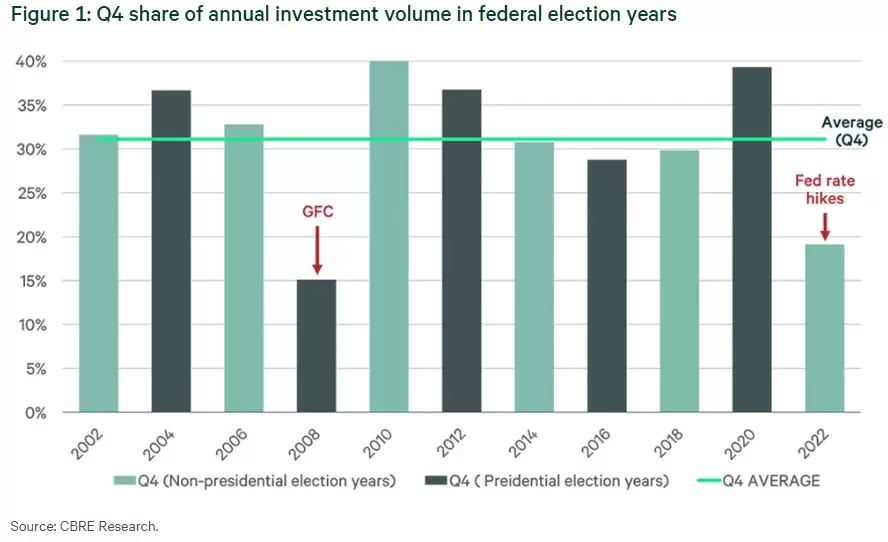
The analysis also considered lagged impacts, examining two quarters following elections. “There was no statistical evidence to suggest that the lifting of pre-election uncertainty unlocked capital,” the report said.
What Drives CRE? Macroeconomics
The one exception to “election impact” in this analysis wasn’t political but economic—namely, the Global Financial Crisis. The researchers pointed out that broader macro trends—like interest rates—tend to drive changes in capitalization rates.
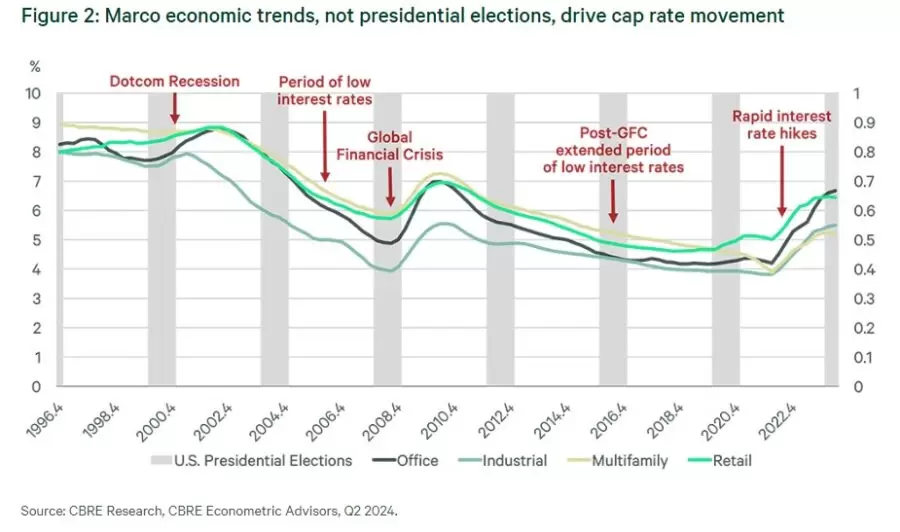
While federal elections don’t seem to impact investment volumes or property values, policies enacted while an individual is in office can. Government spending, the federal budget deficit, individual and corporate taxes and certain regulations can affect CRE investments and sales. “It’s always wise for investors to keep an eye on policy proposals that, if enacted, could affect property values over the long term,” Mellott commented.
What it Means for Investors
So why is it assumed that federal elections have such a direct impact on CRE investment performance? “It could be that some investors assume that others will change their approach because of the election,” Mellott observed. “These perceptions likely have a lot to do with the inordinate media attention—both news reports and paid advertising—that put presidential elections at the top of our minds every four years.”
He explained that the takeaway from the analysis is that strategic property decisions shouldn’t be delayed just because of an upcoming federal election. “This is especially true at the present time, when there may be opportunities to capture favorable pricing amid a market recovery,” Mellott added.
- ◦Lease
- ◦Sale/Acquisition
- ◦Development
- ◦Financing
- ◦Policy/Gov't

