National CRE News In Your Inbox.
Sign up for Connect emails to stay informed with CRE stories that are 150 words or less.



Report: Data Suggests that CRE Continues Holding On
There’s little doubt that the commercial real estate sector continue wading into headwinds. The combination of decreasing office utilization, retail challenges and apartment demand erosion led the Board of Governors of the Federal Reserve System to highlight commercial real estate as a possible economic risk trigger.
Just-released Q2 2023 preliminary multifamily, office and retail data from Moody’s Analytics CRE supports the commentary that “the worst of fears have yet to ring true.” By the same token, “the industry is still on a knife’s edge,” according to a press release discussing the data. Basically, multifamily is still holding strong, while office remains unchanged from the previous quarter. In the meantime, Moody’s Analytics Senior Economist Lu Chen and Moody’s Analytics Head of CRE Economics Thomas LaSalvia suggest that “retail is in it for the long haul.”
Multifamily: Still OK
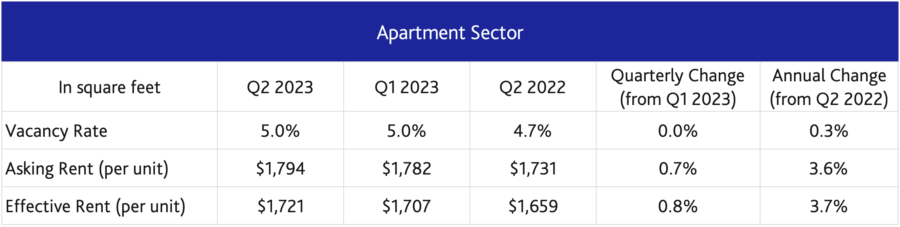
The Moody’s metrics indicate that national average vacancy rates remained at 5%, with “construction delivery a bit more sluggish than expected” due to inflationary pressures and increased financing costs. Still, net absorption had ticked up, supported in part by a continued strong job market and slowing single-family housing activity.
Though quarter-over-quarter rent growth was marginally higher, it’s nowhere near the double-digit numbers reported at the peak of 2022. Chen and LaSalvia noted that the rent growth is close to the pre-pandemic level.
Office: Little Changed, Still Stressed
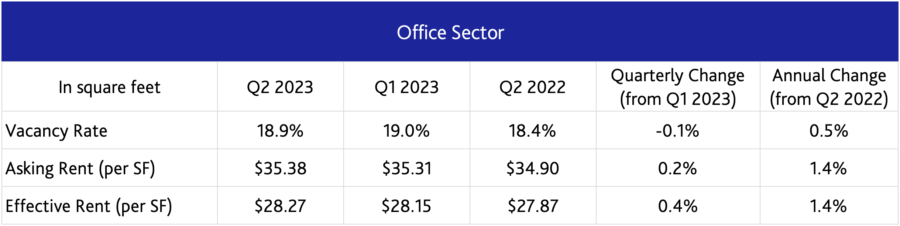
It’s probably no surprise that office construction has significantly slowed. Nor is it any surprise that underutilization continues to be the issue. Despite back-to-office mandates, American workers, on average, are coming to the office only half as frequently, compared to 2019.
Because of this, and because of overall economic uncertainty, “office demand remained unstable and continued to bump along the negative territory,” the Moody’s experts noted. The average national vacancy is at 18.9%, “uncomfortably close to its historical peak of 19.3% back in 1991 during the Savings and Loan Crisis,” LaSalvia and Chen wrote.
Retail: Buoyed by Consumer Confidence
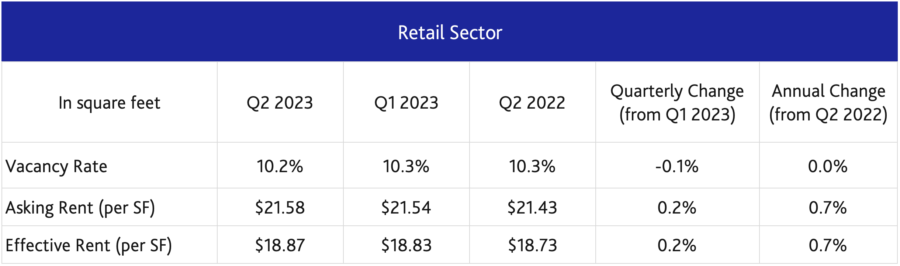
Though the retail sector has been hammered by growing e-commerce and COVID restrictions and lockdowns, “surprisingly strong pent-up demand (has) brought the opportunity for retail performance to turn the corner,” the Moody’s experts said. Neighborhood and community shopping center performance continued to improve. In the meantime, construction delivery continues to remain sluggish. As a result, vacancy levels stood at the pre-pandemic level of 10.2%, while asking and effective rents increased slightly on a quarter-over-quarter basis.