



National CRE News In Your Inbox.
Sign up for Connect emails to stay informed with CRE stories that are 150 words or less.


Report: Consumer Confidence Falls for Second Straight Month
The Conference Board Consumer Confidence Index stood at 103.0 in September 2023, a decline from the 108.7 reported in August 2023. The metric represents the second straight decline of the index.
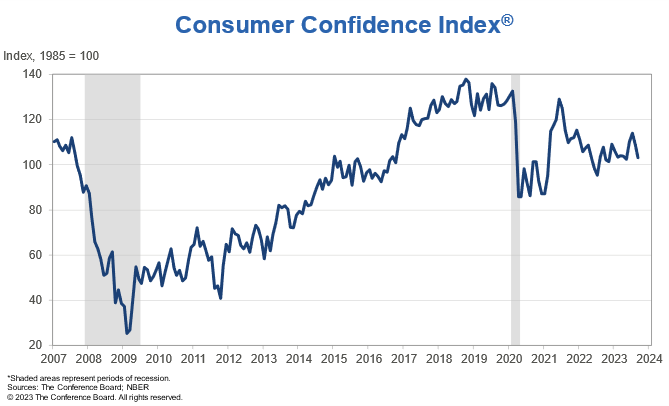
Other notable data were:
- The Present Situation Index is based on consumers’ current business and labor market assessment. This increased slightly in September to 147.1 from August’s 146.7.
- The Expectations Index is based on consumers’ short-term outlook for income, business and labor market conditions. This declined from 83.3 in August to 73.7 in September.
“Write-in responses showed that consumers continued to be preoccupied with rising prices in general and for groceries and gasoline in particular,” said The Conference Board’s Chief Economist Data Peterson, in a press release detailing the report. “Consumers also expressed concerns about the political situation and higher interest rates.”
The Causes for the Sentiments

Experts told Connect CRE that the numbers weren’t necessarily surprising, given everything happening. “The current index actually went up slightly, but the expectations index declined,” according to economist Ray Perryman, president and CEO of The Perryman Group. “Inflation – especially gas prices – and interest rates were certainly major causes, but this was also likely impacted by weather factors, the prospects for a government shutdown and the resumption of student loan payments.”
Realtor, rental property owner and real estate writer Alexander Capozzolo added that other causes of declining confidence could be employment concerns, especially regarding layoffs, instability, and market volatility. “Major market downturns can affect high net-worth individuals and trickle down to consumer sentiment,” he said.
Will This Continue?

As mentioned above, the Expectations Index declined, with fewer consumers anticipating business conditions to improve, their wages to increase, or the short-term labor outlook to be more favorable. Additionally, consumers’ assessment of their Family’s Current Financial Situation turned more negative in September.
Capozzolo suggested whether these declines continue depends on whether the underlying issues are satisfactorily addressed. “Impactful policy changes or improvements in the job market could stabilize or even uplift consumer confidence,” he said.
Meanwhile, Perryman said that if inflation continues downward and the economy achieves a “soft landing,” the index could improve. Furthermore, if the government shutdown lasts a few days and causes only minor inconveniences, “some of this concern should dissipate,” Perryman added.
The CRE Impact
Perryman noted that “it would take a prolonged trend coupled with other factors” for consumer sentiment to have any visible impact on commercial real estate. “Keep in mind that consumers are a step removed from commercial real estate, unlike the situation with housing,” he said. Furthermore, “consumer behavior over time has not really tracked with consumer sentiment or consumer confidence indices.”
Capozzolo offered a slightly different point of view, pointing out that owners and managers should evaluate real estate investment risks, “especially in sectors heavily depending on consumer spending.” He also suggested that landlords keep communication open with tenants during these uncertain periods. Understanding tenant situations better could inform leasing strategies.
He also proposed that owners and landlords have enough liquidity or credit to meet any potential declines in income or property values. Finally, “be prepared to take advantage of market downturns to acquire valuable properties at lower prices,” he suggested.
- ◦Economy
- ◦Policy/Gov't


