



National CRE News In Your Inbox.
Sign up for Connect emails to stay informed with CRE stories that are 150 words or less.



Rent CPI Elevated as Rent Growth Dips
The U.S. Bureau of Labor Statistics’ Consumer Price Index Summary, released on April 10, indicated that overall year-over-year inflation had increased by 3.5%. Boosting that figure was the increase in shelter costs (i.e., rents), which rose 5.7% year-over-year.
Yet many reports released over the past several months pointed out that apartment rent growth has drastically decreased, sometimes falling into negative territory. So, what gives? How can overall rent growth be in negative territory while the CPI numbers continue pushing it up?
Apartment List attempted to make sense of the dichotomy with a recently released report.
Apples and Oranges
First and foremost, Apartment List analysts explained that there are differences between its index (the Apartment List National Rent Index) and the CPI’s rent component. “The Apartment List rent index measures composition-controlled price changes for new leases,” the analysts said. Meanwhile, the CPI numbers track rent changes across ALL households.
“Since only a small share of households sign a new lease in any given month, it takes time for changes in market-rate asking rents to filter through to the entire market,” Apartment List analysts pointed out. To that end, Apartment List’s index hit bottom close to six months ago, in October 2023, implying that “it will likely be some time before rent CPI completes its gradual descent,” analysts explained.
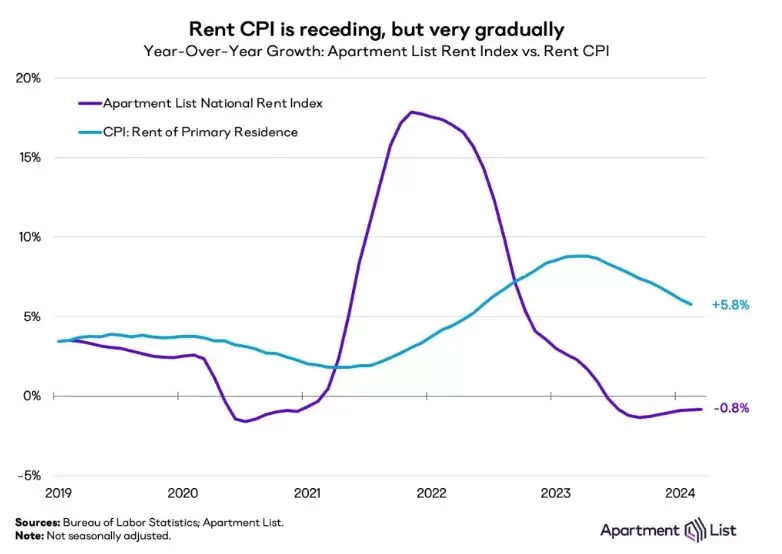
(Note: The Apartment List report was released two days before the CPI; the above figures reflect the CPI from February 2024)
What’s to Come?
The CPI shelter component measures not just residential rentals but also owner-occupied housing costs. No, owners don’t pay rent. However, according to the Apartment List analysts, these are measured under the idea of “owner’s equivalent rent.” This is leading overall shelter costs to run hotter than the overall CPI, preventing inflation, as a whole, from declining.
So, what does this mean for inflation and how the Federal Reserve might react? The Apartment List analysts believe “that the upward pressure being exerted by the shelter component will continue to gradually ease.” While analysts wouldn’t put a specific date on the decline, they did indicate that the year-over-year growth rate of shelter CPI has been declining fairly steadily at 0.2% each month. At this pace, the shelter inflation component could end the year at just under 3.5%.
Another consideration is that the Fed doesn’t need shelter CPI to hit 2% before taking action. “The Fed understands the relationship between new-lease rents and full-market rents and is actively tracking the cooldown reflected in real-time private market indicators,” the Apartment List analysts commented.
- ◦Lease
- ◦Economy
- ◦Policy/Gov't
