



National CRE News In Your Inbox.
Sign up for Connect emails to stay informed with CRE stories that are 150 words or less.


Reality Check: The Truth about U.S. Retail Spending

The U.S. Census Bureau’s “Advance Monthly Sales for Retail and Food Services – August 2023” offered some cause for optimism, with total sales up 2.5% from August 2022. The report also indicated that total sales for the June 2023-August 2023 period increased by 2.2% year over year.
But Xander Synder, senior commercial real estate economist for First American Financial Corporation, begs to differ. The problem with the retail sales report is that it isn’t inflation-adjusted but is expressed in nominal terms. “The nominal 2.5% growth, therefore, excludes the most obvious challenge the American consumer has faced over the past year,” he wrote in a recently published article. The challenge? “Inflation,” he wrote.
REAL retail sales growth
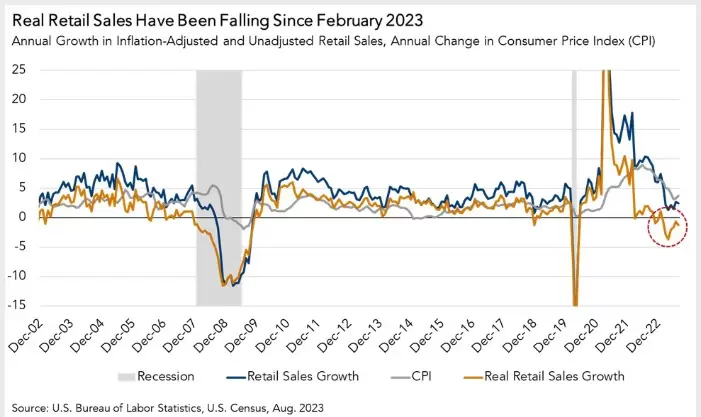
Snyder noted in his article that not accounting for inflation means that any growth in headline retail sales could be attributed to economy-wide price growth. Subtracting inflation from retail sales growth generates a metric called real retail sales growth.
So why does the Census Bureau rely on nominal retail sales growth? “It’s likely a consequence of the data release itself not being inflation adjusted, so any direct citations are, therefore, in nominal terms,” Sander explained to Connect CRE.
So, adjusting retail sales growth for inflation, real consumer spending declined by 1.2% in August compared to a year ago. Furthermore, real retail sales have declined annually since February 2023. “Excluding the pandemic, the last time there was a prolonged annual decline in real retail sales was during the Great Financial Crisis in 2008-2009,” Snyder wrote in his article.
Understanding the impact
Snyder told Connect CRE that comparing today’s real retail sales decline to that of the GFC isn’t practical, as “real retail sales are still higher than they were pre-pandemic.” With that in mind, part of the trend should be viewed as what he called “post-pandemic normalization.”
Snyder also cautioned against providing a broad brush on any consumer spending activity. For one thing, the numbers vary by retail location and type. And while retail spending might be declining, “the limited supply of retail space should limit vacancy increases and retail property price declines,” he said.
Furthermore, experience matters. Said Snyder: “Experiential locations – locations that must be physically visited to receive the products or services being sold – have been more resilient to the slowdown in retail sales than non-experiential ones.”
