



National CRE News In Your Inbox.
Sign up for Connect emails to stay informed with CRE stories that are 150 words or less.


Re-evaluating Urban Housing Myths and Misinformation
At the height of the pandemic and even afterward, populations migrated away from city centers to find less congested spaces and perceived safety from the dangers of the virus. This meant real estate investors turned their attention to exburbs and suburbs when it came to residential buys. The assumption was that CBD housing wasn’t necessarily worth their while.
Today, five years after the pandemic, the same assumptions about city-center multifamily persist. In its report, “Urban Comeback: Exploring the Post-Pandemic Resurgence of CBD Multifamily Living,” Cushman & Wakefield sought to dispel five myths about urban multifamily housing.
Myth #1—CBDs Continue Losing Population
The belief here is that rising crime in downtown areas is prompting businesses and people to move to the “safer” suburbs. The truth is that outmigration from city centers began dwindling in 2023, while crime rates have been shrinking since then.
Cushman & Wakefield analysts noted that “population growth, declining crime rates and revitalized neighborhoods have pushed foot traffic into clear recovery mode. While Downtown foot traffic is still around 20% below pre-pandemic levels, it has recovered significantly from its nadir.”
Myth #2—Renters Prefer Suburban Living
While three consecutive quarters in late 2020 and early 2021 saw a surge in suburban apartment demand, “in every other quarter since 2000, demand has been stronger for CBD apartments as compared to their suburban counterparts,” Cushman & Wakefield analysts said.
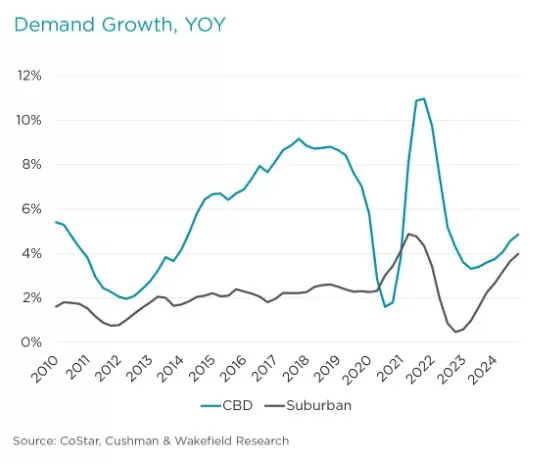
The analysts acknowledged that some figures were due to a smaller CBD inventory. “However, the data clearly demonstrates strong demand for downtown living, and developers are responding,” they commented.
Myth #3—Suburban Apartment Fundamentals Are Healthier
Cushman & Wakefield indicated that this myth is based on long-term data trends. Over the past 10 years, suburban apartment vacancy has been lower than that of city centers, with the gap widening during the pandemic. However, as cities reopened after the pandemic, CBD occupancies also recovered.
“Since the midpoint of 2023, the CBD vacancy rate has been mostly in line with the suburbs, hovering in the high single digits,” according to the analysts.
Myth #4—CBDs are Too Expensive
Cushman & Wakefield analysts noted that average CBD apartment rents are approaching $3,000 a month, “a staggering figure that would comprise 45% of the monthly budget for a household earning the median income (roughly $80,000 annually).”
However, the cost doesn’t consider the number of growing affluent renters; in 2024, renters in high-rise properties (generally in the CBD) earned more than $150,000 per year, meaning an average rent-to-income ratio of about 21%.
“The relative lower rent-to-income ratios reflect a growing population of lifestyle renters who continue to seek out high-end amenitized urban apartments and have even more ability to pay that premium compared to their suburban counterparts,” the Cushman & Wakefield analysts commented.
Myth #5—Capital Markets Continue to Favor the Suburbs
The report pointed out that the belief that suburban apartments consistently outperform those in the CBD has “driven an abundance of capital into suburban opportunities, narrowing the price gap between the two. ” This was the case for much of the early 2020s, during the pandemic and in its immediate aftermath.
But in 2024, things began to shift. “In a declining market, CBD properties demonstrated greater resilience,” Cushman & Wakefield analysts pointed out. While CBD and suburban volumes were lower, “the CBD was only down about 20% compared to closer to 40% in the suburbs,” the report said.
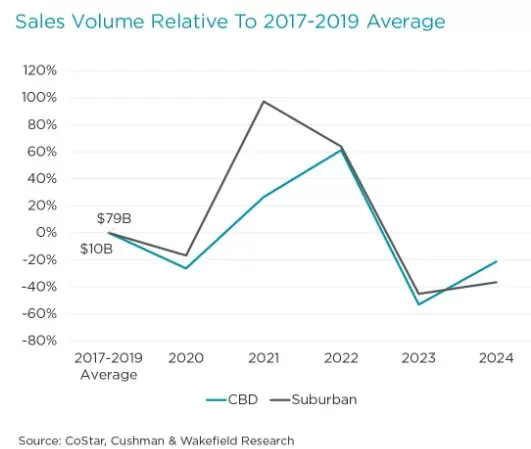
In addition, cap rates are adjusting to the change. As such, “with improving fundamentals and many of these CBD apartments priced at relatively low levels—often below replacement costs—now appears to be an opportune time to invest in urban cores,” the Cushman & Wakefield analysts noted.
- ◦Lease
- ◦Sale/Acquisition
- ◦Economy


