



National CRE News In Your Inbox.
Sign up for Connect emails to stay informed with CRE stories that are 150 words or less.

Q3 2026 Industrial Market: Demand Hits Highs as Vacancy Eases
Not so long ago, the industrial sector was dealing with oversupply concerns and uncertain demand.
However, during the third quarter, the pendulum seems to be moving in the other direction. Reports from CBRE, JLL, Colliers, Cushman & Wakefield and Plante Moran Realpoint noted stronger occupier demand, gradually shrinking vacancy rates and a return of developers.
Absorption
The common denominator of the write-ups was that net absorption had reached multi-year highs.
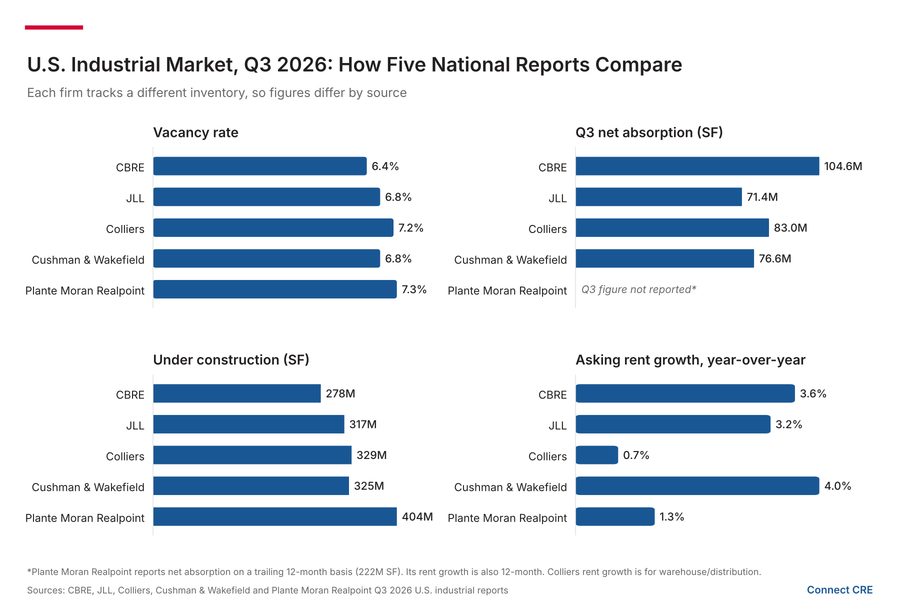
CBRE reported that absorption was at its highest quarterly total since late 2022, while JLL said year-to-date absorption has already surpassed all of 2025, even as its third-quarter total dipped from the second quarter. Colliers and Cushman & Wakefield also reported increased absorption numbers.
Interestingly, the inland markets did most of the heavy lifting in Q3, with Cushman & Wakefield reporting they accounted for roughly 80% of year-to-date absorption. However, port markets also experienced movement. On a regional basis, Colliers said the South and the Midwest were the leaders.
The firms also said there were signs that demand is moving beyond the newer buildings. Cushman & Wakefield and CBRE said warehouses built from 2000 through 2019 are stabilizing or gaining occupancy. And while Class B space continues to post smaller losses, JLL said that signaled a flight to quality rather than market departures.
Occupancy and Leasing
JLL reported its strongest quarter since 2022, while Cushman & Wakefield said that leasing has been on its strongest six-month run in more than four years. CBRE said its leasing activity increased from the year before, with its largest deals totaling 700,000 or more, nearly doubling.
JLL commented that more tenants expanded in place rather than relocating due to a lack of larger space availability. Cushman & Wakefield added that manufacturers accounted for more than one-quarter of its year-to-date leasing volume, up from just under one-quarter over the previous three years.
Vacancy
Most of the reports said that national vacancy was easing or holding flat. CBRE, Colliers and Cushman & Wakefield reported declines in vacancy. Colliers said that vacancy fell for a second straight quarter, while JLL noted steady vacancy quarter over quarter.
JLL and Cushman & Wakefield both reported sharp declines in vacancy in larger warehouses. Midwest markets, including Columbus, OH and Indianapolis, IN, posted some of the biggest declines, according to Colliers and Cushman & Wakefield. Colliers said vacancy rose year-over-year in the Northeast and the South.
Construction and Rents
Four of the five firms said the construction pipeline is growing again, with JLL, Colliers and Cushman & Wakefield putting construction at its highest level since 2024. Build-to-suit and owner-user projects made up a growing share, roughly one-third of the pipeline, according to JLL and Cushman & Wakefield, as large users seek custom facilities. JLL noted that pre-leasing on speculative projects remains low in most markets.
JLL said rent growth was at its fastest pace since 2024, while Cushman & Wakefield said it accelerated for a third straight quarter. Some markets, including Dallas-Fort Worth and several other Southern and Midwestern regions, reported double-digit rent growth, while others, such as California, New Jersey and Miami, experienced softer growth.
A Different View
Unlike the other reports, Plante Moran Realpoint’s numbers weren’t quite so positive. Based on a trailing 12-month basis and CoStar data, the firm said that vacancy remained elevated, with space availability providing more tenant options.
In its view, leasing slowed slightly over the past year but sits near pre-pandemic norms. At the same time, new supply continue to put pressure on markets.
While other firms saw big boxes tightening, Plante Moran said space availability is highest among larger warehouse and distribution properties, where inventory grew fastest. Smaller industrial facilities, by contrast, remained well occupied because little new space has been built.
The firm also said that annual rent growth is at its slowest pace in more than a decade. Construction starts are declining due to rising costs and labor shortages. Plante Moran also commented that less construction should mean less supply.
Outlook
Most firms expect continued tightening into 2027. Cushman & Wakefield forecasts a modest decline in vacancy led by high-growth inland markets, while JLL expects rent growth to accelerate modestly. Colliers and Cushman & Wakefield said development should remain concentrated where leasing is strong.
There are headwinds, however, including diesel price increases, trade policy and tariff uncertainty, interest rate volatility and the potential for an economic slowdown. JLL also cautioned that low pre-leasing could slow vacancy compression as new projects deliver.
Photo: 4045/Shutterstock
- ◦Lease
- ◦Development

