



National CRE News In Your Inbox.
Sign up for Connect emails to stay informed with CRE stories that are 150 words or less.


Q1 U.S. Industrial Market Report: Lower Absorption, Higher Vacancies
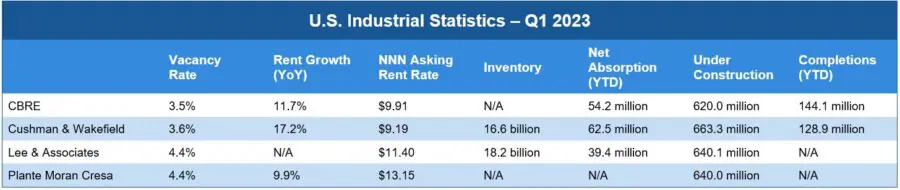
Analysts releasing national industrial market report numbers for Q1 2023 were unanimous in that absorption fell, while vacancy rates increased. The causes were twofold: Declining tenant demand and increased supply.
“There was a sharp first-quarter decline in U.S. tenant demand for industrial space, as wholesalers and retailers reconsider their inventory levels out of caution over the economic outlook,” according to Lee & Associates’ Q1 2023 Industrial Overview.
The Plante Moran Cresa U.S. Industrial Real Estate Market Summary Q1 2023 agreed, pointing out that the current declining numbers follow in the wake of “several quarters of record-breaking performance.” Also influencing the situation is “the record amount of speculative development expected to enter the market this year,” Plante Moran Cresa experts added.
The CBRE U.S. Industrial Q1 2023 report went one step further, putting the new deliveries into record-breaking territory, while pointing out that the amount is still below historical averages. Furthermore, “under-construction projects declined for the first time in more than four years, down by 7% from Q4 2022,” CBRE analysts pointed out, adding that “net absorption fell below the 10-year average, but is still in positive territory.”
And despite the economic turbulence and uncertainty, Cushman & Wakefield U.S. Industrial MarketBeat Report for Q1 2023 pointed out that “the U.S. industrial market trajectory stayed positive across all key indicators.”
The national industrial market outlook calls for continued supply and absorption, even as Cushman & Wakefield analysts call for a reduction in tenant demand. This could result in “totals closer to those achieved earlier in the expansion cycle, as consumer spending shifts away from purchasing goods amid softer economic conditions,” the Cushman & Wakefield experts pointed out. CBRE analysts also believe that a large amount of new supply could cause vacancy spikes, “but should be fully absorbed by late 2024.”
Speaking of which, it’s likely that factory onshoring should help with ongoing demand. “The onshoring/reshoring of high-tech manufacturing should help keep net absorption positive for the next several years,” the Plante Moran Cresa analysts commented.
This, in turn, will drive vacancies up, but only slightly. “Barring a severe shock to the U.S. economy and industrial leasing, the volume of space set for delivery will produce only a moderate increase in vacancy without tipping the market in the tenants’ favor,” according to Lee & Associates’ experts.
Furthermore, “rent growth will persevere amid high occupancy rates, growing in the single digits annually over the next few years,” the Cushman & Wakefield analysts noted.
- ◦Lease
- ◦Economy


