



National CRE News In Your Inbox.
Sign up for Connect emails to stay informed with CRE stories that are 150 words or less.
Providing Affordable Housing for America’s Seniors
By Jennifer Duell Popovec
As the world struggles to contain the COVID-19 pandemic, this unprecedented environment has created an economic crisis for millions and exacerbated the need affordable housing for at risk seniors.
Housing older adults is a critical issue for America, and the need is particularly severe for lower income adults. With nearly every U.S. county lacking an adequate supply of affordable housing, there’s currently a shortage of 7 million affordable homes for the lowest income populations, according to the U.S. Department of Housing and Urban Development.
As rents rise faster than income, older Americans are increasingly burdened by housing costs and forced to cut back on other basic necessities such as food, healthcare, and transportation. And the lowest income seniors are teetering on the edge of homelessness.
“There’s an affordability crisis for older Americans,” says Jennifer Seamons, Senior Vice President of KeyBank’s Community Development Lending & Investment. “Seniors have a long life ahead of them, and it’s important that they have a safe, affordable place to live—especially those on fixed incomes.”
KeyBank boasts a fully-integrated platform that provides debt and equity investments to finance affordable seniors housing projects, according to Robert Likes, KeyBank’s National Manager for Affordable Housing. He estimates that roughly a third of the affordable housing projects KeyBank evaluates are targeted toward seniors.
KeyBank’s experience with affordable housing and its in-depth understanding of the mechanics of these projects help it to be more responsive to clients and helps support them as they build these life-changing projects, Likes says.
“The demand for affordable housing for seniors is coast-to-coast—every city, every county, every state is short on affordable housing,” Likes points out. “The gap is in the millions.”
Unprecedented number of senior households
The number of older households has reached unprecedented levels, according to Housing America’s Older Adults 2019, a new report from the Harvard Joint Center for Housing Studies. The number of renter households headed by someone age 50 and over has grown from 16 million in 2018 (35% of all renters) to a projected 21.2 million in 2038 (40%).
Additionally, 35 million of the nearly 50 million adults age 65 and over in 2017 lived either alone or with a spouse or partner. Some 42% of households in this age group consisted of a single person and 37% were empty-nester couples.
With age, as you would expect, the share of solo households increases, reaching 58% among those 80 and over. This increase is noteworthy because many individuals in this age range that live alone have higher disability rates and lower incomes than same-age couples. As the number of single-person households in their 80s rises in the coming years, so, too, will the demand for affordable housing units that include supportive services.
Older adults in worse financial shape
Older adults are in worse financial shape than same-age households 20 years ago. Many households in the 50- to 64-year-old age group have not recovered from the Great Recession of 2008, leaving them with lower incomes and homeownership rates than their predecessors at similar ages, according to Housing America’s Older Adults 2019.
The report shows that lower-income households are falling further and further behind their higher earning peers in terms of income. In 2017, the median income for the lowest earners was $14,400, significantly lower than the 2000 level of $17,100. Similarly, renters in the bottom income quartile for all households had a net wealth of only $1,900 for 50 to 64-year-olds and $1,100 for those age 65 and older.
The decreasing wealth of older renters is related to the erosion of household incomes as rent increases outpaced income gains over the last 15 years, according to the Harvard Joint Center for Housing Studies. Currently, the number of older adults facing housing cost burdens is at an all-time high of 10 million.
High housing costs—older renters are spending 30% of their income or more on housing costs—have big consequences. After paying rent, the lowest-income renters (defined as those with incomes in the bottom quartile of all households) aged 50-64 had only $560 each month to cover all other expenses. Renters 65 and older had even less at $495.
“With little income left over after paying rent, older adults may have to make cutbacks on other expenses,” the report states. “Cost-burdened renters age 65 and over who were in the lowest expenditure quartile (a rough proxy for income) spent less on food, healthcare, and transportation than their unburdened counterparts.”
Lack of affordable units
Across the nation, apartment vacancy rates are at their lowest points since the mid-1980s. That means there’s fewer available units at any price point.
According to the National Low-Income Housing Coalition’s Out of Reach 2019 report, only 4 million rental homes are affordable and available to the nation’s 11 million extremely low-income renter households whose incomes are less than the poverty rate or 30% of their area median income (AMI), leaving a shortage of seven million rental homes.
In only 10% of U.S. counties can a full-time worker earning the average renter’s wage afford a modest two-bedroom rental home at fair market rent, working a standard 40-hour work week. The same worker could afford a modest one-bedroom apartment in 41% of U.S. counties.
Consider this: a family of four with poverty-level income in most areas of the U.S. earns no more than $25,750 annually, sufficient to afford a monthly rent of no more than $644. Many extremely low-income families can afford far less. Individuals relying on social security income can afford a monthly rent of only $231.
KeyBank has provided financing for hundreds of affordable housing projects, many of which are targeted toward people who are 55 and older. “Our mission is to help communities and individuals thrive,” Seamons says, “by investing in affordable housing. This is what has a long-term positive impact on the communities we serve.”
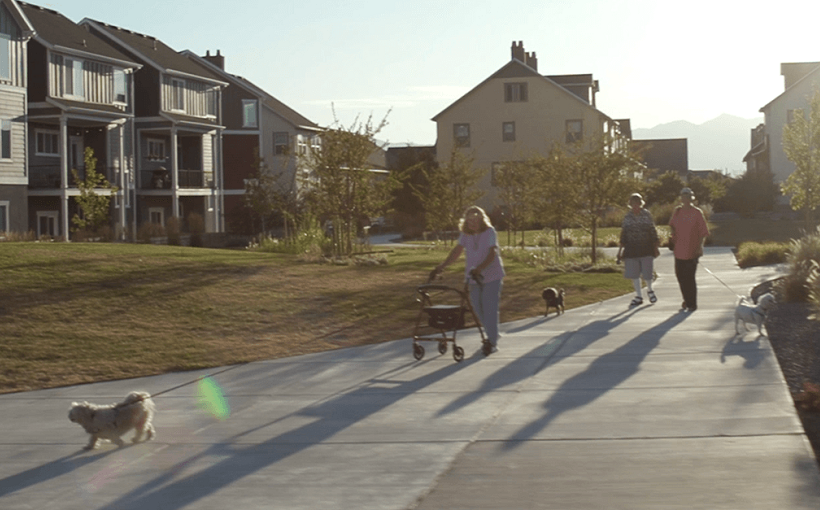
Recently, KeyBank provided financing to Wasatch Advantage Group to build a four-story, 97-unit project in Midvale, UT, focused on low-income seniors. The elevatored development, Kimpton Square, is located in the Salt Lake City MSA. It consists of 14 studios, 62 one-bedroom, and 21 two-bedroom units, of which 78 are low-income units restricted senior households (55+) earning 25, 39, 45, and 50% AMI or less.
Kimpton Square features an on-site management office, clubhouse, courtyard, computer lab, exercise facility, and pool. It also offers 99 garage parking spaces and 32 carport parking spaces though it is situated within walking distance of multiple light rail stations and is served by public bus transportation. In addition, a senior center is located down the street, along with several healthcare facilities, which are particularly important for older adults.
“What makes this project so compelling is the support it received from the community,” Seamons notes, explaining that Midvale’s mayor was particularly instrumental in getting the project approved and underway. “The city’s elected leaders were committed to ensuring that seniors had an affordable place to live.”
Homelessness rises in older adults
Along with Kimpton Square’s income-restricted units, the community also has five units dedicated for homeless or near homeless seniors. Another 10 are accessible and restricted for physically handicapped persons and eight restricted for veteran seniors.
“Both as a financial institution and a member of the community, KeyBank is focused on being a part of a solution for homelessness in general,” Seamons says. “Our affordable housing program is part of that solution.”
Based on income and wealth trends for the lowest-income older adults, the outlook for homelessness is grim. Though the number of people experiencing unsheltered homelessness has decreased over the last 10 years, the number of older adults experiencing sheltered homelessness is on the rise, according to Housing America’s Older Adults 2019.
“It takes a lot of dedicated people, energy, and resources to make affordable housing projects successful,” Likes says. “It really is a labor of love. And there is nothing else we would rather be doing than partnering to move them across the finish line.”
For questions, comments or concerns, please contact Jennifer Duell Popovec
- ◦Financing
- ◦Development


