



California CRE News In Your Inbox.
Sign up for Connect emails to stay informed with CRE stories that are 150 words or less.

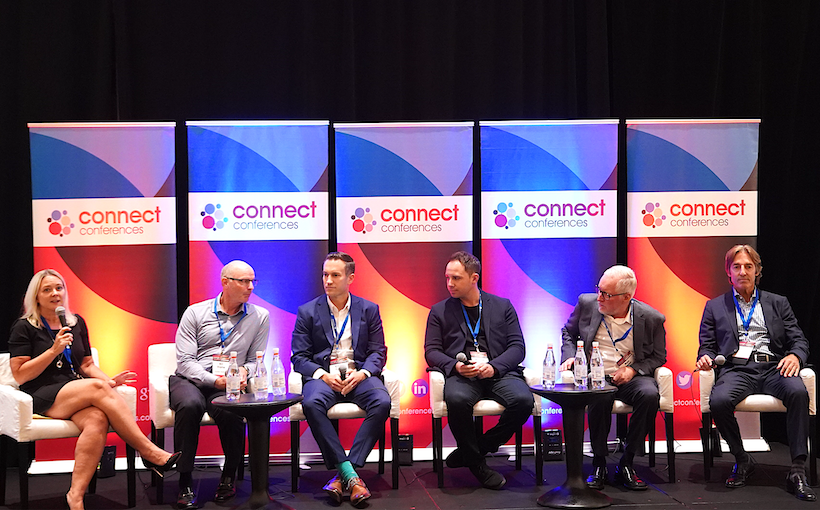

Preparing Your Business and Portfolio for What’s Next
By Dennis Kaiser
A standing-room crowd of nearly 500 commercial real estate leaders gathered last week at The Resort at Pelican Hill in Newport Coast for the annual Connect Orange County conference. The afternoon featured a keynote address by KBS Realty Advisors Chuck Schreiber (watch the video here), as well as three deep-dive panel discussions.
One of the big questions on everyone’s mind was: Is there a bad moon rising? Heading into the 11th year of the current economic expansion cycle, the conversation of the Preparing Your Business and Portfolio for What’s Next panel centered around delivering advice that CRE players needed to know in order to prepare for a potential downturn.
Allen Matkins’ Sandra Jacobson moderated the panel, and kicked off the discussion noting that it seems the recession is on hold given the past couple months when it has been “crazy busy for everyone.” She asked panelists to share their perspective on the topic of a recession.
Kidder Mathews’ Bill Frame noted from a brokerage perspective, they are not seeing a slowdown it at all. He pointed out that he’s not seen an August like this before, which is shaping up to be the “biggest summer or close to it.” He says all facets are active and the brokerage side is “as busy as it’s ever been.”
Trammell Crow Company’s Chris Tipre agreed that TCC is seeing high levels of activity. He added, though, that as their projects are stabilized, they are turning a page on the next ones. He said they’re “not sure spec office is way to go.” They think diversification is a wise strategy whether that be geographic or product type. They have expanded to Las Vegas for a spec industrial project in the Golden Triangle. They are also expanding into the multifamily product type. Though Trammell Crow is looking for opportunities to bring to market product that is different from competitors to gain an advantage. That includes doing active adult 55+ projects that feature high-end, amenity-rich lifestyle elements and are focusing on South Orange County and North San Diego County.
CREXi’s Michael DeGiorgio said 70,000 brokers use the tech platform for CRE and he heard many were spooked that a slowdown was coming, but then two months later that same broker said the market was “on fire.” He pointed out that overall transaction volume was down slightly from year before and this year, but in general says it is a “booming market,” especially for core stable assets because good real estate tends to sell quickly. He noted that as rates drop the bid ask gap should close a bit, and that will likely help everyone by extending the market longer.
Parker Properties, Inc.’s Russ Parker thinks now is the time when we’re seeing enough red flags that you shouldn’t follow a herd mentality heading into a possible downturn. “Now is when you need to think creatively and now is when you need to figure out what your true niche is and talk within your organization and talk with consultants because when things change, they change really quickly.” He notes that while the market seems good now, there enough “factors going around we might need to be a little cautious now.”
John Hancock Real Estate’s Parker Jones said topping the list of ways that they are planning ahead of the market is through capital improvements. They have completed “substantial” capital spends on “virtually all assets.” As an example, he noted a renovation of a two-property Class A asset on Von Karman that had grown a bit “tired.” It has been transformed with new lobbies, restrooms and a plaza that now connects the buildings. He says it has served to enhance value and helped convince a major tenant to re-up long term because they “saw an opportunity to create campus environment” for their HQ in OC.
Tipre said the competition for tenants has evolved into an amenities race to try to add more to a project and try to outdo others. The service element was the company’s biggest differentiator on The Boardwalk project, as the development team tapped into management expertise and resort-style experts to create a bridge between office and hospitality. They created a platform of programs and services with same-day dry cleaning, interesting events, a car wash valet, tutoring for employees in buildings, and photo and yoga classes. That “appealed to tenants” because they saw it as a way to enhance their day, he says.
DeGiorgio noted that one of the causes of the amenities war could be attributed to the WeWork expansion, which is seeking to add another million square feet in Orange County. A drop in rents could cause troubles for co-working operators and the region, he notes.
Co-working is a big question especially from a securitization perspective over the past several years, notes Tipre. “How are you going to manage your way out of it should things go awry?,” said Tipre. Co-working has filled the gap for shorter 1- to 3-year deals. But he notes it is important to make sure you are comfortable with their business model. He says they’ve looked at their space and if things did go awry, they would likely tap the services team to take it over and mitigate any leasing risk along with their leasing teams.
Tipre said the capital markets indicate it’s OK to have 25-30% co-working space in a building today, but noted that’s in a good market. If things turn sour, that’s “not going to be an acceptable number,” he noted. He believes a good target for co-working space is the 10-15% range, which is more comfortable and would allow a landlord to manage the space themselves or find tenants to fill the space.
Currently, co-working occupiers have claimed roughly two million square feet in Orange County. If co-working grows to the three- to four-million-square-foot range, it could be more concerning like the timeframe when the savings and loan or mortgage crisis hit, and those sectors were occupying seven to eight million square feet.
Jones indicated the amenity wars are overstated in his view. He noted adding a towel service, surf board storage, or a bocce ball court are not costly, but careful choices need to be made. He thinks at the top of the list of what every project needs are food service and an athletic facility. Parker Properties’ Parker noted that the most effective amenities are “organic,” because it creates more vibrancy and authenticity at the project.
Frame says suburban office is one sector he’d be careful about and tread lightly around, especially in smaller markets, in light of a potential downturn. Though he says Class A downtown office is fine in the West Coast markets. Land acquisition deals are in demand for development, especially industrial and downtown multifamily.
Parker sees mixed-use as a “mega return product of future.” On the five-year horizon, he believes it is a robust opportunity to provide five different uses from hospitality, entertainment and office with a little less multifamily since it may not mix as well with what MXU could be.
Tipre offered a view that each component must stand on its own in a MXU. It must be a strong office deal or multifamily deal and not be expected to “prop up or draft off the success” of other elements, especially when trying to get them financed. He says, when they underwrite MXU projects they are factoring in downsides including 2-5 years of entitlements.
Parker countered that view noting that in an effort to extend the day of an office project there is a need for restaurants, hospitality or sports clubs that work together. He says they saw what that strategy delivered in a down market at the Summit. He notes it is worth the risk, thought and creative playing to find the right mix. It could be “magic for everybody,” including apartments office, and retail.
Shifting to the investor front, Jones notes the market is leaning back more toward a traditional capital source market, and away from Chinese capital sources. That’s a view that was shared by Frame who says they are seeing that in Seattle too. Through those sources have dried up they are seeing “velocity from more traditional deals.”
Given that the cycle continues to hum along panelists noted it is smart to prepare for an inevitable downturn. Jones notes it will likely be a geopolitical event with multiple flashpoints that helps bring on any downturn. Proactively preparing for that from a leasing perspective, Jones says it is generally wise to be ahead of the curve approaching lease expirations, especially with major tenants, because that sets up success of ongoing leasing.
In regard to how an election year looming on the horizon might impact, CRE, Tipre pointed out three years ago the election year felt like “people took their foot off the gas but didn’t necessarily put it on the brake.” He notes that may happen this time too. He doesn’t foresee a full-scale stop, though it may not be a “hard acceleration” through it.
Jacobson notes there’s no indication of a slowdown. All product types and deal types are active including acquisitions, dispositions development and leasing. But she cautions, don’t be “disillusioned” that perfect conditions right now will continue. She advises being prepared, be thoughtful, be cognizant when underwriting tenants, do renewals now, and look at tenants uses to identify potential problems if a recession hits.
For comments, questions or concerns, please contact Dennis Kaiser
- ◦Financing
- ◦Development
- ◦Sale/Acquisition
- ◦Lease


