



National CRE News In Your Inbox.
Sign up for Connect emails to stay informed with CRE stories that are 150 words or less.
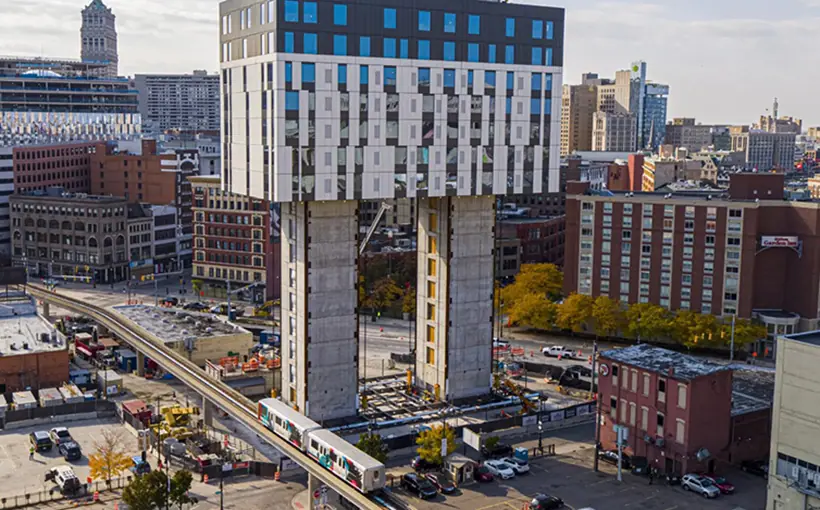

Now For Something Completely Different: Top-Down Construction
Pictured: The Exchange, Detroit
Though not widely known, top-down construction could save time and money while promoting sustainability
Most construction is “ground-up” for obvious reasons. Contractors and subcontractors begin at ground level. Then they build up until the project is topped off.
Then there is the Termohlen-Thornton method, better known as a “top-down” building construction method. A recent article in Urban Land reported that top-down procedure could help reduce materials and labor costs while improving sustainability during construction.
Defining Termohlen-Thornton Method
The Termohlen-Thornton method was introduced in the early 1970s by Charles H. Thornton (with the Thornton Thomasetti structural engineering firm) and inventor David Termohlen. The partnership eventually led to the formation of the construction firm TGE, which offers its TGE Top DownSM System.
The process entails the following:
- Building the core
- Developing the roof and each floor less than six feet off ground level
- Raising the floors with heavy-duty hydraulic jacks
- Extension of solid steel bars from the central core, which are inserted into holes at the floors’ periphery
- Permanently bolting the floors into place
The Benefits
According to TGE, the top-down platform can generate the following benefits:
Structural weight reduction. The process leads to higher concrete and steel structural efficiency. This cuts total structural weight in half compared to conventional construction.
Column-free interiors and exteriors. Rather than relying on columns, the top-down method uses central cores. The result can be more floor space and design flexibility.
Increased safety performance. Building decks at ground level eliminates specific safety hazards. Tower crane operations can be eliminated. Furthermore, workers don’t have to work on scaffolding from elevated positions.
Time savings. The top-down process can cut the construction timeline in half due to standardized procedures, materials reduction and ground-floor construction.
Additionally, there tend to be fewer necessary materials related to top-down construction, leading to the potential for a higher level of sustainability.
The Current Scenario
Between 2017 and 2018, TGE completed a 1.2 million square feet project in Bangalore, India. At the same time, the company licensed the system to LIFTbuild (a Barton Malow subsidiary) in 2017. With help from this platform, LIFTbuild completed The Exchange, a 16-story, $64.6 million building in Detroit’s Greektown neighborhood.
Meanwhile, TGE and Ubuntu Partners Real Estate are in the design phase of eVolve, a mixed-use apartment, hotel and retail project in Denver’s Arapahoe Square District. “We came in about 25 percent less expensive than a high-rise, cast-in-place, flat-plate concrete project,” Charles Thornton told Urban Land.
- ◦Development


