



California CRE News In Your Inbox.
Sign up for Connect emails to stay informed with CRE stories that are 150 words or less.


Neighborhood Centers: Finding Success in the Every Day
By Dennis Kaiser
Connect Retail West brought together a standing-room-only audience of more than 300 CRE leaders for an information-packed conference at the Hurley Surf Club’s new retail experience at Pacific City in Huntington Beach, CA. The immersive afternoon overlooking the Pacific Ocean included three intimate conversations with top brands, two panel discussions and a retail trends keynote.
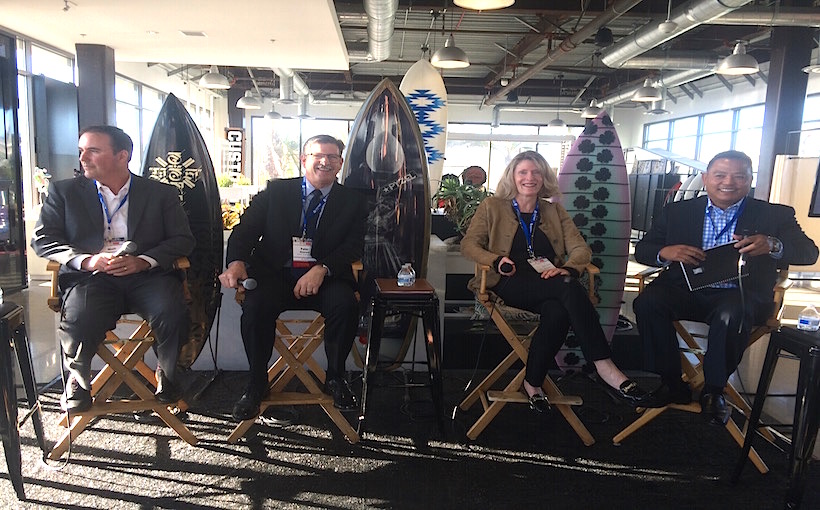
The panel on neighborhood centers was moderated by Coreland Companies’ Matthew Hammond, and included Irvine Company’s Peter Moersch, NewMark Merrill’s Susan Rorison, and SRS Real Estate Partners’ Michael Lagazo.
The consensus was some retail will never go away, since people will always need to be able to run to the store or the dentist for the conveniences of everyday life. Yet, clearly changes are sweeping across this sector of the retail industry too.
Coreland Companies’ Hammond noted the 2017 holiday season was “one of the best” experienced, and says the fact that 4,000 new stores opened in 2017 reflects just how resilient the retail sector really is.
SRS’ Lagazo predicts “three C’s” are ahead for the retail industry: Closures, Consolidations and Contractions. He advises watching “how the sector is transforming,” and “capturing opportunities to do something innovative.”
Still, neighborhood center owners and leasing teams must adopt nimble approaches.
Irvine Company’s Moersch shared the advantage its integrated model encompassing retail, office, and a mix of multifamily and housing components delivers. That allows the company to create live, work, and shop environments that truly engage a neighborhood by addressing what a community needs. He says, having so many “touch points” helps Irvine Co. “get a better sense of what people will want at a retail center. We need to be cognizant of the tenant mix because we recognize the retail center is part of the community.”
Today, Irvine Co.’s approach to leasing encompasses knowing what the cost of occupancy is too, and assuming it is reasonable, leasing teams “go after the best class of tenants,” he says.
For Newmark Merrill, Rorison says the company applies a “grassroots approach to leasing shopping centers. We look for underutilized areas of a center to maximize space, while striving to be the cleanest, safest and most beautiful that a center can be.” That led to the introduction of a non-traditional, ninja trampoline user in a center, which has generated considerable new interest and footfall. And by understanding that a center often becomes “the heart of a community,” NewMark Merrill can look through the lens of both tenant and the customer to deliver a “non-cookie-cutter” experience, even within the grocery category.
In the case of a center that had a traditional grocer that was limping along, NewMark Merrill replaced it with a non-traditional grocer that focused on delivering an in-store experience more aligned with customer’s expectations. Rorison says, that resulted in sales doubling.
Technology is playing an increasing role in neighborhood retail shopping. SRS’ Lagazo says, “technology gives unlimited options for consumers to search and buy products. They are more educated [about products] and product offerings are more transparent today.” The emergence of technology in retail real estate has also “almost automated the site selection process because it is easier to forecast from the tenant side,” says Lagazo.
Though Newmark Merrill’s Rorison also notes technology has allowed the owner of neighborhood centers to mine data of customers who check in on Social Media. That information helps inform and guide its decisions to better serve customers and the overall community.
For comments, questions or concerns, please contact Dennis Kaiser
- ◦Lease

