



National CRE News In Your Inbox.
Sign up for Connect emails to stay informed with CRE stories that are 150 words or less.
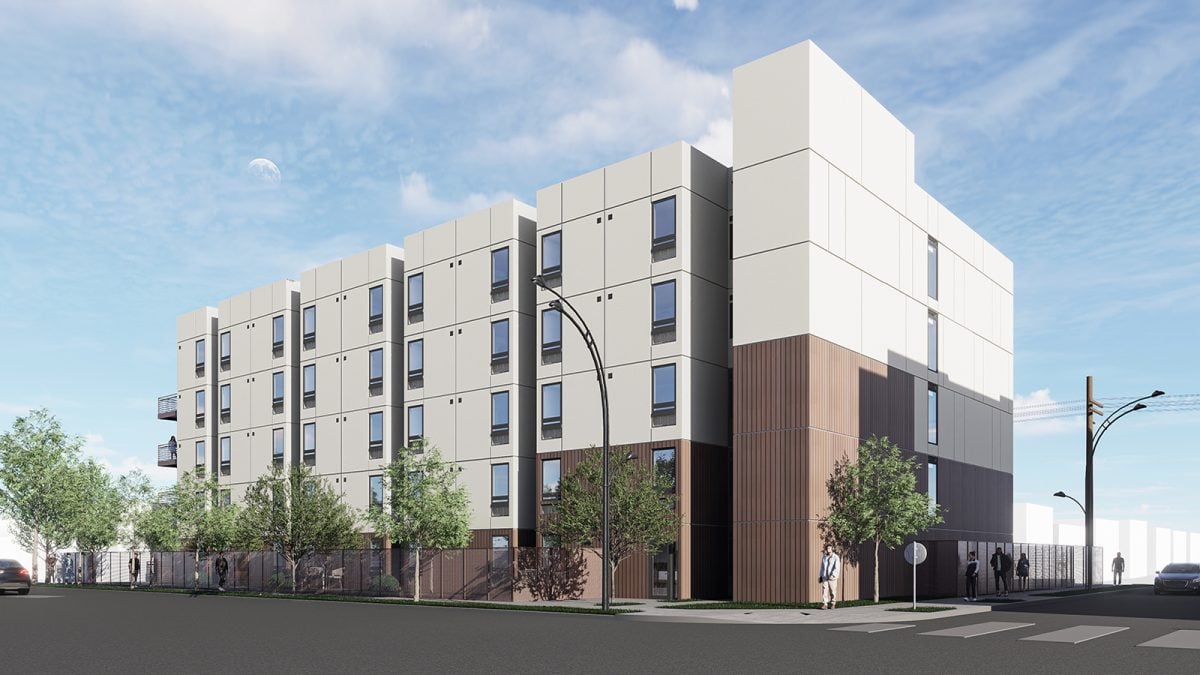

Faith-Based Developer Tests Modular Construction for Affordable Housing Scale

Since its launch in 2017, Los Angeles-based Logos Faith Development has worked with religious institutions throughout Southern California to convert underutilized land into affordable housing units. The nonprofit organization uses property tax-exempt developments to attract developers and investors to projects that might otherwise be difficult to finance.
The developer’s pipeline is currently valued at approximately $750 million and consists of more than 2,000 affordable housing units being developed in partnership with up to 30 faith-based organizations. The organization aims to break ground on five projects annually through 2028.
Now, Logos Faith is determining whether modular construction can help achieve those goals more quickly and efficiently.
The organization has partnered with Model/Z to test the build type at the Logos-Grant Housing Apartments, located at 105th Street and Central Avenue in South Los Angeles.
“We decided to enter the fray with this project to learn by doing,” Logos Faith’s Partner and Founder, Pastor Martin Porter, told Connect CRE.
“We want to evaluate modular to see if it makes sense to deploy this build type on more of our projects.”
Testing a Different Approach
For now, Logos Faith relies more heavily on traditional stick-built construction than on modular construction.
The company has completed the 71-unit Casa Paloma in Orange County and the 49-unit Silver Star Apartments in Los Angeles. It also recently broke ground on the 138-unit St. Rest Community in Los Angeles.
Modular construction differs from traditional stick builds in that individual sections of an apartment building are manufactured in a controlled factory environment. The completed modules are then transported to the development site and assembled.
In theory, the approach can accelerate construction timelines while reducing labor requirements, prompting greater predictability. Porter said those potential efficiencies could allow Logos Faith to scale its development pipeline more quickly.
The organization partnered with Model/Z in part because of Porter’s personal and professional relationship with founder Martin Muoto.
“I appreciate how he has combined being a visionary trailblazer in the housing industry with that of a hard-nosed realist,” Porter said. “I decided to partner with him and his family, and the report so far has been good.”
Logos Faith and Model/Z chose the South Los Angeles site, owned by Grant AME Church, because its characteristics made it a logical candidate for modular construction. While the project remains in the permitting stage, the process has already produced one measurable benefit.
The project’s Ready to Issue (RTI) permits were completed in nine months, compared with the roughly 18 months Porter said is typical.
“This is already a significant benefit,” he said.
Overcoming Perceptions
Porter brings considerable real estate experience to the discussion. Before founding Logos Faith, he held senior leadership positions at national and regional real estate firms, where he was recognized as a top producer and recruiter.
Based on his past and current experience, he said affordable housing can be profitable, particularly over the long term.
“It can produce more stable, meaningful and consistent returns than alternatives, including market-rate,” Porter said.
That experience also supports Logos Faith’s approach to modular construction. Specifically, the organization isn’t betting its pipeline on a single building method. Instead, it is using the Logos-Grant project as a test case.
But getting from RTI to project completion can be a problem.
Porter said modular construction can carry a negative perception among some general contractors and lenders, in part because of what he described as its perceived “esoteric” nature.
However, those attitudes might be changing.
“It’s not esoteric, and we’re making very positive headway in both of these areas now,” Porter said.
There are also longstanding perceptions surrounding affordable housing itself.
“There’s the belief that affordable housing isn’t profitable for investors and doesn’t ‘pencil,’” he said.
Measuring the Results
The immediate goal of the Logos-Grant project is to gather enough information to determine whether modular construction makes sense for future developments.
“We’re looking at the ability to scale up unit count, while driving down unit costs,” Porter said.
Some of the project’s variables remain moving targets, but Porter said the results so far have been encouraging.
“Some of this has involved moving targets, but at the base, the outcomes continue to trend toward more units, faster, at less cost, with good feedback from funders,” he said.
Even if Logos-Grant ultimately proves successful, Porter won’t be abandoning traditional construction. Instead, the company’s goal is for modular construction to account for roughly half of its development pipeline.
“It’s not a silver bullet or one-stop solution,” Porter said. “But it is worth seriously considering when a multifamily developer is trying to build high-density housing.”
Photo: Logos-Grant Housing Apartments rendering, courtesy of Logos Faith Development
- ◦Development


