



National CRE News In Your Inbox.
Sign up for Connect emails to stay informed with CRE stories that are 150 words or less.

Less Use and Increased Vacancies Mean “Zombie” Office Buildings

It’s no secret that the office sector continues to experience its share of challenges. The combination of higher vacancy rates/lower utilization and decreased financial viability is turning many of these properties into what the Boston Consulting Group (BCG) dubs “zombie” buildings.
In a recent article entitled “Countering the Curse of Zombie Buildings,” BCG director Santiago Ferrer and colleagues noted that buildings become zombies when “vacancy rates and unused space under lease drive utilization to 50% or less.”
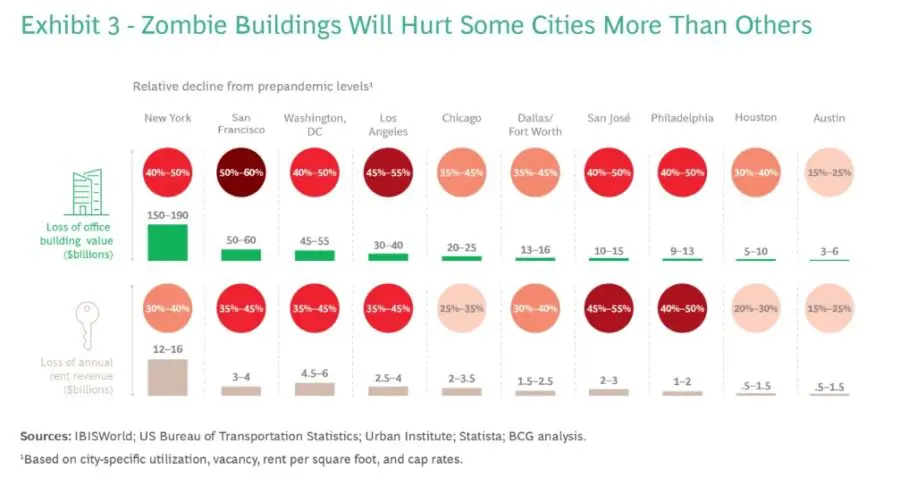
“While all cities will be impacted by this, a handful – like New York, San Francisco and Los Angeles – will feel that impact a bit more,” Ferrer told Connect CRE. “This is due to the value of real estate and the mix of jobs within these geographies, such as a higher level of tech jobs and roles.”
BCG research shows that many buildings are already in trouble. The BCG research reported that average vacancy rates are at 17%, while utilization has fallen to 42%. According to the report’s analysts, the decline is the result of “at-risk” space, or “the enormous amount of space under leases that are unlikely to be renewed.” The article indicated that 60% of office leases are scheduled to expire within the next three years.
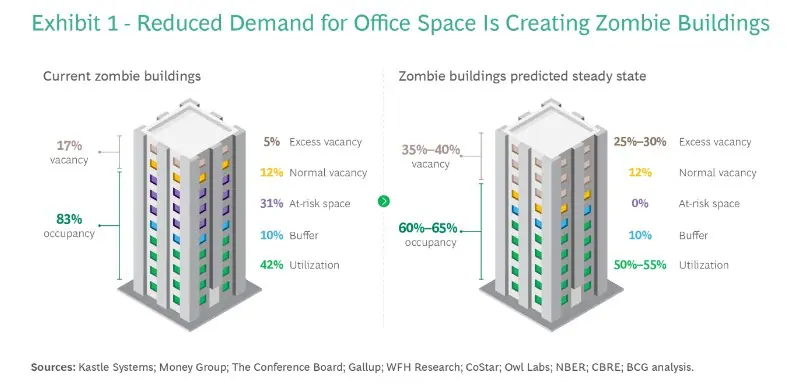
Adding to the problem are rising interest rates, creating a need to refinance. But newer debt is more expensive. The BCG article shared grim news, pointing out that a reduction in tenant demand and more scarce financing will lead to a fall in building values by about 40% from pre-pandemic levels over the next 12 to 36 months. This will also likely mean a rise in defaults.
The outlook? “There will be zombie buildings in most major office markets, but the impact will not be felt equally,” the BCG said. Cities with higher concentrations of office buildings will likely feel the pain, as will cities with economies that are friendly to remote work. The BCG analysts also indicated that the public sector won’t be unscathed, as it is anticipated to lose “property tax and public-transit revenue of $15 billion to $25 billion nationally.”
Ferrer said that action needs to be taken now to mitigate a potential zombie (building) apocalypse. “Building owners need to understand the impact of this across their portfolio, and start to take action now,” he said. “They either need to reposition buildings to attract new tenants or to re-develop for different uses.”
He went on to say that municipalities must also lend a hand by bringing in their own workers, supporting developers in repurposing buildings and ensuring safe and clean spaces.
“Ultimately, the impact of zombie buildings will need to be mitigated through a collaboration between the owners and municipalities to revitalize downtown areas,” Ferrer commented, adding that some cities, such as New York formed a task force that focuses on downtown revitalization plans.
Meanwhile, if nothing is done, “we’d expect to see a further decrease in office-building utilization and erosion of CRE office building value,” Ferrer said.
- ◦Lease
- ◦Economy


