



National CRE News In Your Inbox.
Sign up for Connect emails to stay informed with CRE stories that are 150 words or less.


Landlord-Built Office Spaces Garner Growing Interest
Once upon a time, a tenant wishing a specific style of office space would often opt for a tenant improvement allowance (TI) as part of a lease agreement. In this situation, a particular workspace would be built out based on tenant requirements.
However, the pandemic came along and upended the office sector in many ways, including the use of TIs. According to a recently released CompStak report, tenants’ workplace requirements shifted abruptly. These tenants were also more reluctant to plunge into a lengthy build-out process connected with tenant improvements. This has meant an increase in landlord-built spaces and lease transactions.
What Are Landlord-Built Spaces?
Unlike tenant improvements, in which a tenant comes in and dictates how a space should be finished out, a landlord-built space sees the building’s owner spending the money upfront and “finishing the space to different levels before signing a tenant or a tenant move-in,” Alison Baumann, CompStak’s Director of Real Estate Intelligence tells Connect CRE. “Examples of this include pre-built units, new-built installations and turnkey projects.”
The CompStak report said landlord-built spaces’ effective rent premium has experienced double-digit growth since 2018.
Who Uses It?
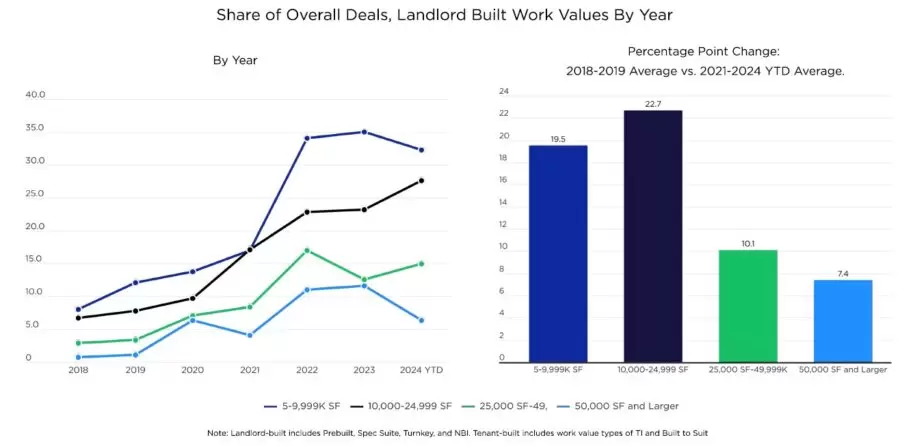
The report commented that in the past, landlord-built space attracted small businesses that operated out of smaller offices, “targeting companies seeking ready-to-use space.” However, in the post-pandemic period, landlord-built spaces have increased in transaction size, while tenant-built transaction sizes have declined.
Additionally, “the share of deals involving landlord-built spaces has increased across all transaction sizes” when comparing trends between pre- and post-COVID periods, the report said.
Why is Interest Increasing?
One reason for the increased gravitation to landlord-built space is the time factor.
“Landlord-built transactions move from lease signing to commencement about 33% faster than tenant-built deals,” the report noted. This means tenants are in their space more quickly and can start operations immediately.
Higher-quality completed spaces have been ideal for attracting “employees back to the office while aiming to minimize the lengthy delays between lease signing and move-in that typically accompany post-execution build-outs,” the report said.
Additionally, “the office market is more competitive than ever when it comes to capturing tenants,” Baumann explained. “The tenants committing to deals have less appetite when it comes to waiting for a space to be ready, not to mention increased construction costs and timelines.” She noted that landlords are pre-emptively building out more spaces to attract these tenants, and the tenants, in turn, like the idea of the completed space. “These are the deals that are being leased over others,” she added.
The report also noted a stronger correlation between lease and work values with landlord-built space, which can also be appealing to tenants.
Looking Forward
Does this mean landlord-built spaces will continue making inroads on shell construction and tenant improvements? Baumann acknowledged that the office market is still transforming and that it’s still too early to tell.
Still, “as the office market remains competitive and tenants have the advantage of choices and negotiating power, I would expect landlords may continue to offer more built, ready-to-go spaces,” she said.
Additionally, concessions—or the amount of money attributed to “work value” in an office deal—is still high, relative to pre-COVID. “This has been true for landlord-built space and TI dollars for the tenant to spend on buildout,” Baumann said. “Concessions haven’t shown signs of a decline yet.”
- ◦Lease
- ◦Development


