



California CRE News In Your Inbox.
Sign up for Connect emails to stay informed with CRE stories that are 150 words or less.
L.A.’s Westside Holds Attention of Media-Tech Convergence
By Dennis Kaiser
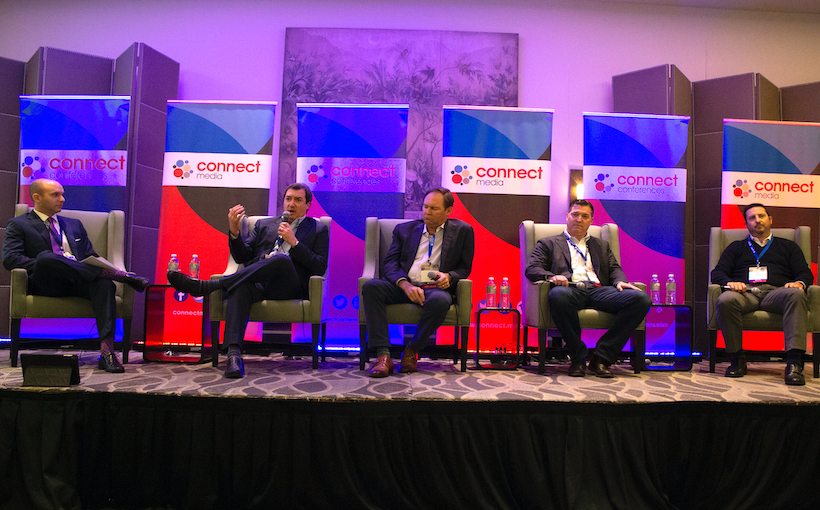
Connect Westside Los Angeles’ panel titled, Construction Town: New Projects, TOD Development, Construction Costs and More on the Westside, covered what is driving all the development activity in the market. The conference drew a crowd of more than 250 real estate professionals last week to hear from a mix of CRE leaders who discussed the biggest Westside market trends, deals and growth opportunities. The event kicked off with a 2020 forecast by CBRE’s Spencer Levy, and included panels on financing and the Westside market overview.
The Construction Town panel was moderated by Allen Matkins’ Spencer B. Kallick, and the speakers included AECOM Capital’s Ted Fentin, Artisan Realty Advisors’ Mark Laderman, Lowe’s Marty Caverly, and Hackman Capital Partner’s Mike Racine.
Once the conversation shifted away from the evolution of the Westside market beyond its traditional “West of the 405” parameters, the discussion focused on where development was occurring, such as Culver City or El Segundo, and why some cities are favored over others due to the “business-friendly” and “pro-growth” approaches they’ve adopted.
This expanded Westside market has shifted south as executives have moved to cities such as Manhattan Beach or Palos Verdes. Tenant parity has arrived on the Westside, as markets have transformed from their traditional defense contractor user bases. Areas like Culver City or El Segundo present a good value proposition, especially if a project is near public transportation and offers the right amenities to help companies compete for talent.
Hackman’s Racine noted that you don’t have to give up the “cachet” or benefits of a Los Angeles address by looking at other Westside markets. He noted they’ve experienced “30% rent growth” in El Segundo since they bought 30 acres of land in that market in 2016.
Panelists agreed development in Los Angeles requires an approach that includes patient capital, flexibility and a savvy underwriting. AECOM’s Ted Fentin said, “The process is lengthy even when you have entitlements in place.” He added development in L.A. “requires a long-term vision,” especially for “big complicated projects.”
Lowe’s Caverly agreed, noting that the length of time to get projects redone is difficult, “Our inclination is to do TOD’s like Ivy Station and keep moving east, rather than west,” he says.
Artisan’s Laderman pointed out that Santa Monica remains a particularly challenging market in which to develop. “It is a long process, and you need the right capital partner for projects in Santa Monica,” he says.
Fentin added, the lengthy process requires accounting for a host of unexpected contingencies, the need for flexible capital and a long-term view, all of which are critically important today. While Caverly pointed out rising construction costs must also be accounted for in today’s projects.
A strategy Racine favors on the Westside is to look for “properties that are cash-flowing and under-utilized.” That provides a safety valve runway, and allows them to pivot if needed while still having an asset that delivers incremental value as is. He points out adaptive reuse projects can often present hidden issues to address as they move forward, which is why having a “backstop” of cash flow helps them sleep at night. He notes the key is to be cost-efficient through the value-engineering process, but not cheap. That may encompass self-performance of some work, adjusting the line-up of general contractors or subs, or starting demo work on a project early, so the interior is opened up to uncover unforeseen issues and get ready for the next phase of re-development.
Fentin advised before the land is bought, completing as much due diligence as possible is time “well spent” because it helps to “avoid some of the pitfalls once a project goes vertical.”
The panelists agreed that Los Angeles and the Westside is expected to continue attracting companies that will need space. Artisan’s Laderman said, “people love living in L.A., it’s the weather.” He notes the convergence of media and technology will continue to drive demand and people will still want to live here. That’s not changing.”
For comments, questions or concerns, please contact Dennis Kaiser
- ◦Development
- ◦Sale/Acquisition
- ◦Lease


