



National CRE News In Your Inbox.
Sign up for Connect emails to stay informed with CRE stories that are 150 words or less.


It’s No Mistake: Apartment Space IS Shrinking
Those looking for units in newer buildings these days might find themselves eyeing less space than in previous years. This is because the average size of apartment units decreased over a 10-year period.
In spite of the pandemic-generated need for more at-home space, the average apartment size in 2022 was 887 square feet, compared to 941 square feet in 2012, according to a recently released RentCafe analysis.
RentCafe’s Adina Dragos, who authored the study, and Doug Ressler with Yardi Matrix told Connect CRE that cost-to-develop and huge housing demand are two reasons for the “shrinkflation.” “The downsizing trend was visible even before the pandemic, fueled by the need to bring more apartments on the market during one of the most construction-crazed decades in recent history,” Dragos explained.
Though pandemic-fueled demands did increase space in new apartment units for a brief time, “developers in 2022 focused more on bringing online more smaller units that would meet the demand for housing,” Dragos said.
In breaking down the average sizes by region, the RentCafe report said that apartments in the south were the largest, while those in the Pacific Northwest were the smallest. New apartments in Tallahassee, FL averaged 1,182 square feet, while new apartments in Seattle came in at 659 square feet.
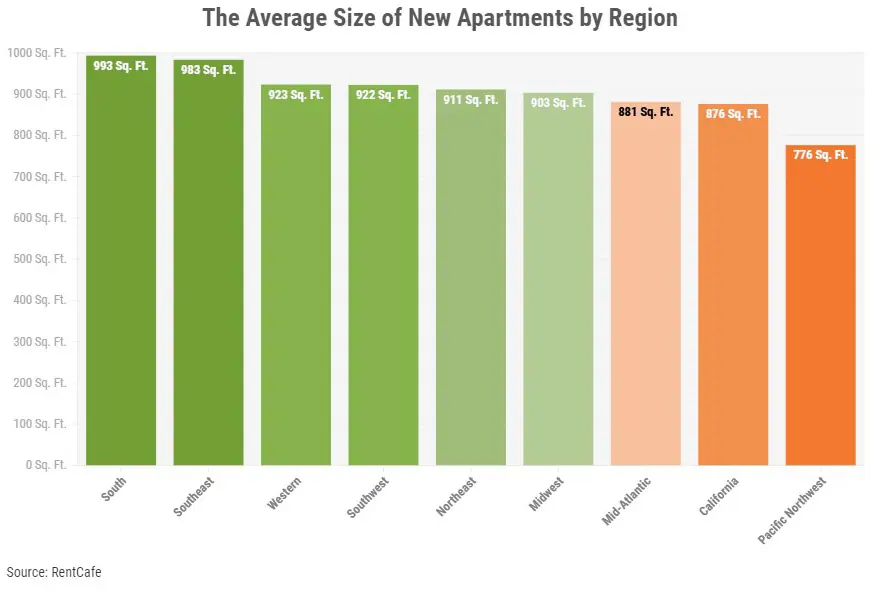
Surprisingly, the report pointed out that apartment sizes in Manhattan, San Francisco and Washington are growing. Dragos said that one possible reason for this might be due to an increase in delivery of two- and three-bedroom units in these areas. She said that many of these apartments also are defined as high-end, meaning larger unit configurations.
“At the other end of the spectrum, Seattle continued the trend of building small apartments, with a high share of studios and one-bedroom units,” Dragos added.
When asked about whether this apartment “shrinkflation” would continue, Ressler said the answer depended on multiple factors, including cost-to-develop. “In high-cost markets, building trends meet changing demographics, more than housing affordability,” he said. “This has driven the decrease in average apartment size.” On the other hand, in moderately priced markets, decreasing apartment sizes might be attributed to renters downsizing from larger homes.
“The introduction of the SFR/BTR product that accommodates larger families and has larger bedrooms will likely influence a smaller apartment trend as well,” Ressler added.
- ◦Lease
- ◦Development


