



National CRE News In Your Inbox.
Sign up for Connect emails to stay informed with CRE stories that are 150 words or less.


Is There Enough Supply for Low-Carbon Building Demand?
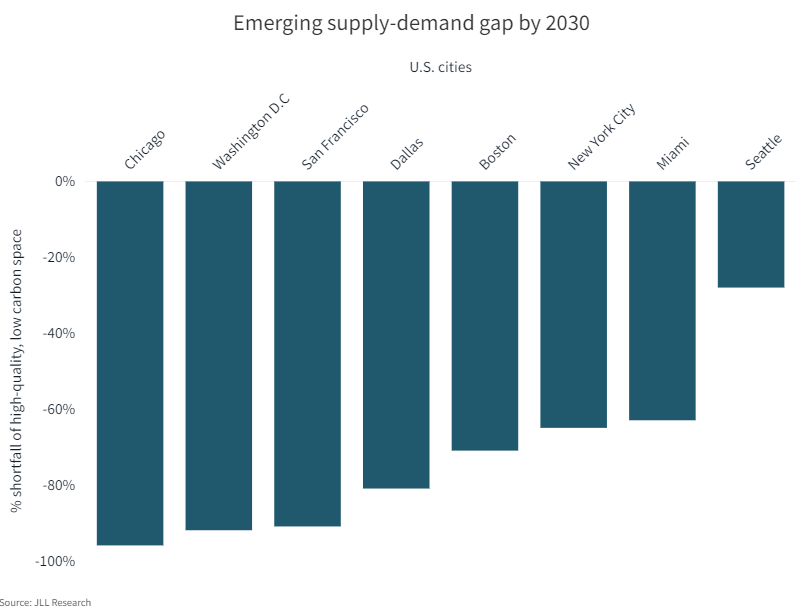
In a recent article, JLL’s Guy Grainger and Paulina Torres said that corporates demand more high-quality, low-carbon workspace. But that demand is anticipated to outstrip supply by 75% across major U.S. markets by 2030. Noted the experts: “This equates to a projected supply shortage of 57 million feet of low carbon office space in the next few years.”
Grainger and Torres pointed out that demand for energy-efficient, electrified and clean energy-powered space is growing because it is:
- Resilient to changing regulations
- Meets near-term sustainability targets
- Attractive to employees
From the supply side
The authors caution that supply and demand for energy-efficient office space vary from city to city, depending on industry, corporate space requirements and the current stock. “Washington, DC, for example, has a higher imbalance than many other cities due to the large presence of government agencies with stringent sustainability targets to hit,” Grainger and Torres explained.
Chicago doesn’t have enough supply because of a constrained development pipeline, inefficient existing stock and lack of available clean energy. New York, which is “dominated by finance and professional services firms with ambitious targets of their own,” has higher sustainability requirements. While future demand of 23.3 million square feet is forecast, the current pipeline is anticipated to deliver only 8.1 million square feet of “potentially suitable space between now and 2030,” the authors explained.
Examining demand
Grainger and Torres say that “many corporate occupiers are reassessing their office footprint with sustainability becoming top of mind” in conjunction with hybrid working arrangements, collaborative space and amenities. Decarbonizing real estate operations and leasing low-carbon spaces provide “easier wins compared to tackling Scope 3 emissions across supply chains,” the authors point out.
JLL estimates that three of every four new lease requirements across the top 100 office occupiers in major U.S. markets will require a carbon commitment between 2023 and 2030. Additionally, low-carbon buildings tend to be more efficient in terms of operations.
Improving buildings, forming partnerships
Grainger and Torres say that the supply/demand gap supports making buildings more sustainable. On the one hand, owners that retrofit or develop their buildings with low-carbon in mind “can enjoy financial benefits through higher rents, cheaper debt and the chance to attract or retain high-quality tenants,” the authors point out. On the other hand, costs of increasing regulation, combined with migration tenant demand, could diminish net operating income.
The authors explain that the supply-demand imbalance could encourage owners and tenants to collaborate on reducing building emissions and, in doing so, could “share both the costs and benefits.”
- ◦Lease
- ◦People
- ◦Policy/Gov't


