



California CRE News In Your Inbox.
Sign up for Connect emails to stay informed with CRE stories that are 150 words or less.


Investors Move Up Risk Spectrum, Though Gateway Cities Growth Present Compelling Case
By Dennis Kaiser
Connect Los Angeles is the event that helped launch Connect Media five years ago. The standing-room-only crowd of more than 500 at this year’s Connect LA conference heard a wide-ranging conversation among commercial real estate’s leaders. In addition to five deep- dive panel discussions, there were three special presentations, capped by a salute over cocktails to the latest winners of Connect Media’s Top Broker and Women in Real Estate Awards.
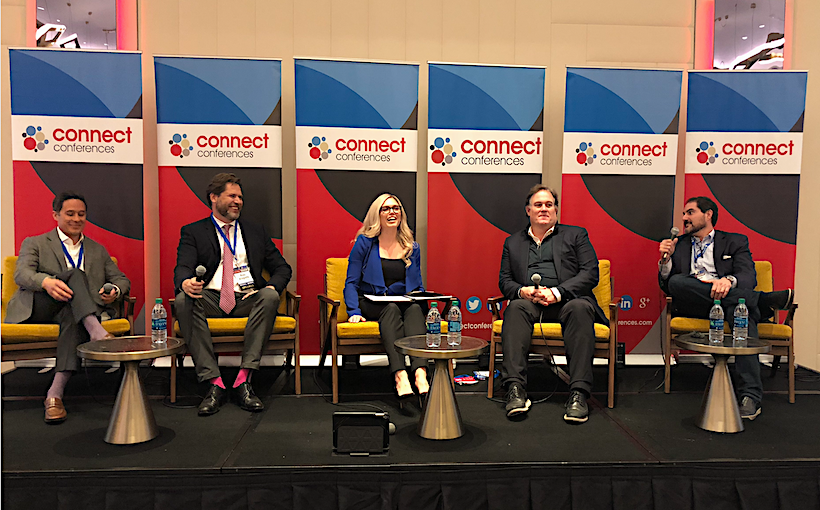
The Buy, Build, Sell, or Hold: Investment & Development Insights panel, moderated by Cushman & Wakefield’s Morgan Jackson, featured a regional view on SoCal investment, development, and asset performance from the most active players. Panelists shared their insights into the market, the factors driving redevelopment and new development opportunities, and how they are shaping their deals.
Greenoak Real Estate’s Jonathan Epstein launched the discussion by explaining what is behind a shift in asset classes for investors to a higher risk profile of value add core plus from core. “There is a consistent need for return in the world. I think as interest rates have been relatively low for a long time and will to continue to be low, I think something like two thirds of sovereign debt is still in negative yield territory, that’s been that continued push for huge amounts of capital to continuously seek higher returns.”
He pointed out that the high volume of capital coming into the system is creating an environment where the need to place capital is helping to drive up prices. Though Epstein notes, the U.S. is viewed as a market that has the capacity to absorb the volume of those capital flows.
Epstein indicated they are finding value add deals interesting, while also pursuing core plus assets, as they work to balance the risk-return of their investment portfolio. The U.S. market, as a whole, represents trillions of real estate value that presents sufficient opportunities if investors pay attention to emerging trends or areas of growth. “We can find the right spaces to invest that capital,” said Epstein.
Given that core is largely considered a fixed income alternative and in an environment of interest rate normalization, most core investors saw a continuous rise in the curve. So, for investors seeking yield, core assets have provided significant returns from appreciation, though not income. Epstein notes, now that it has stabilized, there’s little leverage remaining, thus it is pushing institutional investors with 7% to 7.75% IRR expectations up the risk spectrum. He says, “We’ve seen money move out of core, but for the most part we’ve seen new entrants coming into the market the last two years that have really looked at the value add space and less so on core plus, which we see as an opportunity because there’s been less capital raised in that space.” And when projected five years forward, the value add will be a core plus or core deal.
Rising Realty Partners’ Chris Rising notes his fundamental view is that while location is important, each building is its own micromarket and they essentially compete against two to four buildings. Knowing a building inside and out and delivering different characteristics is actually what wins lease deals, he says. Though he doesn’t believe office location decisions are “pre-baked,” in his experience as a tenant representative broker it typically comes down to a few buildings. That means landlords must focus on location to know where the “puck is going to be,” but more importantly create an office environment with unique amenities and experiences to “beat the two to three buildings we think we compete against,” says Rising.
That means adopting an approach that is centered on “impact as alpha.” Rising notes that more often today that involves tracking a buildings’ carbon footprint and working to reduce what’s produced, taking a building to LEED Platinum and creating a workplace experience where tenants feel healthy because that’s what people think about now. That is challenging when taking on a historic redevelopment, notes Rising, because they’ve had to relearn lessons with each project and there’s hurdles with the permit process this cycle.
The end result, Rising believes, is worth it because the final office product they deliver tells a story in an authentic way that appeals to the people who ultimately work in the building. “What we are able to do with these historic buildings is give someone that sense of history, that sense of place within a 21stcentury infrastructure,” says Rising. “I think that’s really appealing to tenants today.”
To create that experience for tenants, Ocean West’s Russ Allegrette says it requires a close examination of the market and the tenant requirements. “There are certain bones and qualities we look at, like natural light, common areas for people to gather, and the path of travel,” he said. That means looking at the areas where people arrive at the property, go through the lobby and get to their space.
Tenants on L.A.’s Westside have typically been creative or tech companies, he notes. The approach is to either deliver a work environment to the tenant’s specifications, which could be extravagant in pre-leased situations. Or in other cases, Allegrette says, landlords must closely look at how to create a comfortable environment that meets a tenant’s needs from a technology infrastructure perspective, without going over the top.
For Ocean West, that typically involves making sure it is a place where people will want to spend considerable amounts of time. That’s why he says they incorporate indoor and outdoor gathering places, as well as borrow ideas from the hotel and residential sectors.
Pimco’s Christopher Flick notes one of the reasons Los Angeles is attractive is demand. He pointed out that tech is the leading job driver on the Westside. In combination with the quest for talent in a tight labor market, it has tightened real estate market conditions. Nearly all available sites have been snapped up, and the Westside is largely at full build-out. “The companies that can afford to pay the most are here and are they’re going to stay here, and they are probably going to keep growing if they can,” says Flick.
What makes markets appealing to Allegrette are three primary components. The educational capital being produced by a market’s research institutions and universities; its healthcare system, and the transportation infrastructure to support job growth. Those help predict future growth, he notes. For the value add deals they pursue, they look to be ahead of where a market will eventually be because if it has already experienced revitalization a “main and main” location deal is actually a core deal. “It’s [being] more focused on that, and thinking about the long-term 20- to 30-year trends and finding the short-term opportunities that are three to 10-year kind of opportunities,” says Allegrette.
Offshore investors tend to find gateway U.S. markets appealing, notes Allegrette, who points out it is more difficult to get that investor interested in deals that are not in prominent markets like Los Angeles, San Francisco, Washington, D.C., Boston, Seattle and New York. Those foreign investment decisions can largely be driven by their country’s government regulations, their economic conditions and the need to hedge currency.
Panelists expressed a wary eye to co-working companies, though WeWork may have achieved a “too-big-to-fail” status. While they agreed it has provided an appealing option in a sharing economy and may add value to a building, there is caution about the model should the current economic and real estate cycles shift downward.
The consensus among speakers is that the economy continues to clip along at a good pace, and debt is not rising out of control by companies in gateway markets. In fact, Epstein noted the Bay Area and other gateway markets are expected to continue growing as a result of significant repatriation of capital by giant tech companies who “are carrying huge cash balances.” He notes, that has driven growth recently, and the “knock-on effect” is expected to continue doing so going forward.
Epstein says that’s one reason gateway cities are attractive now. He notes they continue think about cash flow and are taking less residual risk now. But they are continuing to look at gateway cities, despite their relative high-expense, as a good long-term strategy. “They’re the most defensive in a downturn, they recover the quickest in an up-turn, and if the market continues, they out-perform most other markets,” says Epstein.
For comments, questions or concerns, please contact Dennis Kaiser
- ◦Development
- ◦Sale/Acquisition


