



National CRE News In Your Inbox.
Sign up for Connect emails to stay informed with CRE stories that are 150 words or less.


Intrastate Capital: Where It’s Going and Why
Not so long ago, many real estate investors funneled capital into projects located in their regions or states. But that trend is shifting. According to John Chang with Marcus & Millichap, capital has been migrating across state more frequently since the onset of the COVID-19 pandemic.
A recently released video entitled “What Capital Migration Trends Mean for CRE,” Chang said that before the pandemic (Q1 2022), 53% of total commercial real estate volume headed to secondary and tertiary markets, a notable increase from 2011, when 47% of that dollar volume was allocated to smaller cities.
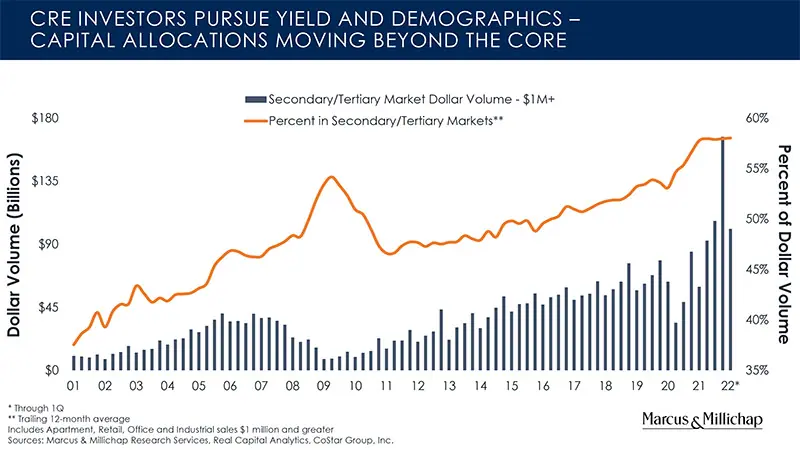
“Over the last two and a half years, the share of investment dollar volume going into secondary and tertiary market has climbed by 58%, the largest share on record,” added Chang, who serves as Marcus & Millichap’s Senior Vice President, National Director, Research and Advisory Services.
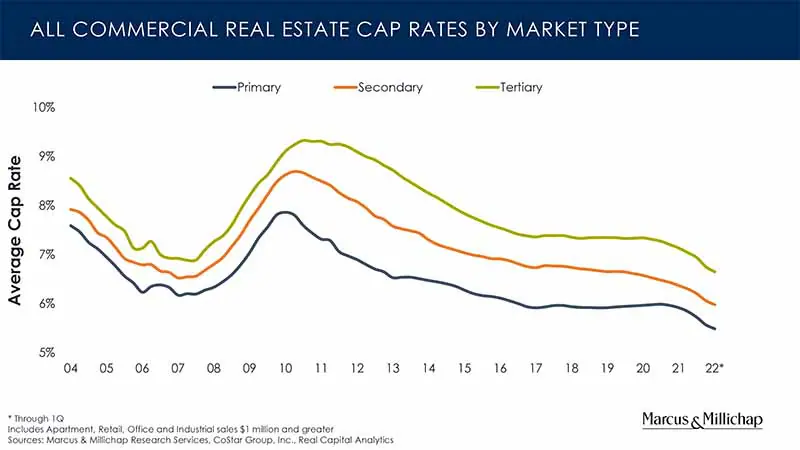
As a result, the influx of capital is compressing yield which, in turn, is “reducing the yield premium offered by secondary and tertiary markets, relative to primary markets,” Chang commented. “Cap rates in tertiary markets are just now 1.1% higher than that in primary markets, the tightest spread since 2021.”
Based on Marcus & Millichap sales trends, Texas experienced the highest increase of inbound capital within the past 12 months, while California stood as the dominant source of exported capital. The northeast also facilitated a great deal of outbound capital, led by New York State, Chang said.
While the statistics focused did focus on Marcus & Millichap’s transactions, “the influx of capital movement is telling,” Chang said. “It suggests increased interstate competition for local properties.”
He explained that investors select out-of-state commercial real estate for various reasons like diversification, tax policies, retirement strategies, market dynamics – or simply because they like a particular asset.
For example, “an investor planning to relocate to Florida from New York may have significant state income considerations,” Chang pointed out. “By selling investment properties in New York and acquiring properties in Florida, Texas or other states with low or no state income taxes, the investor may be able to generate a stronger after-tax yield.” Chang went on to say that the investor might be happy to pay a premium for that property, “because state taxes could mitigate some of the yield differential.” Or an investor could sell property with a 3% or 4% cap rate in California and buy a property with a six-cap rate in another state, leading to a cash flow increase.
“It appears that a lot more investors are looking at a bigger range of investment opportunities beyond their own backyards,” Chang commented. “They’re becoming more active in other states as a way to diversify and maximize returns.”
- ◦Sale/Acquisition
- ◦Financing
- ◦Economy


