



National CRE News In Your Inbox.
Sign up for Connect emails to stay informed with CRE stories that are 150 words or less.

Industrial Q1: Supply-Demand Gap Narrows
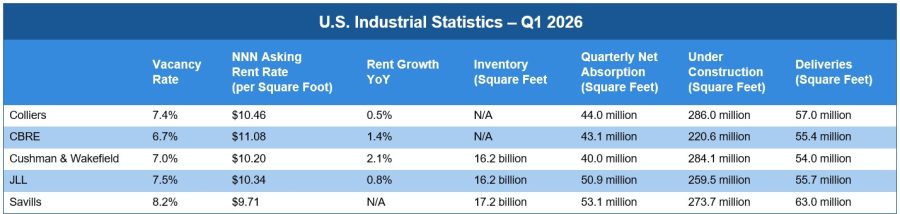
According to the Q1 U.S. industrial real estate reports, the sector experienced robust absorption for the first time in years as “strong leasing momentum continues, leading to the strongest Q1 in years,” according to Savills’ “State of the U.S. industrial Market” report.
Colliers’ “U.S. Industrial Market Statistics” write-up noted that user demand and new supply were very much aligned. CBRE’s “U.S. Industrial Figures” report indicated the gap narrowing between completions and absorptions, “pointing to a more balanced market.”
The above, “combined with the lowest quarterly delivery volume since Q2 2017, signals the market’s transition from an oversupplied environment,” according to JLL’s “Industrial Market Dynamics” report.
So, Who’s Leasing?
The reports were unanimous in that:
- Flight to quality reigned. Cushman & Wakefield’s MarketBeat report said that modern spaces were in demand “as occupiers prioritize automation-ready facilities with higher power capacity.”
- 3PL providers led the charge. “Given the supply chain shocks experienced over the last five years, 3PLs have become essential partners, offering the flexibility and expertise that retailers and manufacturers need to navigate volatility,” according to JLL’s researchers.
- Larger users are returning. “Bulk leasing increased, reflecting stronger demand by large suppliers of 100,000 square feet-plus,” CBRE noted. Savill’s analysts agreed, commenting that “large-block leasing surged back after a two-year retreat.”
Is Spec Coming Back?
Another issue the reports agreed on was that build-to-suit and owner-used projects were the main drivers of the development pipeline.
“New construction remains largely concentrated in build-to-suit projects and those with tenant pre-commitments, signaling a focus on risk mitigation by developers,” CBRE’s analysts observed.
Furthermore, “development remains disciplined, with BTS projects accounting for 40% of space underway and supporting longer-term industrial growth,” the Cushman & Wakefield researchers said.
But don’t count out speculative development, which seems to be making a small comeback. Cushman & Wakefield reported that approximately 73% of deliveries in Q1 were speculative, an increase from 71% in 2025.
Looking Forward
Geopolitical tensions, rising oil prices and economic volatility continue generating uncertainty across all commercial real estate sectors. This isn’t likely to change.
In the industrial sector, the current environment has made decision-making more difficult for occupiers, leading some to delay expansion plans or negotiate shorter-term leases.
The pressures are also changing supply chain strategies, as “companies are increasingly prioritizing domestic manufacturing capacity and regional distribution networks to reduce exposure to volatile shipping costs and geopolitical risk,” JLL researchers noted.
The supply-demand gap should continue with “limited supply and steady occupier demand expected to push vacancy moderately lower this year, particularly in more balanced markets,” Colliers analysts said. Cushman & Wakefield researchers agreed, forecasting that continued tight conditions, combined with new logistics product deliveries, could trigger a recompression of vacancy.
While completions “should remain modest through 2026, renewed groundbreakings in markets with healthy demand lifted the national development pipeline for a third straight quarter,” the Cushman & Wakefield analysts added.
- ◦Lease
- ◦Development
- ◦Economy


