



Chicago & Midwest CRE News In Your Inbox.
Sign up for Connect emails to stay informed with CRE stories that are 150 words or less.


Industrial Earns Favored Asset Class Status
By Dennis Kaiser
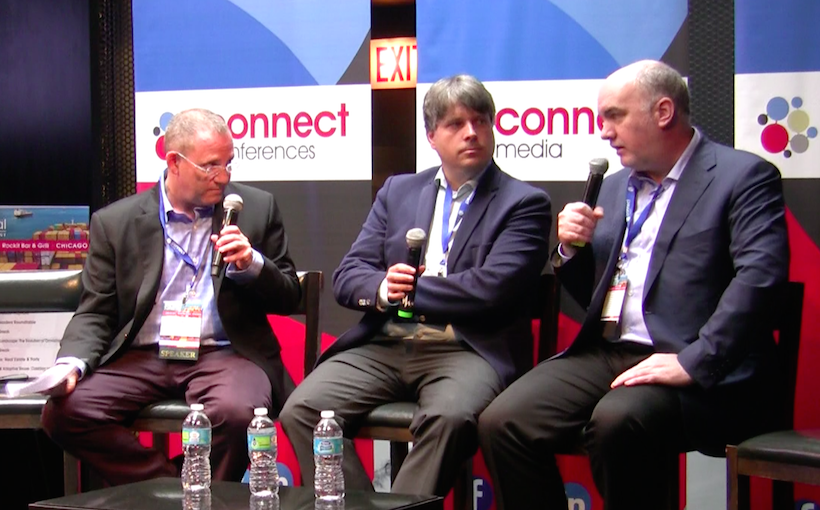
Connect Industrial’s inaugural conference in Chicago on June 28th included an Economic Forecast keynote discussion between CoStar’s Rene Circ and Real Capital Analytics’ Jim Costello that was moderated by NKF’s Geoffrey Kasselman. The primary focus of the conversation hinged on the fact that industrial has emerged as a favored asset class for investors, and what lies ahead for the sector.
NKF’s Kasselman reported that the numbers point to the U.S. being “on the verge of its second longest post-war recovery,” with a chance that it could it become the longest. He says there’s been 10 consecutive quarters above 50 million square feet of industrial net absorption, the vacancy rate has slid to a 30-year low at 5.4%, and rents are solid, gaining 7.1% year-over-year, which has remained consistent since Q2 2017, and is perhaps accelerating.
Those performance stats reflect the fact that industrial has emerged as a prime player, but the reasons driving the trend reveal why. Real Capital Analytics’ Costello noted that “industrial is just a more stable performer.” Since industrial doesn’t experience the “high highs or low lows, in terms of price swings, as other property types, for a lot of institutional money, they love that. They love [industrial’s] low volatility and the fact that they can count on stability and returns,” said Costello.
CoStar’s Circ points out that the industrial asset class is “a newcomer to the game,” though it is gaining more and more notice among “institutional investors that are under allocated to industrial.” He says, “portfolio right-sizing” has emerged as “one of the drivers” for industrial, since there are only a few investors who are over allocated to industrial.
International money is also becoming a more significant player in the industrial sector. Circ noted that activity involves “big trades” or portfolios that are being acquired with foreign money. That’s the “primary difference in the capital cycle” in this market. Since institutional investors and foreign capital doesn’t write small checks, they initially focused on assets such as office. That’s changed as industrial “portfolios now are center stage and that’s unprecedented, with big names from foreign markets, and a lot of pension funds investing in this sector,” says Circ, whether by direct investment or by backing industrial developers or projects.
Costello also added, “The other thing going for industrial is that even though we’re pretty far into the cycle, the yield you get on an investment in an industrial property is on average higher than most other property types.” Costello notes the stability and yield compared to other property types “is making industrial attractive.”
Compared to more expensive and higher volatile asset classes, industrial stands out, even this late in the game. Overall deal volume has started to fall a bit, notes Costello. Yet industrial deal volume in May was up 23%, roughly the same pace as last year, while other asset classes are as much as 30% lower.
Cap rates are compressing worldwide, says Costello. “Investors have not seen rates this low in virtually every city. Global convergence of property performance, with money flowing around the world, has helped make that compression.” He notes the components driving low cap rates are different than previous cycles though. “The spreads are narrow, but what’s different is safety in what people are buying. There’s more equity in the game today,” said Costello.
One of the challenges facing industrial investors, notes Circ, is the fact that it is tougher to find assets to buy today. “No one wants to sell,” he says, because “if they sell today, they have to move up the risk spectrum, or potentially buy a more expensive asset than they sold, which is not accretive.”
NKF’s Kasselman predicts there will be challenges in Q4 2018. He believes once the country moves past the “chaos of the mid-term elections, the cost of capital will inch up, there will be fewer sources of capital and it will cost more, while much of the demand that’s driving the market now will have been addressed.”
Costello agrees that 2018 could get ugly. “It may be a good time to take a vacation,” he said.
For comments, questions or concerns, please contact Dennis Kaiser
- ◦Development

