



National CRE News In Your Inbox.
Sign up for Connect emails to stay informed with CRE stories that are 150 words or less.

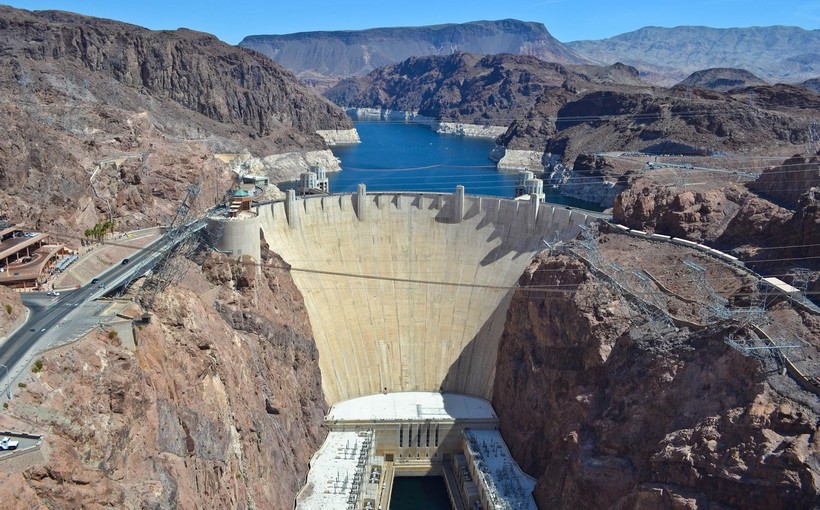

Hoover Dam’s “Once in a Century Moment” for Energy Storage
Hoover Dam, generally regarded as one of the last century’s engineering marvels, was built to provide hydroelectric power. Now the Los Angeles Department of Water and Power wants to make the dam function as a kind of auxiliary battery as well.
The department’s proposal calls for equipping Hoover Dam with a $3-billion pipeline and pump station that would be powered by solar and wind energy. The pump station would help regulate the water flow through the dam’s generators, sending water back to the top to help manage electricity at times of peak demand, the New York Times reported.
The result would be a kind of energy storage capacity for the dam, a function that has been discussed informally over the past 15 years. Now, the Times reported, it’s gaining traction as California weighs how to better manage its alternative-energy production, which has reached such high volume that the Golden State sometimes pays other states to take excess electricity in order to avoid overloading its own grid.
Such storage capacity is being compared to the giant lithium-ion batteries produced by companies like Tesla and used by some utilities. One advantage the Hoover Dam scenario would have is cost savings: 15 cents per kilowatt-hour for a pumped-storage hydroelectric project, compared to 26 cents per hour for a utility-scale lithium-ion battery.
A 2028 completion date is being targeted, and some proponents say the proposal could encourage innovation at other dams. “I think we have to look at this as a once-in-a-century moment,” said L.A. Mayor Eric M. Garcetti. “So far, it looks really possible. It looks sustainable, and it looks clean.”
Nonetheless, political and environmental hurdles need to be surmounted. “Any idea like this has to pass much more than engineering feasibility,” Peter Gleick, a co-founder of the Pacific Institute, a think tank in Oakland, CA and a member of the National Academy of Sciences, told the Times. “It has to be environmentally, politically and economically vetted, and that’s likely to prove to be the real problem.”
For comments, questions or concerns, please contact Paul Bubny
- ◦Economy


