



National CRE News In Your Inbox.
Sign up for Connect emails to stay informed with CRE stories that are 150 words or less.


Fundamentals Continue Hammering the Office Sector
The office sector can’t seem to catch a break. During Q4 2022, the news was a “give-back” of space, resulting in an increase in office sublet availability. Fast-forwarding three months, “mounting financial services disruption, highlighted by the collapse of Silicon Valley Bank and several other banking acquisitions, contributed to a temporary pullback in office demand,” noted Avison Young’s Q1 2023 Office Market Report.
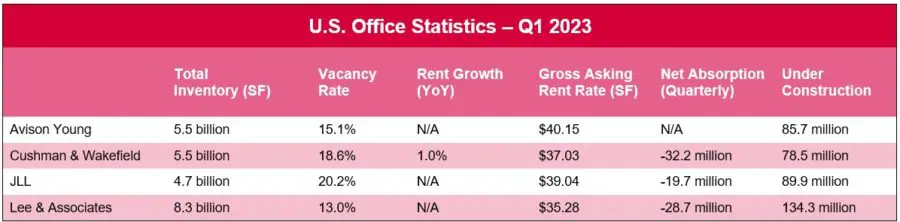
Additionally, just like Q4 2022, space givebacks continue. According to Lee & Associates’ Q1 2023 Office Overview, “Corporate users have been reducing office footprints, adding to available inventory.” Additionally, “Occupiers have growth cautious, looking for cost-cutting opportunities,” said Cushman & Wakefield’s U.S. National Office MarketBeat Q1 2023. “This is beginning to play out in the labor market, as layoff and hiring freeze announcements have grown, and office-using employment growth has cooled.
JLL’s Q1 2023 Office Outlook explained that the decline in leasing was caused by three additional factors: corrections among key growth industries, large-scale activity delays and a “diminished pipeline of new requirements as tenants exercise caution.” Then there were the broader fundamentals of “inflationary pressures, increased interest rates, tight labor markets and economic uncertainty,” Lee & Associates analysts said.
On top of this, all analysts pointed to the bank failures as a cause for concern, especially when it comes to available capital. This, along with higher costs of labor and general uncertainty is also impacting office construction.
Debt maturities also topped the list of concerns. “Continued office foreclosures, especially on properties with fixed-rate loans originated before 2021, are expected near term. This could include dispositions by institutional landlords with assets in gateway markets,” Avison Young analysts commented. What might save the current situation is conservative lending standards. However, “the impact of rapid interest-rate increases may nullify much of the risk mitigation that has taken place,” JLL analysts commented.
When it came to the outlook, Avison Young believes leasing activity will increase in the remainder of 2023, but still won’t reach pre-pandemic levels. JLL noted that even with employer cost-cutting measures, “relatively stable employee headcounts may necessitate renewed expansion for companies that find themselves with a shortage of space or insufficient space to expand.”
Moving even forward into the future, Cushman & Wakefield analysts anticipate that vacancies should stabilize in 2024, though this depends on job recovery; markets with a faster recovery will see positive absorption that much more quickly. Additionally, declining construction should help “rebalance the supply-demand relationship as sublease and vacancy levels peak,” JLL analysts pointed out.
- ◦Lease
- ◦Financing
- ◦Economy


