



California CRE News In Your Inbox.
Sign up for Connect emails to stay informed with CRE stories that are 150 words or less.
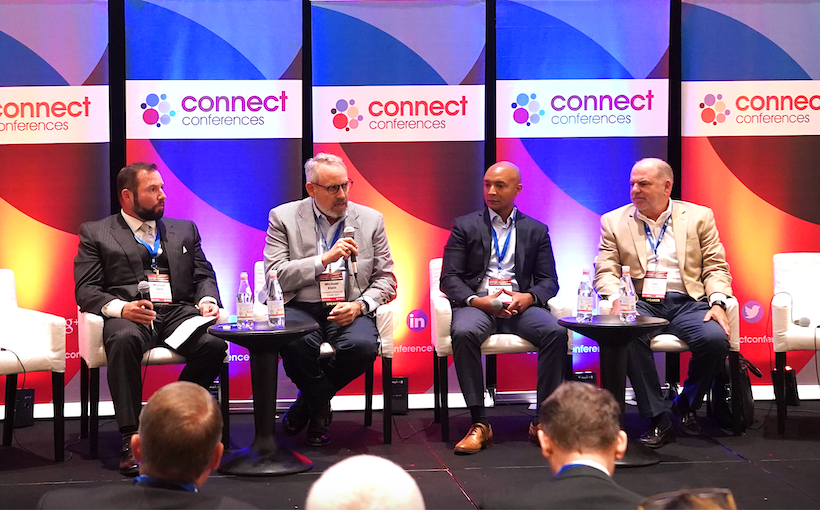

Financing Today’s Deals: Plenty of Runway but Preparing for a Downturn
By Dennis Kaiser
A standing-room crowd of nearly 500 commercial real estate leaders gathered last week at The Resort at Pelican Hill in Newport Coast for the annual Connect Orange County conference. The afternoon featured a keynote address by KBS Realty Advisors Chuck Schreiber (watch the video here), as well as three deep-dive panel discussions.
Capital plays vital role today for commercial real estate dealmakers, which is why a panel titled Financing Today’s Deals was a perfect conversation to launch an afternoon of panel discussions and networking at Connect Orange County. Investors and lenders focused on what deals are getting done in Orange County, where capital is looking and where the market is headed.
The discussion started with Marcus & Millichap Capital Corporation’s Michael Derk (moderator) saying, “Talking about financing, I think the time couldn’t be better. The market shift that most of us in this room have seen over the last 30-60 days of the 10-year Treasury moving about 60 basis points has really jolted market in a very big way, mostly very positive.”
Derk says, “As far as financing goes right now, the deals are making a lot of sense from our perspective inside a large investment brokerage. We have not seen prices actually go up yet, so I think investors are really coming to take advantage of the situation in the market.”
He also noted the agencies, Fannie and Freddie, have hit a wall early in year, and that’s raised some big questions that the CRE industry needs to work around. He says, “We are starting to see lenders set artificial floors on deals today and taking advantage of higher yield.” And while it is a great time for lenders to earn additional money, agencies “hitting their budget very early in year” is having a very big impact on multifamily.
Red Mortgage Capital’s Don N. Frankman, who works with the agencies and balance sheet financing for multifamily, noted most know the agencies are under conservatorship by the U.S. government. The annual loan limits have been set at $35 billion combined and they are on pace to exceed those. He notes, 10 years ago Freddie and Fannie were the only lenders, but now there are others that have stepped in to fill demand. Frankman pointed out the condition being felt now is a “blip” because it is considered a partial slowdown. In November, they expect the caps to be rescinded and the artificial rate increases that have been imposed won’t be present in 2020 allocations.
Chase’s Kevin Pleasantsays they focus on financing for investors on stabilized properties in infill locations. He notes, multifamily is considered risk free or a more riskless asset type so that’s allowed for the bank to have a greater appetite for MF among the CRE asset classes. He noted there are some soft floors on the commercial side, but he’s not seeing the bank impose them on multifamily. Their advice is to take a long-term view because that will help borrowers weather any type of market.
Freedom Financial Funds, LLC’s Michael Kleinis a debt REIT focused on Build-to-Suit financing, and structured deals. Klein stays they stay away from retail, especially big box mainly because they don’t have confidence in the long-term viability of the types of tenants filling those spaces now. They tend to do renovations of multifamily, but not ground up apartment development. That’s because the proformas they are seeing on those development deals envision perfection and leave little room for error. That means, “If everything goes right they are building to about a 75 bps spread to very optimistic cap rates,” Klein said. “I’m not sure why anybody would put their equity capital let alone our debt capital at risk in those deals. That’s been a challenge.”
Derk notes they are doing multifamily repositioning deals where a client buys a C or D asset and investing $15,000 to $30,000 per unit to get the rents. Since the vacancy rate in the market is nil, they are getting the returns they seek and the financing correlates into that.
Frankman is seeing appraisals come in short though in some markets. They must justify high end rents and determine if they are sustainable. They are already seeing the bubble burst in San Francisco and other high-end areas due to the market not demonstrating that high end rents are sustainable on a long-term basis. With regard to the green lending programs the agencies created, Frankman says they see “no change for the moment.”
The bulk of what Klein is seeing are transitional or value add deals i.e. via a repositioning or reconstruction or new construction. The spreads between what people are developing to keeps getting lower in relation to the exit cap rates. That spread has contracted. Borrowers from a few years ago with a 200-basis point spread deal is now coming to them with deals that have 140-150 bps spreads.
Klein says what they are paying close attention to with regard to Interest Only (IO) deals is managing risk since a couple point change from 5% to 7% may require a landlord to do concessions and that “narrowing of the margin” creates a situation where everything has to be “perfect.”
Pleasant says, Chase has elected not to do IO through full term. The bank offers it but does it less than others mainly because it is a personal bank preference more aligned with balloon risk. He noted the market fundamentals are “still relatively strong” which indicates there may be “more room to run.” Chase is preparing for a turn of some sort though, and that’s how they are positioning themselves and having conversations with clients about, since it is unlikely the bull market will be able to sustain that level.
Frankman echoed Pleasant’s view, noting that the treasury is at the lowest it’s been the last 10 years, and only twice has it been this low. So that indicates, ultimately it will go up, he says. Though he’s not sure how or when it will rise. Rates historically are going to continue to be favorably for CRE, he believes, but heading into election year and year after that, there could be a transition.
Klein and Pleasant noted they are seeing diversification strategies emerging in the market at this time in the cycle. That may involve expanding into a different market or kicking the tires on a new asset class. Klein, who is relocating to Arizona, believes in having a boots-on-the ground perspective to ensure not to make bad investments. Though Pleasant says, Chase intends to remain “Dedicated and disciplined in what we know works,” which is infill properties on the West Coast.
The conversation concluded with Derk noting there is plenty of capital available, though it may be shifting from the agency lenders to other options. He cited a deal they just closed in Irvine that would have gone to an agency lender but smoothly transitioned to a CMBS lender.
For comments, questions or concerns, please contact Dennis Kaiser
- ◦Financing
- ◦Development
- ◦Sale/Acquisition


