



California CRE News In Your Inbox.
Sign up for Connect emails to stay informed with CRE stories that are 150 words or less.
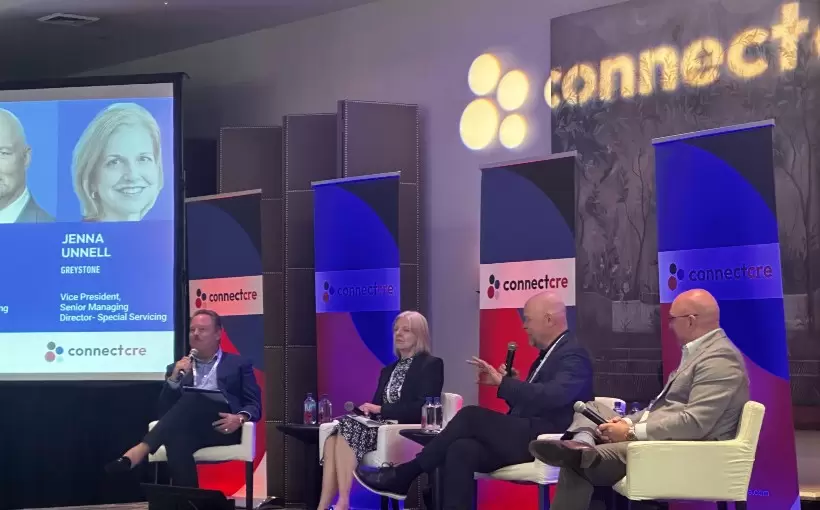

Experts: CRE Distress is Just Getting Started
Notwithstanding some recent high-profile return-to-office edicts by major occupiers, the office sector continues to be the biggest contributor to monthly increases in distress metrics. And as the experts brought together for the “Distressed Property Outlook: The First Inning” panel made clear, the cycle is just getting started.
“I don’t know that the flood’s hit yet,” said Curt Spaugh, director, special servicing in response to an audience question at the in-person Connect Distressed Investment & Finance event, held Oct. 22 at the Luxe Sunset Boulevard Hotel in Los Angeles. “I know that for us, we haven’t liquidated a lot of inventory yet.” However, he continued, citing SASB and conduit CMBS along with CBD office properties, “you’ll see more of that in ‘25 and ‘26.”
However, the panelists made it clear that there’s enough distressed activity at present to identify trends. Looking at office properties in Greystone’s special servicing portfolio, “The recurring theme there is that these are defaulting primarily at maturity,” said Jenna Unell, VP/senior managing director—special servicing. “There is little liquidity for office right now. So finding refinancing opportunities or some other type of transaction to pay off a loan is typically where we are seeing the distress.”
Mitchell Hunter, chief commercial officer with Trimont, described his company’s current workload. “We’ve probably got about 12 or 15 [properties] that are currently in the foreclosure process that we hope to have title to by the end of the year,” he said. “And that’s all office product.”
That being the case, the discussion covered the spectrum of major property types. “When I’m giving these numbers, I want to give you the other side,” said moderator Steve Pumper, executive managing partner with Transwestern. “So if I’m telling you 12.58% is going into special servicing for office, that means that 87% isn’t.” Retail isn’t far behind in terms of special servicing percentage, and both lodging and multifamily owners and developers are experiencing financial challenges as well.
In most U.S. apartment markets, rental rates are down 2% or 3%, Pumper pointed out. “Their occupancy, which used to be 92% or 93%, is dropping to 80 or 89. And concessions are coming back, in some cases as much as two to three months of a one-year lease.”
Inventories of new apartment deliveries can also pose a problem, notably in the Sun Belt states. “All the places you want to own are getting overbuilt,” said Pumper.
Spaugh drew a parallel between office owners that have staked a claim in the current market and retail landlords that have overcome the risk of obsolescence. “The [office] owners that got ahead of it were the ones that made their amenities better,” he said. “You take that lobby, you make it something nice. You put in a brewpub or something for the young people. Same with retail: the ones that have gotten ahead of it and have adjusted to the times are going to do better. And not everybody’s done that.”
On the hotel side, Unell said, “We have a good number of hospitality assets in our portfolio and it’s a little bit of a mixed bag. On the ones that have come in in the last 24 months, we’ve had some good resolutions on a few of them.
“But we have a couple that were really struggling,” she continued. “Those are going to end up being pretty big losses and they’re CBD hotels. That’s where the problem areas are.”
The afternoon-long event also presented discussions on Fannie Mae and Freddie Mac, opportunistic capital and the current investment sales market. Check back later this week for more coverage.
- ◦Sale/Acquisition
- ◦Financing
- ◦People

