



National CRE News In Your Inbox.
Sign up for Connect emails to stay informed with CRE stories that are 150 words or less.

Delving more Deeply into Global Climate Change
There are better ways to regard climate change and its related dangers than one-size-fits-all. Unfortunately, risk mitigation tends to focus on one-size-fits-all solutions when discussing the topic.
Cushman & Wakefield’s “Climate Risk—Global Cities Outlook” examines weather and other issues arising from global warming, including hazards and mitigation strategies for 100 global cities.
The Risks of Climate Change
The commercial real estate industry (and others) are already familiar with many of the risks of ever-growing climate change. Those unaware of these risks should look at the headlines from the past week discussing the dangerous impacts of Typhoon Krathon in Taiwan and Hurricane/Tropical Storm Helene in the southeastern United States. These two recent storms don’t consider other hazards, like droughts and wildfires.
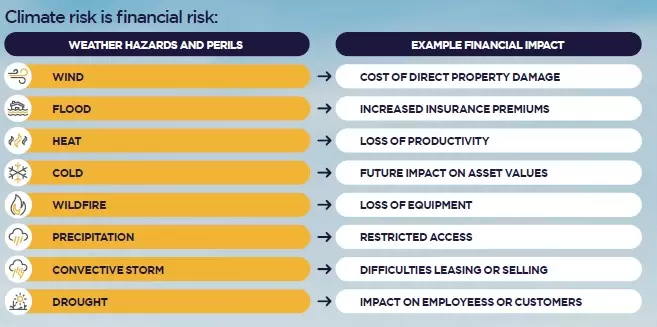
In addition to destroying life and property, the report commented that climate change risks have increased insurance premiums, productivity loss and “future impact on asset values.” From a CRE perspective, the impacts could also lead to “more circumspect tenant or investor demand.”
Not All Risks Are Created Equal
An essential takeaway from the report is that “for acute events, the geographic distribution of hazard exposure is much more varied, particularly in cases of flooding.” The report explained that cities on major waterways or coastal areas are more prone to flooding. However, Tropical Storm Helene’s flooding all but destroyed Ashville, NC, which is far inland from the coast.
For communities subject to flooding, flood management measures—dams, sea walls, wetlands and overflow canals—can help reduce risk. However, getting back to Helene, the report acknowledged that cities with infrequent occurrences (Ashville) “may lack the same protections, leading to more significant and longer-lasting impacts.”
While all cities could experience changes in climate-related hazard exposures, here’s how the report broke them out:
- Cold: Cities with low cold exposure aren’t likely to experience any change, while those with cold days will likely experience fewer. However, the report commented, “All cities will become hotter but from differing starting points. “
- Flood: Just about all cities could experience a greater flood risk. While locations that currently experience significant flooding might not see much change, “an area previously unaffected by flooding that suddenly becomes exposed may face more severe impacts due to lower preparedness and protection.”
- Wildfire/precipitation: More cities are anticipated to experience higher drought, leading to a potential uptick in wildfires and more frequent storm events. Southern Europe is experiencing more heat exposure and could become more susceptible to drought and wildfire risk. The report also said that more frequent storm events are anticipated in Asia Pacific.
The Good News?
While climate-change-related hazards are highly concerning, Cushman & Wakefield analysts did list some silver linings in the dark clouds. For one thing, the report explained that not all risk exposure is necessarily catastrophic. “Most of the 100 cities we looked at have numerous mitigation and adaptation measures in place,” analysts explained. Moreover, many cities already have mitigation strategies in place.
Still, the report suggested that climate-related risks be taken seriously, not so much in terms of catastrophic events, but an understanding of “the level and type of hazards your asset or portfolio is exposed to and the potential impacts.”
The specific suggestions for real estate owners and investors are to:
- Conduct a detailed asset and portfolio risk assessment
- Gain an understanding of government-led mitigation measures
- Identify highest-risk issues and assets
- Make operational changes and capital upgrades on real estate
- ◦Development
- ◦Policy/Gov't


