



New York & Tri-State CRE News In Your Inbox.
Sign up for Connect emails to stay informed with CRE stories that are 150 words or less.

Connect New York: Disruptors and Employment Gains Drive NYC Office
The office market in New York is being driven by disruptors, including the advent of co-working firms and the expectations of tenants, said panelists at the recent Connect New York. However, it’s also being driven by employment gains, and plenty of them.
Between 2008 and 2018, “we added the entire city of San Francisco in New York” in terms of new jobs, said Andrew Levin, SVP of leasing at Boston Properties. A good number of those new positions have come from the tech sector, as the city’s economy diversifies away from its traditional financial services base.
With the influx of tech tenants has come a workforce who have taken the driver’s seat when it comes to decisions about where to locate. Bruce Mosler, Cushman & Wakfield’s chairman of global brokerage, noted that whereas tenants once based their leasing decisions on the CEO’s convenience, now their priority is attracting and retaining workers.
“In the war for talent, location matters,” said Mosler.
Tech tenants have also influenced tenants’ expectations for amenities—and not only in the tech sector, said SVP Carolyn Pianin of Arcturus. Food and beverage, fitness centers and other one-time perks are now musts, regardless of whether the office worker is a programmer or an attorney.
That amenitization mindset now begins as soon as the tenant, or visitor, walks through the front door of the building. Kate Hemmerdinger Goodman, co-president of ATCO Properties, recalled that the lobby was once a place that people passed through, and the goal of building management was to get those people through the lobby as quickly as possible.
Today, she said, the lobby is a hangout, and building owners might encourage people to stay awhile through electronic signs and other attractions. “It’s really an extension of the building,” said Goodman.
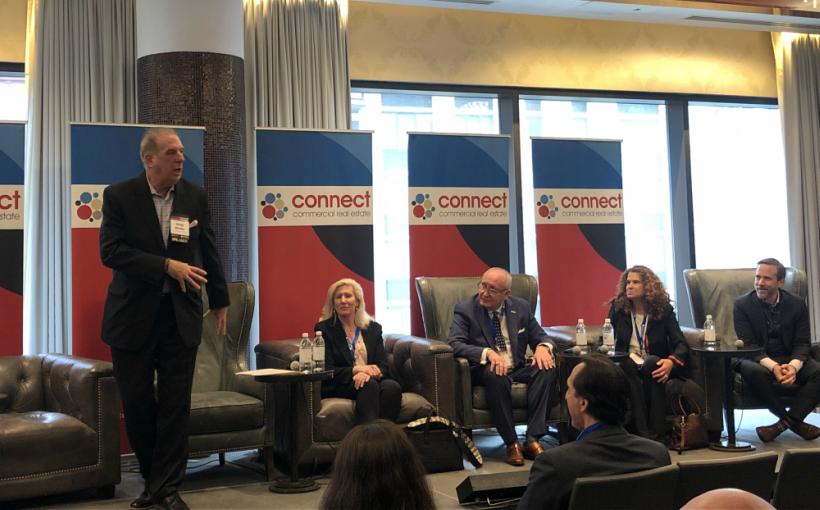
Similarly, co-working space is not merely a disruptor of the traditional leasing model, said moderator Gregg Weisser (standing, in photo), executive managing director with the Moinian Group. “It also has an influence on the complexion of your property,” he said.
Mosler noted that co-working and flexible space are now evolving into version 2.0. What form that 2.0 takes, he added, is unclear.
For comments, questions or concerns, please contact Paul Bubny
- ◦Economy
- ◦Lease


