



National CRE News In Your Inbox.
Sign up for Connect emails to stay informed with CRE stories that are 150 words or less.
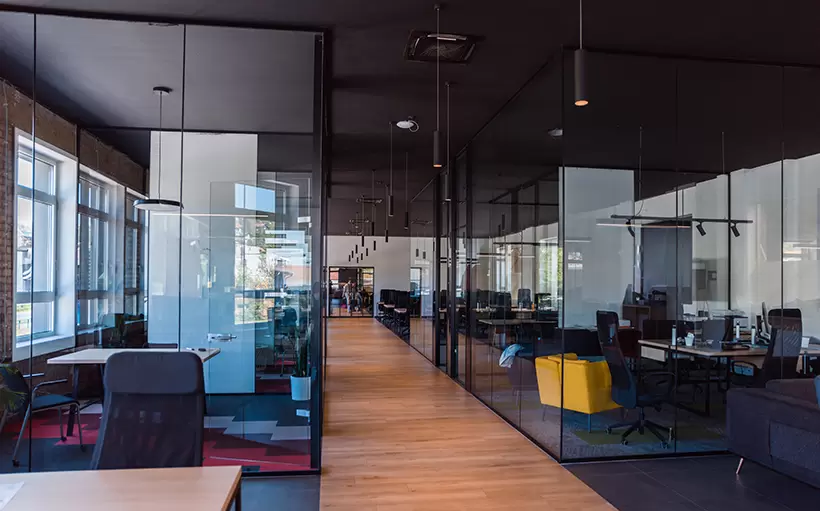

Changing Up the Concept of “Flex Space”
When you mention “flex space,” what could come to mind is a large room (generally an office) with moveable walls, modular construction and portable furniture. Certainly, “flex” is short for—well, flexibility. But experts tell Connect CRE that the concept has shifted to encompass multiple formats throughout interior and exterior spaces.
So, What Is “Flex Space?”

Corgan’s Associate Principal Emily Strain said that “flex” historically meant adaptable space, which could be easily transformed with little cost to accommodate new uses or additional staff. “However, ‘flex’ has evolved to mean new and different ways of utilizing space,” Strain said. This can include but isn’t limited to, different seating strategies in a workplace or accommodations for working from home.
According to Albert De Plazaola, global principal, strategy, Unispace flex generally has two attributes:
It can be easily reconfigured for different purposes. This might include demountable wall construction systems, different space etiquettes or distinct and changeable protocols.
It can include furniture systems that shift depending on headcount or project work. The concept, also called “furnitecture,” means desks, tables, chairs and others can be moved to create new spaces without permits or expensive buildouts.

Strain noted that flex has been typically connected with workplaces but encompasses just about any built environment. “Most built environments are only used for part of the day,” she explained. “Creating dual functionality within the same space reduces construction waste and operational costs.”
Jason Fudin, CEO and co-founder of Placemakr, also pointed out that flex means offering customers different options instead of a one-size-fits-all focus. “With the flex living space my company offers, we can provide empty or completely furnished apartments or a virtual or in-person check-in experience,” he said. “We meet our customers where they are.”
Furthermore, in line with De Plazaola’s comments, Fudin said that flex focuses on usage. With office space, this can mean a switch between office and conference uses. “In retail, this means swapping out stores seamlessly without major buildouts,” he added.
The Nature of Change

As mentioned, one change in the flex concept is that it goes beyond workspaces. Fudin’s company offers flex living spaces. Even church spaces are becoming part of the flexible movement.
Once upon a time, faith-based spaces were meant only for faith-based activities. These days, “some churches serve as community hubs, providing coffee shops, indoor playgrounds and even space to encourage utilization beyond typical religious activities,” Strain said. Then, there is the neighborhood library. While known as places to house books and other content, “they often flex to accommodate community events,” Strain said.
What’s behind the change? Fudin points to external causes, like the pandemic and, to an extent, higher interest rates. “I think commercial real estate owners now understand the inherent value of more sustainable plays and having real estate that works through all cycles and seasons,” he commented.
There’s also been a change in customer perceptions of space usage. Less than 20 years ago, renting a room in a stranger’s home while on vacation would have been out of the question. Airbnb changed all of that. Furthermore, “a decade ago, you’d go to a Marriott for conference space and call it a day,” Fudin observed. “Today people are comfortable hunting for more tech-forward options like a WeWork or Industrious.”
Determining Flex Success
From De Plazaola’s point of view, the success of a flex strategy involves how well a space can be shifted into different uses. “The most successful flex spaces we have designed are based on modularity of actual workspaces, beyond the furniture,” he explained, dubbing the concept the “smart block” approach. Each block represents a different space function, which can be swapped according to need. “Think Legos for workspaces,” De Plazaola commented.
Strain went one step further, pointing out that flex strategy success is measured by utilization. “We’ve seen well-designed and well-intentioned space go underutilized due to a lack of desire from end users to work in a flexible way,” she said. The space in question should be consistent with an organization’s culture and policies connected with flexible working, Strain said, adding, “When organizations are already used to working in a flexible way, implementing flexible work environments feels natural.”
Meanwhile, Fudin’s measures of success are higher yields, lower volatility and engaging “a happier and more diverse set of customers.” Flex success differs between companies, but common factors include “aligning interest between owner and operator/brand through revenue share or management agreements in lieu of ongoing leases and being laser-focused on the unit economies as you scale,” Fudin said.
But Flex Isn’t for Everyone
While many organizations are jumping on the flex bandwagon and its multiple uses, the experts caution that it isn’t for everyone. For example, private offices aren’t good candidates for flex because of entitlement issues and privacy, De Plazaola observed. The best flexible spaces tend to be those that offer diverse settings. “Higher-end airport lounges, co-working spaces, student unions and even retail spaces, like local coffee shops, can easily flex,” De Plazaola said. The downside of such spaces is that they’re noisy and filled with distractions.
Then, there are times when too much flex might be overkill. “When decision-makers are so focused on ‘future proofing,’ with a flex strategy, they can, without good design leadership, miss the point of effective design for the present need,” Strain pointed out.
Along those lines, De Plazaola supported user input for flex design but cautioned that “the idea of giving a team an Ikea credit card and letting them buy and configure what they want is a quixotic workplace practice.” Nor does giving users free rein with design result in a worksite that scales easily or successfully, he added.
Finally, flex requires being intentional regarding physical build-out and understanding upfront that space shouldn’t be locked in. Added Fudin: “It also means designing with respect to building codes so that you can change the use and get the right certificate of occupancy to allow flexibility of use.”
- ◦Development


