



National CRE News In Your Inbox.
Sign up for Connect emails to stay informed with CRE stories that are 150 words or less.


Changing Office Sector Capital Allocations
Capital allocations to the office sector have shrunk due to various factors. To that end, office makes up 22% of the NCREIF Property Index (NPI), representing a decline from its 2015 cyclical peak of 37%.
A recent report from CBRE explained that the decline in office is less cyclical and more secular, explaining that “even before COVID-19, multifamily and industrial commanded a greater share of the NPI at the expense of office. The likely factors behind this shift include fund managers who have determined that multifamily and industrial properties provide better growth prospects.
“It is also plausible that office portfolios within the NPI were rebalanced towards higher-value properties,” CBRE pointed out. “We see evidence of this in office’s contribution to the NPI’s market value, which has been much steadier than the sector’s share of actual buildings in the index.”
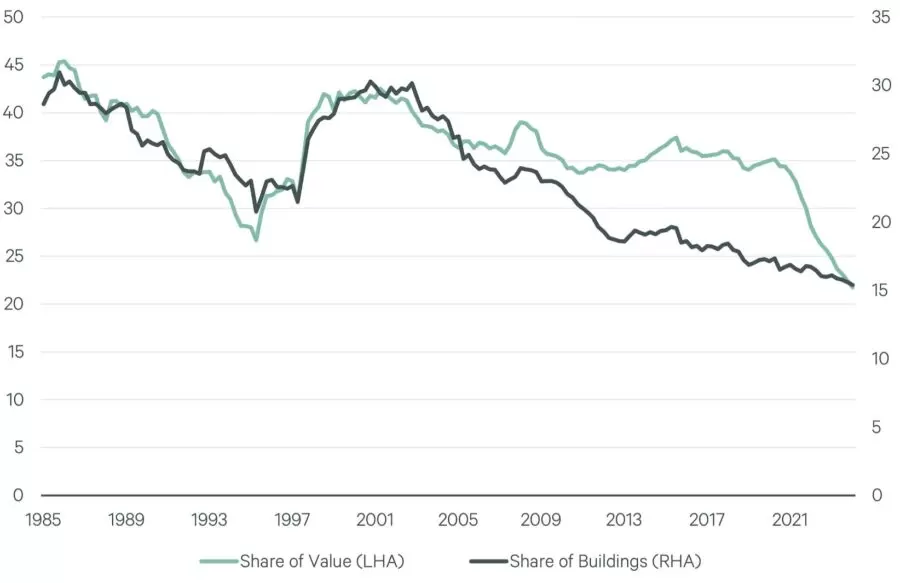
CBRE also noted that this isn’t the first time the office sector has been out of favor. The late 1980s and early 1990s experienced an abundance of oversupply, creating a painful and expensive bust. Still, this “ultimately gave way to a late 1990s boom fueled by an emerging tech sector and capital rediscovering commercial real estate,” CBRE said.
Insert capital allocations chart
CBRE forecasts that the NPI’s office share will remain “subdued” until fundamentals improve and pricing adjusts. Meanwhile, that office share will “likely be weighted toward prime assets in the best submarkets that are positioned for outperformance,” CBRE said.
- ◦Sale/Acquisition
- ◦Financing

