



Chicago & Midwest CRE News In Your Inbox.
Sign up for Connect emails to stay informed with CRE stories that are 150 words or less.


Changing Landscapes: The Evolution of Omnichannel Commerce
By Dennis Kaiser
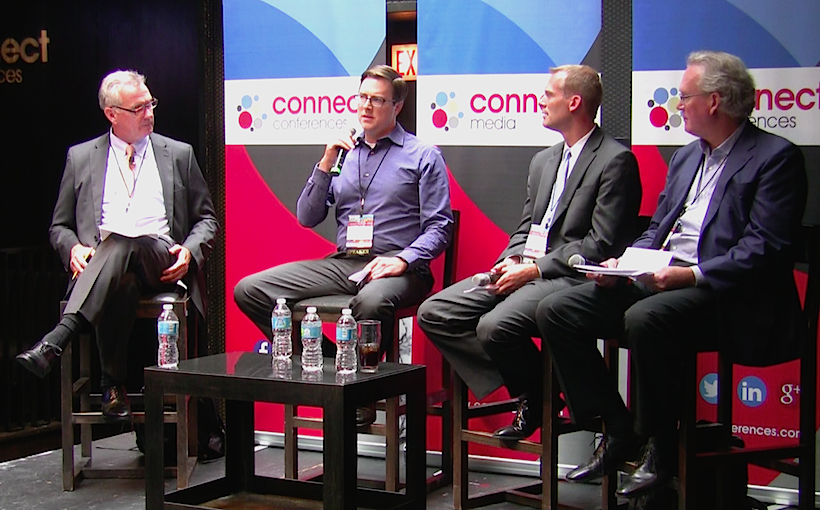
Connect Industrial’s inaugural conference in Chicago on June 28th included an omnichannel panel discussion that was moderated by Transwestern’s Walter Byrd and included DHL Supply Chain’s Keith Gill, Ridge Development’s Jim Martell and Bentall Kennedy’s David Nielsen.
The key takeaways from the conversation included:
Transwestern’s Walter Byrd noted that traditional distribution models are changing to meet and compete with the Amazon’s of the world and to be more efficient.
DHL Supply Chain’s Keith Gill says they have seen demand from the retail and consumer industries. Typically, that’s been focused on a “service is king” model. That shift continues to evolve as everyone keeps upping the game whether by offering same-day delivery to two-hour deliveries to even one-hour. That creates a need to get “closer and closer to dense metro areas,” he says.
The challenges can involve working with older infill buildings to figure out how to be “creative and get the shortcomings at the existing building to work,” Gill says. That may include working with lower ceiling heights, or solving trailer parking through off-site lots, though that could increase transportation costs. A solution can be to create forward stocking locations where the fastest moving SKU’s are placed and then smaller trucks are used to deliver to stores multiple times a day.
Advanced robotics are getting cheaper and cheaper, Gill notes, and that’s making a compelling case for some companies, since they can do the basic job functions of warehouse labor already and eventually will be able to do all functions. Though robots are finicky, he says, and require “super flat surfaces to operate effectively,” which may require floors to be ground smooth, adding costs.
Ridge Development’s Jim Martell says the driver of the business is intermodal. He notes rail transportation is up 10%, trade from Mexico is “way up in the past six months, exceeding expectations, and tonnage is way out of sight and growing so fast.” That’s creating huge demand for warehouses. “Intermodal is simply moving more goods than we had anticipated,” says Martell.
The growth is transitioning demand to secondary markets where investment is being pushed out and “that’s putting pressure on those markets, in terms of driving cap rates lower and rents up,” he says. Demand is increasing in secondary markets because primary markets simply “can’t keep up with the amount of volume.”
It is creating interesting new considerations, especially when percentage growth is factored in. For instance, Charleston, SC has a base of 40 million square feet and it experienced four million square feet of absorption last year. Population and job growth is being driven by companies locating there like Boeing, Mercedes Benz, BMW, Michelin and Volvo. That is driving more demand for warehouse and making it “pretty easy to get excited about those markets,” says Martell.
But a primary consideration, he says, is labor analytics. If a site can’t deliver labor the tenant isn’t interested. A site must also be able to provide on-site amenities that employees seek, in addition to physical elements such as parking for cars, lower truck dock ratios, ample truck parking and sufficient power since the facilities aren’t just used as warehouses now. He notes, many are 100% air conditioned and ecommerce occupiers have different equipment inside facilities that requires more power.
Martell also noted that having a “clear path out of a building” is vital. He says the route from the ports on the West Coast to Chicago takes 3-1/2 days, but it can take two more days just to get the product into downtown Chicago because of the rail crossings, traffic and other impediments of an urban environment.
Bentall Kennedy’s David Nielsen shared that there’s not enough product available though there’s plenty of equity to invest. “The problem is finding the right deals,” he says. “We have closed $300 million in industrial deals this year and have $800 million in equity sitting there to invest in the second half of the year, but the product is not there.” Nielsen says, once the REITS buy they are not keen to sell off, so they’re focused on building portfolios. “We’d like to build more, but land values are slowing down that pipeline,” he notes, which isn’t all bad, but admits it is a struggle to find opportunities.
The company has been “market snobs” as it focused its investment strategy on 15 markets only. It now is “carefully branching out” into other markets, but looks for term and credit when doing deals.
Among the checklist items they look for are functionality (they don’t do roof lifts since that isn’t viewed as a “good use of time or money”), but look for sites with good ingress and egress, along with the ability to subdivide larger buildings as a flexibility hedge against a tenant vacating.
One of the interesting aspects of last-mile facilities Nielsen noted was the volume of car traffic those facilities can generate. That impacts the users’ facility, other tenants, as well as the surrounding neighborhood. The company did a last-mile facility for Amazon in Houston and they were “surprised” by the number of “non-stop” cars to the site, which creates operational considerations to keep other tenants and neighbors happy.
For comments, questions or concerns, please contact Dennis Kaiser
- ◦Development
- ◦Sale/Acquisition

