



California CRE News In Your Inbox.
Sign up for Connect emails to stay informed with CRE stories that are 150 words or less.


Brokerage Leadership Insights: A View from the Top
By Dennis Kaiser
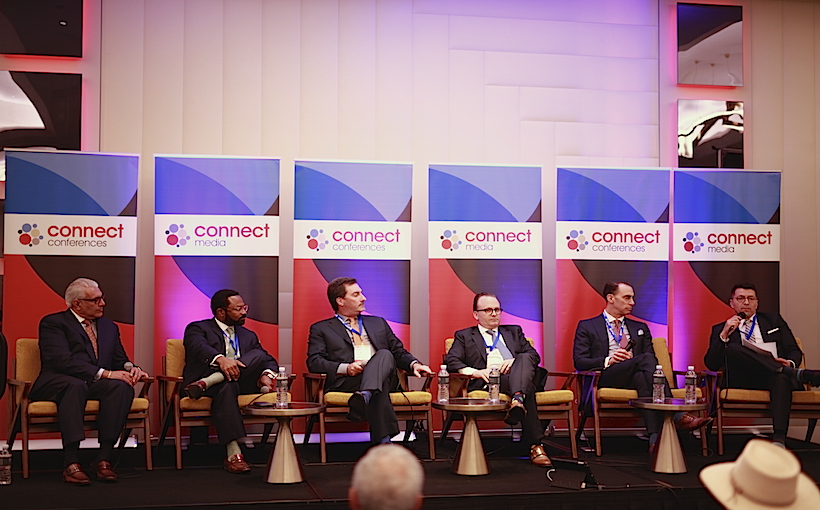
Connect Real Estate Los Angeles’ View from the Top panel featured a robust discussion among five national brokerage industry leaders that was moderated by Connect Media’s Daniel Ceniceros. The diverse group shared insights on shifting commercial real estate trends, activity across property types, and strategies for propelling a CRE brokerage business forward. But a significant component of the conversation surrounded the state of the industry and recession.
Lee & Associates’ Jeff Rinkov believes SoCal is experiencing a tremendous period of growth that likely could lead to a new “jumping off point into a long and productive growth cycle,” he said. “In L.A., we are really poised for the next several years of growth, and nationally we’re confident there’s considerable runway.”
Colliers International’s Martin Pupil agreed that there’s runway room left, with good fundamentals and demand. Construction lending is “tough” and that has perhaps “slowed down” development, but he doesn’t believe the market is in a recession.
To frame the current environment, Pupil noted that 2015 was the “tippy top of this cycle from a capital markets and transaction volume” perspective. But, he believes it would be wrong to say “we’re in a recession” simply because today’s numbers are off from those elevated levels. “The fundamentals have never been better,” he said.
But Pupil doesn’t believe a huge correction is on the horizon because it is “harder to repeat.” He admits the market is cyclical, but doesn’t believe a “deep recession” looms since there’s so much capital and equity on the sidelines that “wants to get in.” The fundamentals of the industry are not indicating a deep recession given the lack of over-leveraging, lack of spec development, combined with overall economic conditions. “The likelihood of 60 to 100% backward velocity in pricing isn’t going to happen, we’re not going to see that this time,” Pupil said.
Avison Young’s Mark Rose also pointed out that the population growth projections of three billion over the next 30 to 50 years will create sufficient future demand drivers too, since those people will need jobs and places to live. That is a good “safety net” underpinning for the commercial real estate sector because that underlying stability and growth is expected to translate to a solid future for CRE.
Rose said, “We’ve got great fundamentals sitting underneath our industry. What we have is a correction in pricing. And this has been going on the past 12-15 months and it is not really moving, which is the absolute ideal description of the beginning part of a correction where the bid and ask has widened. So you have a little bit of stagnation in velocity and volume, but you do not have a lack of demand. It’s just pricing that needs to work its way through, which is so incredibly healthy for the market.”
Still, Rose believes a correction may be occurring now and could “worsen” over the coming 12 to 15 months. He notes, “cycles have smoothed” and it is good for a little bit of “air to be taken out of the balloon,” because it allows capital that wants to be placed to find opportunities. He doesn’t think “risk translates to terrible terrible swings.”
Marcus & Millichap’s Hessam Nadji noted that the usual “implosion” indicators leading up to a recession are not present, those being over-building or over-leveraging. “The economy is not anywhere near recession, he says. The benefit of the type of “slow recovery” currently being experienced since 2010, though “frustrating in fashion,” has created “longevity of cycle” and one that’s “less intense, with less build up and less bubbles that likely has more staying power,” he said.
Nadji points out a key factor to consider is U.S. demographics, where an 80-million-strong Baby Boomer generation is being followed by another 80-million cohort, Millennials. He says, that gives the U.S. a “population advantage,” versus a deficit other developed countries around the world will experience. Nadji notes in the next three decades there is expected to be a record $30 trillion in wealth change hands, which has “never happened before in this country. That is unbelievable in terms of CRE and housing.” He says, those looking 10 to 15 years ahead will see CRE is a good investment. That’s not just because of lower interest rates, which positively affects the high net-worth investor market. But Nadji also notes there’s an “aging boomer wall of capital flowing to NNN investments and that wall of capital is not going away,” he says. That investor is fine taking lower yield for solid, reliable returns, and it is “growing, not declining,” he said.
NKF’s Craig Robinson noted his concerns about the economy and any potential downturn relate to the uncertainty coming from the White House of late. It could be a Black Swan event or something that can’t be predicted of planned for, he says. Uncertainties and unknowns surround such areas as foreign trade and managing domestic affairs. Another factor that’s interesting to Robinsons is whether or not problems will be “isolated in certain areas,” such as retail, for example. He points out some industries and sectors may be “sucking wind” now, but others are expanding. By and large, the country is not technically in recession, but it is slowing, which is healthy, he says. Robinson notes there is a massive amount of capital coming back to corporations, but it remains to be seen “how it will translate to the industry” yet, he said.
For comments, questions or concerns, please contact Dennis Kaiser


