



National CRE News In Your Inbox.
Sign up for Connect emails to stay informed with CRE stories that are 150 words or less.

Fed Acknowledges Economic “Uncertainty” as Growth, Inflation Forecasts Revised
The Federal Reserve underscored a sharp rise in uncertainty regarding the economic outlook, even as it maintained an optimistic tone about current conditions. The March FOMC statement noted that economic activity was still growing at a “solid pace” and that the unemployment rate had “stabilized at a low level.” However, the Fed acknowledged that inflation remained “somewhat elevated.”
What stands out in the latest Summary of Economic Projections is the surge in uncertainty surrounding the forecasts for growth, unemployment, and inflation. Compared to the December 2024 update, the current outlook reflects a broader range of potential outcomes that the Fed must now account for.
While the FOMC decided to hold rates steady, officials lowered their growth forecast for real gross domestic product (GDP) to 1.7%, down from the previous estimate of 2.1%. Meanwhile, it raised its projection for core Personal Consumption Expenditures (PCE) inflation to 2.8%, up from 2.5%, and increased its unemployment forecast to 4.4% from 4.3%.
“The Fed’s decision to hold rates steady came as no surprise. While most investors are continuing to underwrite a soft landing from a macro standpoint, we all have our eyes trained on the potential inflationary impact of heightened tariffs, especially as it relates to the cost and availability of building materials,” Marion Jones, principal, executive managing director of U.S. Capital Markets at Avison Young shared with Connect.
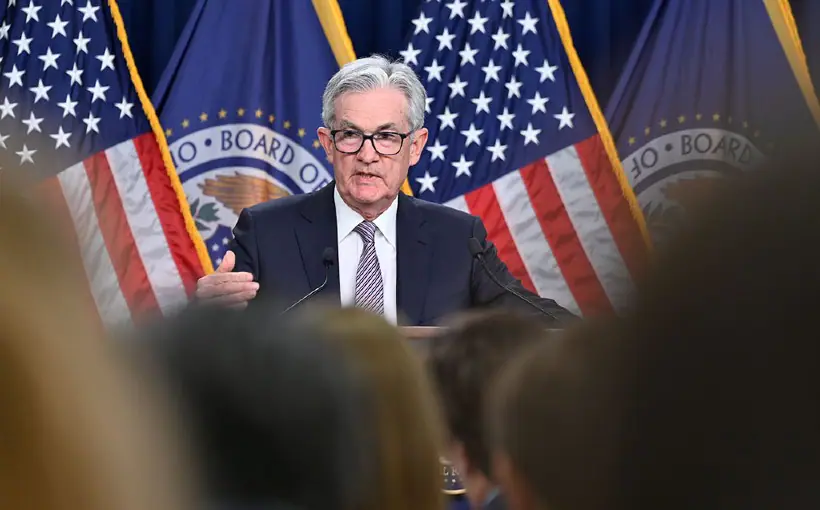
Federal Chair Jay Powell addressed the challenge of disentangling the sources of inflation, particularly in relation to President Trump’s aggressive tariff policies. Powell admitted that pinpointing how much inflation stems from tariffs is complex, stating, “clearly some of it” is attributable, but emphasized it’s premature to determine whether the Fed can simply “look through” tariff-related price increases.
Powell avoided directly mentioning President Trump but pointed to the upheaval in Washington as a key factor unsettling economic sentiment. “We understand that sentiment is quite negative at this time and that probably has to do with turmoil at the beginning of an administration that’s making big changes in policy,” he remarked in the press conference.
“Earlier this year, the U.S. economy showed positive signs with solid hiring and growth, along with declining inflation. However, challenges such as ongoing inflation, tariff threats, and reduced consumer and business confidence have emerged,” Michael Underhill, CIO of Capital Innovations, told Connect.
“These factors raise concerns about stagflation, a troubling mix of stagnant economic growth and high inflation. This scenario is particularly challenging for the Fed, as traditional approaches to managing inflation or unemployment may conflict in such conditions,” Underhill added.
Despite the heightened uncertainty, most officials still anticipate interest rates will fall by year-end to a range of 3.75% to 4%, consistent with the projections from December 2024. However, views among policymakers diverged notably: eight of them now predict either no further rate cuts or just a single reduction, while only two expect a more significant drop of 0.75 percentage points.
“We know in the near term to expect some continued volatility in the cost of capital, but the rate cut conversation is giving way to a larger dialogue around trade wars, rising costs, and potential supply-chain disruption. This confluence of factors can affect the rebounding office market – where every TI dollar is scrutinized heavily,” added Jones.
Looking further ahead, most officials expect interest rates to drop an additional half a percentage point by the end of 2026, bringing the federal funds target range to 3.25% to 3.5%. By 2027, most foresee rates settling around 3%.
“The Fed is likely to remain on hold over the near-term future given renewed inflation concerns and what had been until recently a relatively steady pace of economic growth,” Bryan Jordan, chief strategist at Cycle Framework Insights, Inc told Connect.
“Looking further ahead, the recent spike in uncertainty and the early signs of knock-on effects in investment, hiring, and consumption should mean a resumption of the easing cycle in the months ahead,” said Jordan.
The Fed also announced adjustments to its balance sheet strategy. Starting in April, the Fed will reduce the speed of its ongoing reduction of its approximately $6.8 trillion portfolio of Treasury securities and mortgage-backed securities. This shift signals a more gradual approach to unwinding its massive holdings.
“With the near elimination of the Fed’s reverse repo program and the Treasury no longer required to deplete its Treasury General Account (TGA) at the Fed, the focus on liquidity will shift to the timing of the conclusion of the Fed’s balance sheet reduction,” said Underhill.
- ◦Financing
- ◦Economy
- ◦Policy/Gov't


