



National CRE News In Your Inbox.
Sign up for Connect emails to stay informed with CRE stories that are 150 words or less.

Another Use for Abandoned Office Space: Satellite Campuses
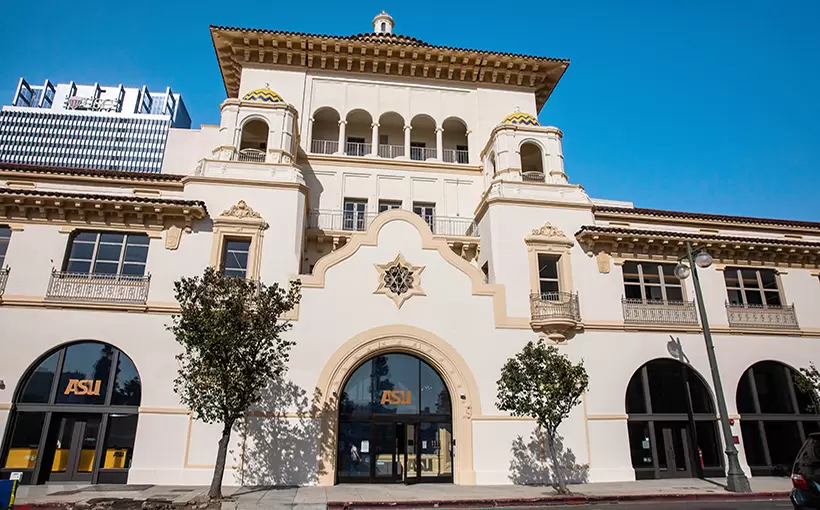
Pictured: ASU’s Downtown Los Angeles campus. Photo courtesy of Arizona State University
There’s been plenty of thought dedicated to this question: What needs to happen to empty office space in urban centers? Much of the news focuses on office-to-multifamily conversions. While the theory is attractive, the reality seems to be more difficult.
A recent article in Urban Land suggested another use: university satellite campuses.
The article began with news about the University of Southern California’s acquisition of a downtown Washington D.C. building and its plan to “convert it into a satellite campus in the nation’s capital.” Nor is USC alone in this activity. “Many schools are converting older buildings into classroom, meeting and performance spaces for educational uses,” the article said.
Other universities following this trend include UCLA’s acquisition of the downtown Los Angeles Trust Building. The building will be the site of UCLA Extension programs. Meanwhile, Arizona State University owns the Herald Examiner Building in downtown Los Angeles, from where its L.A. campus operates. Johns Hopkins University is also in the act, having moved its School of Advanced International Studies into the former Newseum building on Pennsylvania Avenue in Washington, DC.
The Urban Land article noted that other universities have similar expansion projects in New York City, Atlanta and Louisville, KY.
“Not only does it provide an access point for academic exchange in the traditional sense, but it also increases institutional brand visibility and awareness in key markets,” JLL Senior Vice President for Education James Birkey told Urban Land. Plus, universities can find some bargains due to softening demand for office space.
Birkey acknowledged that satellite campuses aren’t new. He explained that what is new is its “competitive tenor.” In other words, there are only so many students out there, meaning higher education institutions need to find different ways to reach out to them. “In that sense, satellite campuses are tools to access market share, just like online platforms are,” Birkey told Urban Land.
He acknowledged that universities expanding to urban cores won’t fill many office vacancies. On the other hand, many of these university extensions focus on programs relevant to the cities where they take space. “That’s why, for example, you often see finance programs in New York, fintech programs in San Francisco, media programs in L.A. and policy programs in Washington,” Birkey said.
Whether the vacant office space can be adapted to educational programs depends on why the universities want the space to begin with. The article acknowledged that many office buildings can’t hold those enormous lecture halls for undergraduates. But as many satellite campuses are graduate-level, “the classes can fit into the smaller spaces typically found in an office environment,” the article said.


