



California CRE News In Your Inbox.
Sign up for Connect emails to stay informed with CRE stories that are 150 words or less.


Adapt to Survive in Today’s Retail Environment, Advises CBRE’s Levy
By Dennis Kaiser
Connect Media and CBRE hosted a retail luncheon this week in Los Angeles to take a deep dive into a sector that has been challenged, yet continues to find solutions. The event was highlighted by a keynote conversation with CBRE’s Spencer Levy, and included a pair of panel discussions on topics such as what top brands are doing today, and trends like e-commerce, logistics, omnichannel and cold storage.
The afternoon featured a presentation by Levy, who serves as Chairman of Americas Research & Senior Economic Advisor. He touched on a range of issues that pertain to real estate, the economy and the retail sector.

Levy
He framed the discussion noting that while we face similar issues today as the 1970s, though we must adapt from the “set it and forget it” CRE mentality. Changes in retail have transpired and the sector is “less durable than before,” the co-working space is disrupting the CRE industry and retail even more so, Levy noted. That may take the form of a shorter lease or even a license agreement. We face “operational risk more now than before,” said Levy. He pointed out, from a capital markets perspective, “the concern is that, are we going to lose value” as a result of shorter term leases? Yet, he believes values will be maintained, despite the reduced length of leases that’s happening worldwide and the drop in cap rates. Levy said, “Ultimately, the capital markets will adjust to this radical change.” But the CRE industry must change the way it thinks too, he advised. It can’t operate like it did in the 70’s, because the set and forget it approach doesn’t work. He noted, we must have more “operational capabilities” than before.
Levy noted Los Angeles has considerable factors working for it. On a global scale, L.A. was ranked as the No. 1 U.S. market for investors globally for the third year in a row. He pointed out the market has been doing well because “L.A. is transforming itself.” The search for top talent continues to drive markets and there are pockets of talent spread across SoCal now. He did note that there are “massive headwinds” in the economy, but from a micro perspective, as long as people adapt in real estate and generally, L.A. will remain a top market.
Shifting to key economic factors, Levy noted inflation has ticked down to low levels, which has kept loans cheaper. But such inexpensive debt likely impacts real growth. He pointed out the downside of no inflation and low inflation, which has caused him to be pessimistic about growth and has made it challenging for economists to predict a possible downturn in the economy. Levy ultimately adjusted his prediction on a recession: noting that he doesn’t foresee one for the next five years.
Given the focus of the event, Levy stressed that the U.S. has been adapting to massive changes in retail, noting that the death of brick-and-mortar retail is the single most overblown story in his career. “The fundamental disruptor isn’t e-commerce, it is demographic shifts,” said Levy. That change requires retailers to change locations or the retail experience itself. He advised to look for retailers that bring in foot traffic. Levy called this new retail environment, new rent: as people adapt to these changes. These changes may translate into the shorter-term leases, and licensing agreements now emerging. Another driving force of change is the smart phone, which can measure foot traffic at a property and beyond. This can lead to change in how trade zone rings are viewed. Foot pings from cell phones can show where customers actually come from. Levy noted, these foot pings can “unearth value in a project” that retailers may not have been aware of.
Levy cautioned not to take the adaptation of retail too far, though. Adaptations can be made to location and retail type, but he advised retailers not to lose their local character, believing local is the new global.
The Retail Brands in Action panel was moderated by CBRE’s Jeff Moore, Senior Managing Director, and included CBRE experts: Andrew Turf, Senior Vice President, Derrick Moore, Senior Vice President and Zachary Card, Vice President.
Card focuses on ground up MXU projects, as well as street leasing in the L.A. metro such as the Westside. He noted demand is driven strongly by the service side, with 65-75% of the deals involving service-related tenants, such as medical, or studio fitness users. He noted, now that those operators can show healthy revenue and occupancy costs, demand has been “pretty wild.” He also indicated restaurant demand is robust, though operators are consolidating their footprints into 2,000 to 3,000 square feet of space. Restauranteurs are starting to “blur lines between fast casual and sit-down” and there’s an emphasis on online and to-go with quick turns, said Card.
Derrick Moore is DTLA focused and noted over the past two decades the market has grown from 18,000 residents to now a population that exceeds 75,000. In the urban space, Moore said 80% of the activity is still in the F&B sector. He agreed that “footprints are shrinking,” that there was “increasing interest in ghost kitchens” to serve demand in an urban environment, and that the grocery sector is “particularly robust in downtown.”
Turf is focused on DTLA after an extended period of time in London and works with high-street international retailers and anti-mall projects. He’s “bullish” on SoCal, mainly due to low vacancies across the market.
Card noted that e-commerce is the greatest incubator for brick-and-mortar, while Moore has seen an emergence of local in the marketplace by using e-commerce and brick-and-mortar strategies equally.
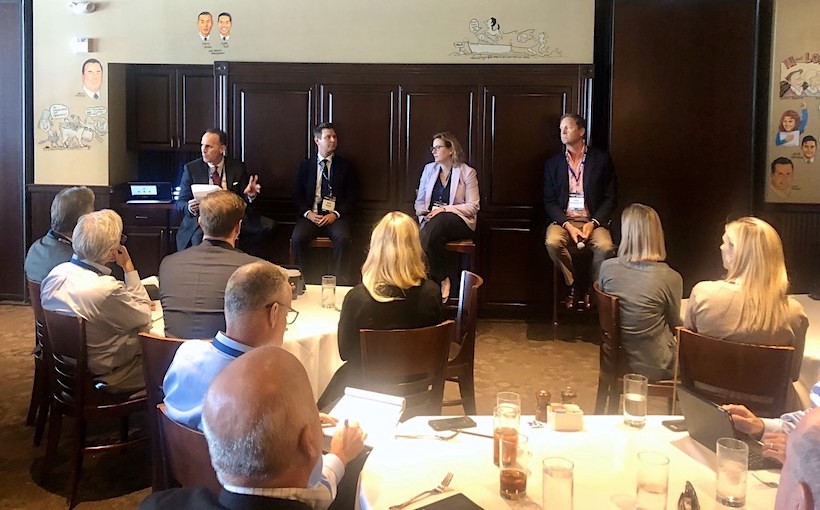
The Behind the Storefront: From E-commerce, Logistics, Omnichannel to Cold Storage panel (pictured) was moderated by CBRE’s Kurt Strasmann, Executive Managing Director, and included CBRE experts Arthur Rasmussen, Jr., Senior Vice President, Justin Schultz, Senior Vice President, and Rebecca Perlmutter, Senior Vice President.
Schultz, who works with retailers such as Nike and Williams Sonoma, shared approaches to omnichannel with consumers and the changes he has been seeing. Retailers are making “massive” investments to execute omnichannel strategies as they work to connect the supply chain to the store. He noted their investments into consumer analytics more than ever are designed to understand consumers. Schultz has also been seeing large retailers invest in the digital experience via online and apps, even as store growth strategies take a “back seat.” That’s a trend he expects to “accelerate for the foreseeable future,” and the need for reverse logistics facilities is “continuing to grow.”
One of the hottest trends in SoCal is cold storage, noted Strasmann. Rasmussen agreed, calling it the “backbone of all food production.” It is all part of a cycle — whether to restaurants, grocery stores, convenience stores or meal kits — food started in a facility that stored and preserved it. Cold storage distribution involves complex, purpose-built facilities, and warehouses can be regulated, and the construction and operations of these facilities are highly sophisticated, which adds risk to the owner, pointed out Rasmussen.
Schultz believes people are going to adapt to ordering groceries online, but not as rapidly as was envisioned, though for urban dwellers it may occur sooner. He did note, Amazon’s rapid delivery option is a “game changer.” He said it will be hard for competitors to keep up with that, and though it won’t happen “overnight,” it is expected to become a “larger part of the grocery business.”
Perlmutter spoke about the impact e-commerce is having on the industry. She indicated she was “seeing tremendous demand for cold storage” as investors look at their industrial portfolios and make allocations in general. They are making sure they are diversified across the product types from bulk, multi-tenant, cold storage, and covered land plays. She noted investors’ frustration due to limited inventory to buy. Case in point: cold storage deals comprised just 1% of all transactions over the past five years. Perlmutter said, there simply isn’t supply available to investors.
Some of the best opportunities, according to Perlmutter, are last mile facilities in population hubs, although defining that product type has become a “bit of a moving target.” Prologis is now calling them “last yard” facilities while the size of a facility to address the population base is shifting too, she noted. She added the fact that metrics are “different than we are used to looking at” regarding terms of coverage rates, cap rates, and per-square-foot pricing.
For comments, questions or concerns, please contact Dennis Kaiser
- ◦Development
- ◦Lease


