


National CRE News In Your Inbox.
Sign up for Connect emails to stay informed with CRE stories that are 150 words or less.


Automation is Reshaping, Not Erasing, Manufacturing Jobs
Automation isn’t wiping out U.S. manufacturing jobs. Rather, it’s restructuring them, according to a recent CBRE report. Multiple manual jobs are being replaced with fewer, more technical ones.
But, “the work is changing faster than the workforce being trained for it, presenting a considerable challenge for manufacturers and the communities that depend on them,” CBRE said.
CBRE explained that the jobs exposed to automation tend to be repetitive, predictable and physically demanding. Pick-and-place assembly, spot welding, basic quality inspection and moving materials between workstations can be handled by robots, which offer greater speed and precision and lower cost per unit for many of these tasks.
Among the occupations CBRE tracked, employment fell the most for hand packers and packagers, and for machinists, from 2016 to 2025, according to Bureau of Labor Statistics data. Machinist employment dropped more than 25%. Over the same period, employment of industrial engineers rose nearly 43%, and employment of industrial machinery mechanics increased by 31%. Electro-mechanical and mechatronics technologists and technicians grew by 13%.
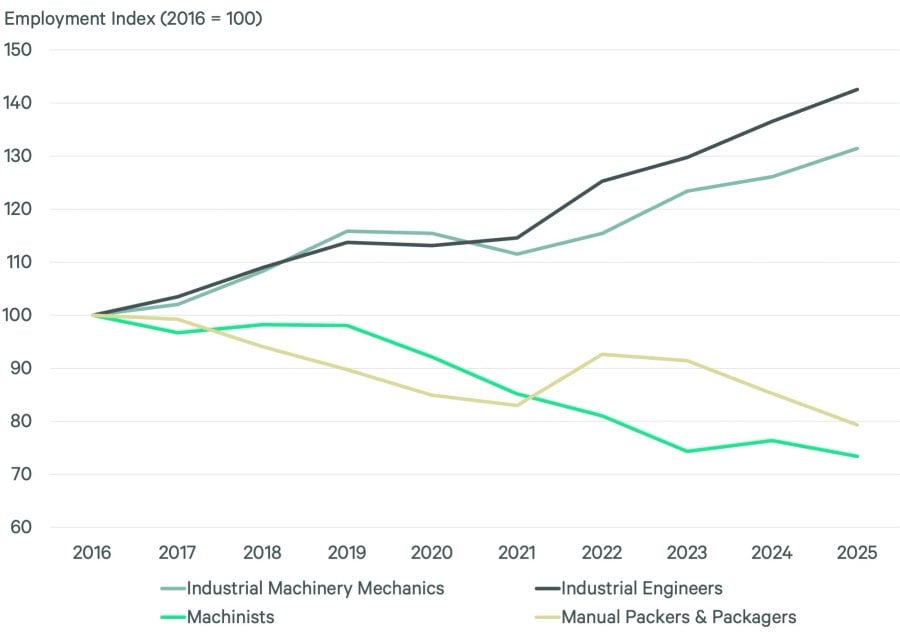
“Economists call this shift job polarization: automation absorbs repetitive, rule-based tasks and raises the value of judgment, adaptability and complex decision-making,” the report said.
CBRE added that today’s manufacturing facilities require a different workforce than the ones they’re replacing, with the following categories:
- Automation technicians and robotics maintenance specialists diagnose and repair robots, robot cells and conveyor systems. The jobs rarely require an engineering degree but pay well above production work.
- Process engineers and automation systems integrators design workflows that combine human and robotic labor. As more manufacturers adopt AI, these jobs include machine vision, predictive maintenance, digital twins and AI-enabled process optimization.
- Data analysts and technology specialists, a new category for the sector, rely on massive amounts of equipment and production data to improve operations, including equipment uptime and defect rates.
Citing Bureau of Labor Statistics data, CBRE said that data science employment in manufacturing rose 171% from 2021 to 2025, outpacing the 147% increase for the occupation across all industries. At the same time, computer occupations in manufacturing grew 72%.
Companies are also paying more for these roles. In 2025, industrial engineers earned a median of $102,000 a year, and data scientists earned $120,000. That’s nearly double the $45,000 to $55,000 earned by machinists, welders, assemblers and machine operators.
However, “recent wage growth has run the other way,” CBRE noted, with a dwindling supply of production workers pushing median pay for hand packers up 64% and for laborers up 55% from 2016 to 2025. Technical wages grew more slowly, with inflation absorbing much of the increase.
According to CBRE, the net effect is that labor cost per unit falls as automation lifts output, even as the average cost of each remaining skilled worker rises. As technical headcounts grow, a larger share of payroll will go to these higher-paid roles.
CBRE said that the next era of manufacturing competitiveness will generate demand for workers able to maintain automated systems, understand complex processes and convert operational data into decisions.
“Manufacturers that attract, develop and retain technical talent across automation, engineering and analytics will be best positioned to capture the productivity gains the technology offers,” the report added.
Photo: Shutterstock
- ◦People
- ◦Recruitment

