



National CRE News In Your Inbox.
Sign up for Connect emails to stay informed with CRE stories that are 150 words or less.

Mid-Bay Industrial Is More Than Size: Why CRE Keeps Missing the Mark

Mid-bay industrial could have a problem. Specifically, how the industry defines it.
In a recent white paper, BKM Capital Partners said that mid-bay should be less about square feet and more about usage and tenant needs.
“The industry has tried to define it by building size, and building size says very little about how a mid-bay property actually works,” BKM Senior Managing Director of Acquisitions & Dispositions Brent Turner told Connect CRE.
Judging simply by size puts mid-bay industrial into a leftover category, sandwiched between small-bay and big-box.
“A leftover category is hard to track, benchmark or price,” Turner said.
Mid-Bay, BKM Style
One problem is that there’s no universally accepted definition of mid-bay industrial. One common definition puts the space at roughly 10,000 to 15,000 square feet, with 20- to 28-foot clear heights and dock-high and drive-in access. Other definitions extend the category to buildings of up to 100,000 square feet that house local or regional operating businesses.
BKM’s definition focuses less on square footage and more on functionality: “a specific combination of suite size, shallow-to-moderate building depth, loading, power, parking, access and infill location that supports operating businesses rather than bulk storage.”
Under that definition, a 150,000-square-foot building that is generally classified as large-bay space might contain several 20,000- or 30,000-square-foot suites that function as mid-bay space.
That’s an important distinction because classifying industrial solely by building size can obscure what tenants actually need.
It also helps explain why mid-bay supply has remained constrained despite strong demand.
Why the Scarcity?
The problem isn’t necessarily a lack of new industrial construction. It’s that much of the new construction isn’t designed to accommodate smaller users efficiently.
Large bulk warehouses typically have deep footprints.
“Carve a 15,000-square-foot suite out of one, and you end up with what amounts to an industrial bowling alley: a narrow slot hundreds of feet deep, with one door and a truck court shared with everyone else,” Turner said.
In a shallower building, that same 15,000-square-foot suite can have meaningful frontage, dedicated loading and parking.
Turner said the supply shortage is particularly pronounced among suites of less than 30,000 square feet in multi-tenant parks, while new construction increasingly is geared toward larger facilities.
Land and construction costs are also a problem.
“Mid-bay works best in established infill locations close to population centers, where sites are scarce and expensive,” Turner said. “A park full of smaller suites also needs more storefronts, bathrooms, demising walls and separated electrical than a single big box does.”
In many markets, mid-bay properties can also trade below the cost of developing a new product, making ground-up construction difficult to pencil.
That leaves the smaller industrial users with fewer options.
Then There Are the Tenants
The other piece of the mid-bay issue is the tenant.
Mid-bay parks have traditionally been home to regional distributors, light manufacturers, contractors and service companies. These businesses are in growth mode; they’ve outgrown small-bay space but don’t need hundreds of thousands of square feet.
Not long ago, many of those businesses were heavily dependent on labor and largely manual processes. Owners who had built companies over decades were also cautious about investing in new equipment.
“The building’s job was fairly simple,” Turner said. “Enough clear height, enough dock doors and enough room for people and product.”
That’s not the case these days.
Generational ownership transitions, process automation, advanced manufacturing and more sophisticated operating models are changing what tenants want from their space, according to BKM.
“Today, the same suite is more likely to hold automated equipment or a production line running alongside warehousing and shipping,” Turner said.
That means prospective tenants might be less concerned with clear height and dock-door counts and more focused on available power and whether additional capacity can be added.
“They also pay closer attention to how the building looks, because a modern facility is part of how they present the company,” Turner said.
Some businesses also fall between conventional property classifications.
For example, a design or marketing company might need space to produce signs, build exhibits or handle printing. A business categorized as a spa service could actually be distributing products to spas and salons.
“For example, we have tenants in Las Vegas creating exhibition displays for customers such as Toyota, and tenants in Houston making pedicure bowls and massage chairs for day spas,” Turner said. “Those operations need warehouse or production space, loading access and room for equipment and inventory, alongside offices. Mid-bay can accommodate that combination under one roof.”
Location Matters
The location of mid-bay properties may also be becoming more important, not less.
Technology allows companies to produce more with fewer workers and less space, but those workers increasingly need specialized skills. Manufacturers and suppliers still need access to engineers, technicians and specialized production workers, as well as customers, suppliers and transportation infrastructure.
That favors infill industrial locations close to population centers.
The ongoing U.S. manufacturing buildout could provide another tailwind. Large manufacturing campuses require ecosystems of component suppliers, equipment providers, engineering firms, maintenance companies and logistics businesses.
Many of those supporting companies don’t need hundreds of thousands of square feet. They need flexible, well-located space.
Rethinking the Mid-Bay Profile
Turner said the discussion isn’t necessarily about reclassifying mid-bay. It’s about defining a segment that never had a particularly clear definition in the first place.
Published industrial research generally sorts properties by building size. That works reasonably well in big-box markets where one tenant may occupy an entire building. It becomes less useful in a multi-tenant park, where a 150,000-square-foot building might house several tenants, each occupying 20,000 square feet.
The problem is that the definition ultimately shows up in the data, and investors use that data to underwrite deals.
“When mid-bay is folded into broader size categories, the picture gets distorted in ways that matter,” Turner said.
Those distortions can affect how investors view pricing, supply risk and other market characteristics.
The larger issue is the tenant profile that gets lost in the process.
Mid-bay tenants represent a significant portion of the country’s small and midsize manufacturers, distributors and suppliers, many of them family-built businesses that have operated for years.
“That ties the segment closely to the health of that part of the economy, and right now, the signals are good,” Turner said.
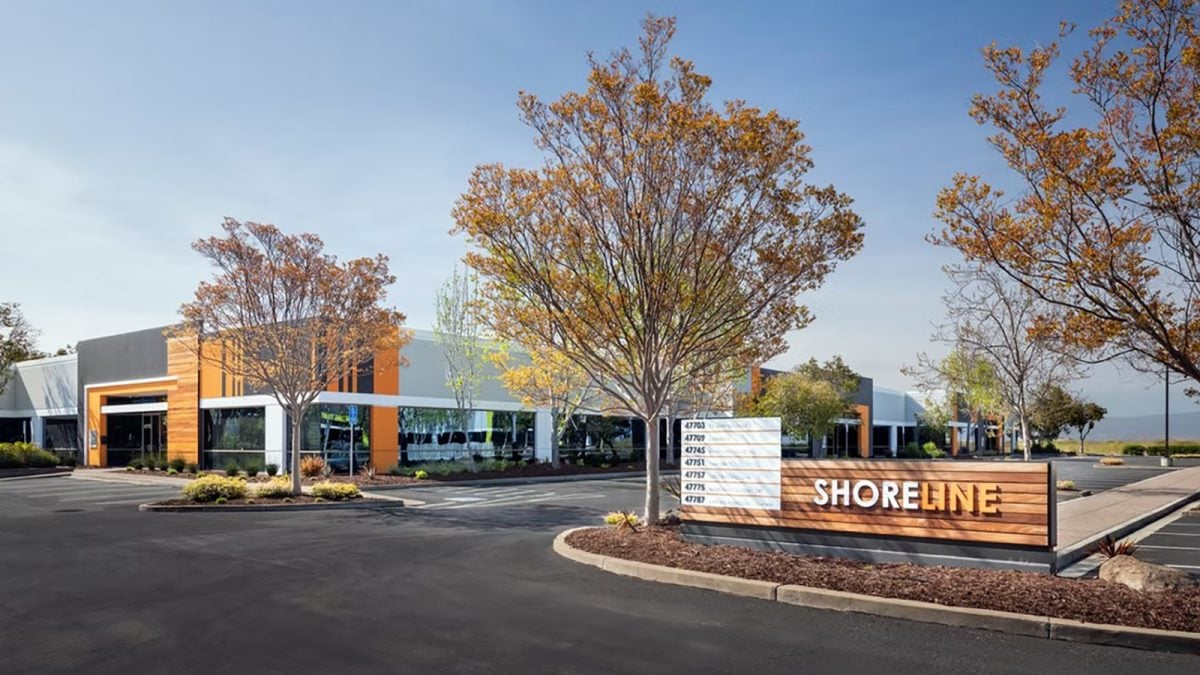
Photo: Shoreline Business Centers, courtesy of BKM Capital Partners
- ◦Lease
- ◦Development


