



National CRE News In Your Inbox.
Sign up for Connect emails to stay informed with CRE stories that are 150 words or less.

The Real Estate Question About Quantum Computing
Quantum computing infrastructure is scaling faster than the real estate needed to support it, according to JLL’s “Future of Quantum Real Estate” report. Today, much of the space and infrastructure is concentrated on university campuses. But over the next decade, JLL said it expects the private sector to play a much larger role.
Unlike conventional computers, which use bits to process information, quantum computers use qubits to tackle extraordinarily complex problems. The technology won’t replace conventional computing. Instead, JLL described it as “a high-value layer of compute within the digital infrastructure stack.”
That emerging layer will require its own physical infrastructure. It could also generate a new real estate niche.
Not Your Average Data Center
Quantum real estate refers to the facilities that support the research, fabrication and deployment of quantum computing systems. JLL identified more than 240 quantum facilities across nine asset types and 35 countries.
It might be tempting to think of quantum real estate as data center 2.0. But the physical requirements are different.
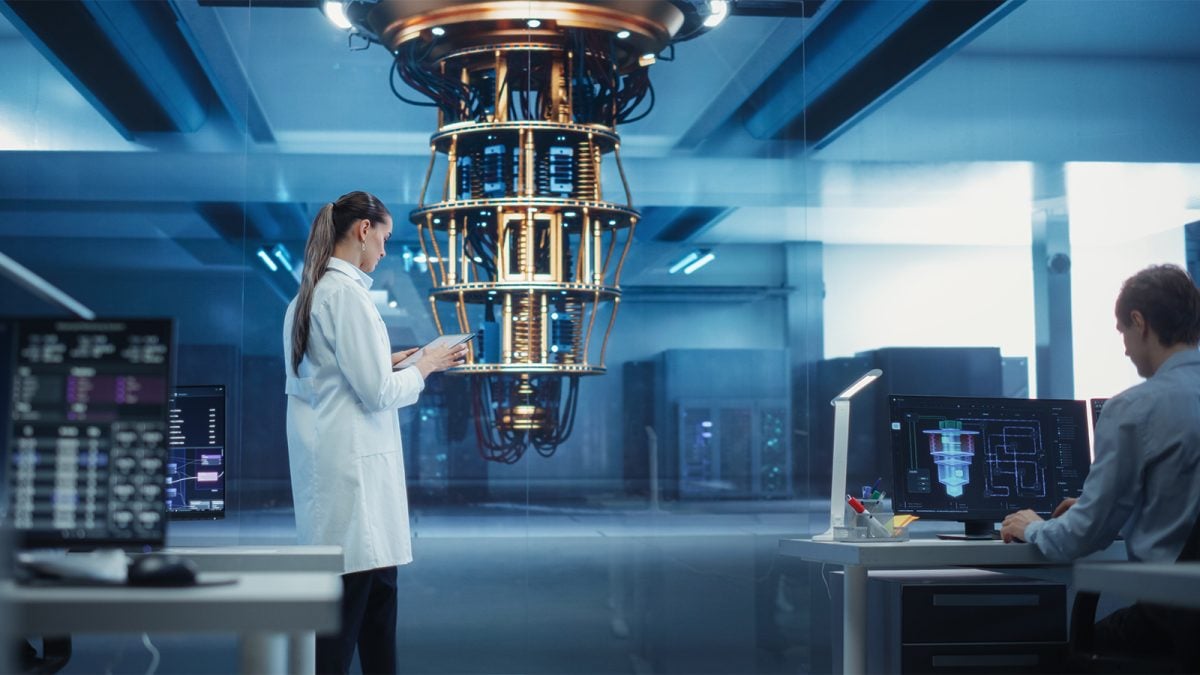
Quantum installations can require a “room within a room,” with dilution refrigerators, vibration isolation and electromagnetic shielding alongside conventional computing equipment. Those systems also rely on low-latency fiber connections to the classical computing infrastructure that includes software, networks and data storage systems.
The requirements vary further depending on the type of technology involved. JLL discussed several modalities, including topological, silicon spin, photonic, neutral-atom, trapped-ion, and superconducting systems. Each of these offers different potential applications ranging from cybersecurity and telecommunications to pharmaceuticals, logistics and finance.
Universities As the Foundation
Higher education institutions currently anchor most quantum ecosystems because they bring together specialized talent, government funding, corporate partnerships and research capabilities.
“The result is a self-reinforcing cluster that makes the university campus a de facto real estate catalyst for the broader quantum district forming around it,” JLL said.
Most quantum facilities today are relatively small, typically under 150,000 square feet and are occupied by academic, government or enterprise users through formal partnerships.
While single-tenant facilities dominate the emerging sector, multi-technology hubs are beginning to emerge. IQMP has a roster of more than six quantum companies, while Quebec’s DistriQ could eventually accommodate as many as 30 firms.
The sector is also beginning to expand beyond academia. JLL said that more than $4 billion in quantum-related real estate projects are planned or under construction globally.
Private facilities are coming online through purpose-built development and adaptive reuse.
What to Watch
JLL expects quantum real estate to follow a trajectory similar to life sciences, moving from primarily public ownership toward greater private-sector participation through the mid-2030s.
That transition could have several implications for CRE.
Talent could matter as much as power. Conventional data center developers and investors look for electricity availability and land. Quantum facilities development will focus on access to specialized talent.
Private capital could become increasingly important. Government funding has helped establish the quantum ecosystem, but commercialization will mean additional private investment. JLL said that capital will favor developers capable of moving quickly as the technology evolves.
One size won’t fit all. Multiple quantum modalities mean different technical and physical requirements for facilities. Gone will be the generic templates. Instead, investors and users will need to tailor their spaces to specific technologies.
For now, quantum real estate remains a relatively small and specialized niche. But as the technology spreads from university laboratories into commercial applications, the real estate supporting it could become an emerging piece of the digital infrastructure landscape.
- ◦Lease
- ◦Development


