



National CRE News In Your Inbox.
Sign up for Connect emails to stay informed with CRE stories that are 150 words or less.

Report: Has Brexit Been a Boon to the UK?
On June 23, 2016, citizens turned out in a national referendum to decide whether the United Kingdom should withdraw from the European Union. After the dust settled, 51.89% voted in favor of departing, while 48.11% voted to “Remain.”
By December 2020, the UK officially left the EU.
Ten years after the highly contentious vote that became known as Brexit, the question is whether the UK has benefited from it. According to economist Ray Perryman, not so much. In his recently released column, “Brexit—10 Years Later,” the president and CEO of The Perryman Group said that “the data clearly indicates that Brexit has indeed severely harmed the UK economy.”
Why Leave?
Many reasons led to the vote to “Leave.” Perryman said key issues included a desire for greater control and reduced immigration. Additionally, “proponents thought the UK would not only save billions of pounds in EU membership fees but would also be able to negotiate better trade deals without the EU bureaucracy,” he said.
Other reasons included a massive publicity campaign by big-gun proponents, including Boris Johnson (former mayor of London) and Michael Gove (justice secretary), distrust of Prime Minister David Cameron (a proponent of the Remain campaign), and Labor’s failure to connect with voters.
Adding to the issue were older voters who flocked to the polls, with research noting that Brexit support was “significantly higher among those aged 55 and over.”
Meanwhile, in 2026 . . .
Statista said that as of June 2026, 57% of UK citizens surveyed in a YouGov poll said their country shouldn’t have left the EU.
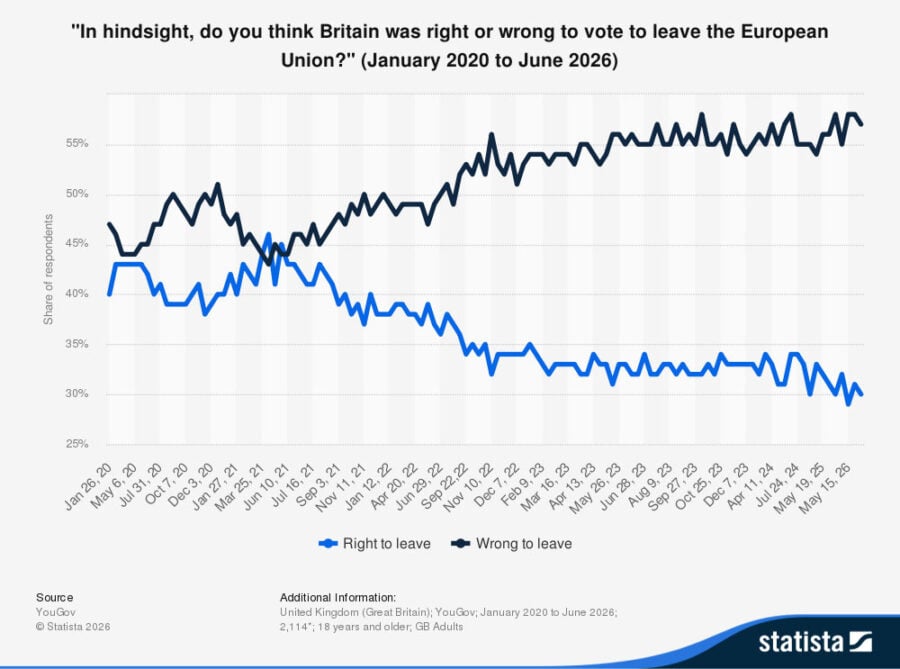
Additionally, a July 2025 YouGov survey reported that “most people in the UK thought that Brexit had a mainly negative impact, especially on the cost of living and the economy,” Statista said.
The opinion is based on fact. Quoting a study by the Stanford Institute for Economic Policy Research, Perryman said that Brexit had reduced the UK’s Gross Domestic Product by 6% to 8%, while investment has fallen by 12% to 18%.
Additionally, employment and productivity fell by 3% to 4%.
Perryman acknowledged that other factors, including the pandemic and energy and fiscal policy, prompted the declines. “However, leaving the EU alone has been a significant and quantifiable factor, due to the uncertainty and disruptions that it caused,” he said.
He concluded the column by saying that global economies already face many challenges, including geopolitical tensions and demographic shifts.
While remaining in the EU wasn’t a perfect solution for the UK, “adding unnecessary difficulties by restricting trade and the flow of capital and labor by ‘Brexiting’ was an unfortunate choice with long-term implications for growth,” he said.
- ◦People
- ◦Economy
- ◦Policy/Gov't
