



National CRE News In Your Inbox.
Sign up for Connect emails to stay informed with CRE stories that are 150 words or less.

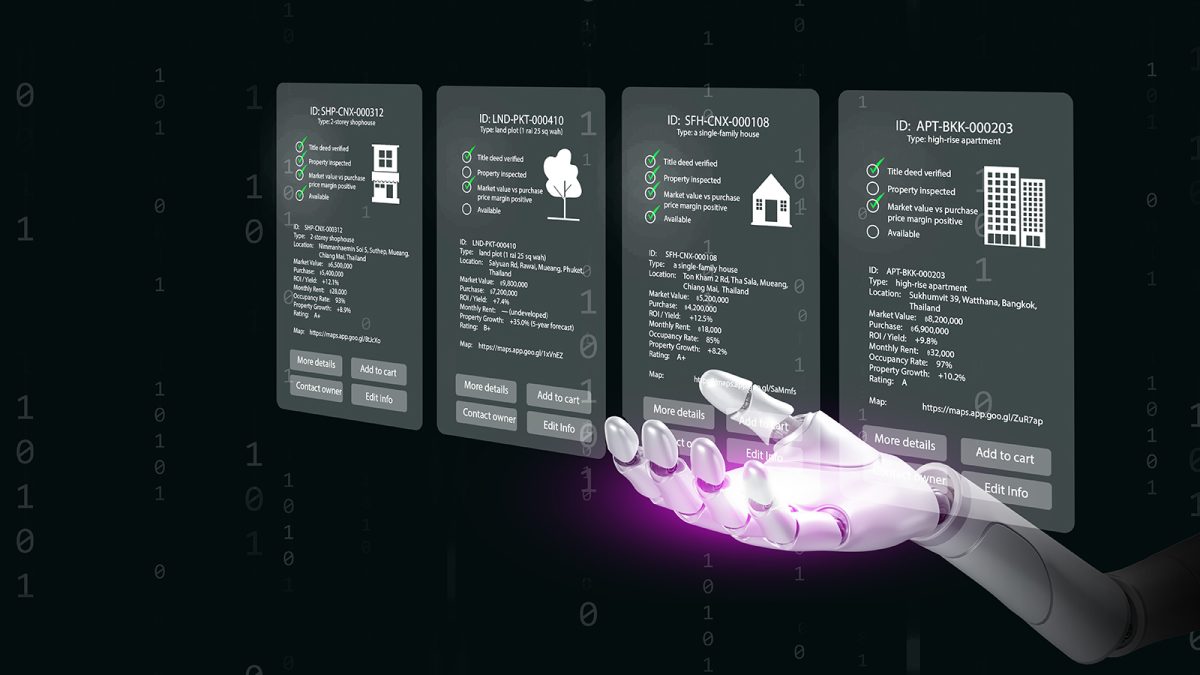

AI Assists with Title Workflows. But Humans Remain Essential

There’s been plenty of glowing commentary about artificial intelligence and the art of simplifying title workflows. HousingWire noted that AI agents are on hand to “redefine performance in title and escrow operations,” while a Qualia study found rising AI optimism and adoption within the sector.
DataTrace Title Chief Data Officer Annette Cotton doesn’t disagree with the AI discussion, pointing out that the most immediate and measurable impact comes from rules-based automation, based on pre-defined logic and the ability to standardize.
However, she told Connect CRE that, while the technology is great at dealing with inconsistencies and organizing data, “it can’t interpret legal intent, resolve complex defects or make underwriting determinations.”
What Works
Cotton, like others, said that automation is reducing time spent on repetitive tasks, such as manual data gathering, document retrieval, running name variations and pulling indices.
“It also improves outcomes by reducing errors and variability,” she said, adding that automated and standardized processes can mean fewer missed steps, stronger audit trails and identification of discrepancies.
“For title agents, this means greater consistency across files,” she explained. “For underwriters, it allows more focus on risk evaluation rather than data assembly.”
What AI Doesn’t Do
The challenge is that deeper AI performance is tied to data quality. And property records are “inherently fragmented, maintained at the county level with significant variation in structure, indexing practices and levels of digitization,” Cotton explained.
Additionally, insurable title decisions require a higher standard than what’s required for basic repetitive tasks.
Cotton said that in this case, data needs to be standardized across sources, validated for accuracy and connected at the property level. It should be complete enough to pinpoint gaps, broken chains and missing relationships.
But with incomplete, unverified and non-structured public records, AI can’t do much. The technology can’t determine whether a discrepancy affects ownership rights or whether a title is insurable. It also can’t handle conflicting information or fraud-related issues.
“Expert interpretation remains essential,” she said. “Insurable title depends on data access, as well as on data integrity, validation and expert judgment.”
Best AI Practices for Title Companies
Cotton suggested that title companies interested in incorporating AI into their operations should begin with an in-depth understanding of the underlying data sources and by putting well-defined, rules-based processes in place. Companies should also put business rules in place, identify escalation triggers and determine when humans should step in.
“Equally important are guardrails that flag or halt processes when data does not meet defined standards,” she added. “Without this structure, automation risks accelerating errors, rather than reducing them.”
On the other hand, firms investing in stronger data infrastructure and automation experience an improvement in speed and consistency. They’re can process transactions more efficiently while reducing error rates and variability.
A strong data infrastructure helps provide normalized, validated and connected information, which supports more reliable decision-making, Cotton explained.
A Glimpse into the Future
Cotton said that over the next five years, more repetitive title workflow tasks will be automated, such as document retrieval, name matching, address validation and rules-based checks.
But humans will still play a role. Professionals will need to be on hand to interpret data, pinpoint and resolve inconsistencies and make the final underwriting decisions.
“The future is not fully automated,” Cotton said. “It’s a more balanced model where technology handles structured work and experienced professionals focus on judgment, risk and accountability.”
- ◦Sale/Acquisition
