



National CRE News In Your Inbox.
Sign up for Connect emails to stay informed with CRE stories that are 150 words or less.


Study Examines a Different Path for Office-to-Residential Conversions

Many cities in the United States are struggling with two real estate issues. The first is housing affordability (or lack thereof). The second is ongoing high office vacancies. While there are signs of a potential turnaround in the office market, the ratio of empty to occupied space likely won’t change immediately.
One possible way out of both problems is the idea of a co-living model. Gensler partnered with The Pew Charitable Trusts to create a flexible co-living concept study and to determine whether it makes sense for office conversions.
“This study was needed because we’re at the intersection of social and economic crises in terms of the affordability and supply of housing, continuing office vacancies, a loss of vitality in our downtowns, and in many parts of the country, a growing population experiencing homelessness and housing insecurity,” Gensler Principal and Strategy Director Wes LeBlanc told Connect CRE.
A Solution, its Challenges and Another Solution
One solution to the housing affordability/vacant office issue that has been extensively written about has been office-to-residential conversions. The problem with this scenario (also extensively written about) is that office configurations and floorplates often don’t support multifamily layouts.
Enter the flexible co-living residential model.
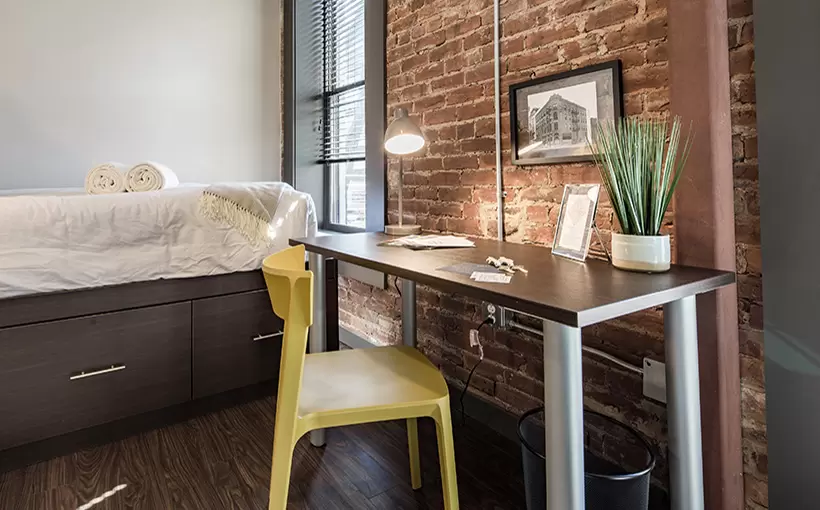
“In our study, co-living is defined as a locked private room with access to a communal kitchen, bathrooms and amenities,” LeBlanc explained. With this arrangement, the building would build utilities, security and cleaning costs into the rent. Meanwhile, sleeping rooms would measure approximately 150 square feet and include a microwave, bed, desk, chair, nightstand and half-sized refrigerator.
“The concept could be adapted for a wide variety of types of residents, including students, seniors, flight attendants, medical staff and those new to a city, as well as anyone earning well below the area’s median income,” LeBlanc said.
The Cities Studied
Gensler and Pew studied three cities to analyze the potential of an office-to-co-living conversion: Denver, Minneapolis, and Seattle. All three face similar problems, including high downtown office vacancy rates, increasing population and relatively high rates of homelessness. The three cities also have:
- Few, if any, regulatory barriers to prevent the creation of co-living spaces
- The political will and support to generate creative solutions connected with housing affordability
- Planned or in-place programs that can be leveraged to support the viability of conversions to co-living
Can it Really Work?
Because co-living has different space requirements than single-unit spaces, the study came up with the following:
- Buildouts could use plumbing from kitchens and restrooms in office buildings rather than adding them to individual units. This would reduce construction costs by 25% to 35% compared to office-to-residential conversions.
- In each city studied, more than half of all renters are single-occupant households. The co-living concept offers more affordable units than the average market-rate studio.
While the concept could generate a rate of return that still needs public subsidies, the units produced per subsidy dollar would “exceed the impact of existing affordable housing delivery models,” according to the blog about the study.
The above are all positives. However, LeBlanc cautions that conversion to co-living won’t work with all office layouts. “The floor plates studied are between 10,000 and 25,000 square feet and have many construction typologies, core configurations and window types,” he said. As such, floor plates should be large enough to accommodate single rooms and shared amenities, LeBlanc added.
Looking to the Future
The co-living concept isn’t new. According to LeBlanc, the current models tend to be geared toward affluent, first-time city residents. But the idea can be extended to renters and households struggling to find housing that fits their budget.
LeBlanc said that the response from city governments and potential stakeholders has been very positive, especially as the study focused on a population of future renters.
“Though American cities face complex problems due to the housing crisis, adaptive reuse projects pose powerful solutions that are more sustainable, cost less and typically take less time to renovate,” LeBlanc added. “Design thinking and feasibility studies can make a significant impact on the future of the built environment, and ultimately, the human experience.”
- ◦Development


